
Latest News
Miller confirms withdrawal process in Afghanistan is underway

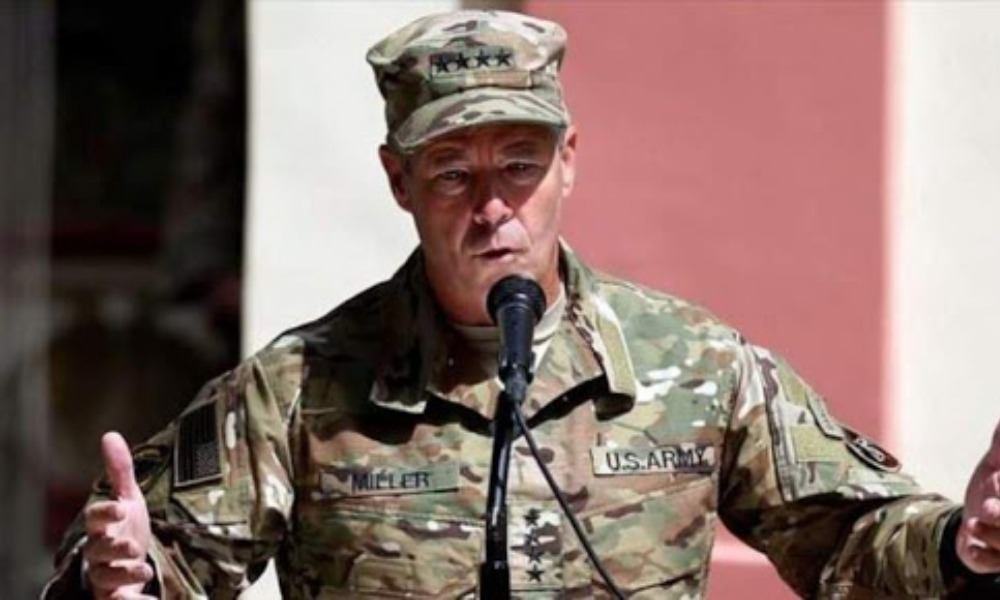
US-Forces commander in Afghanistan General Austin Scott Miller said Sunday the evacuation of some bases has already started in Afghanistan.
“We will turn over the bases primarily to the Ministry of Defense and other Afghan forces,” Miller told reporters in a press conference in Kabul on Sunday, adding that: “The notification day will be the first of May but at the same time as we start taking local actions, we have already begun that”.
The US is expected to hand over three military bases and one airport to the Afghan forces in the next two weeks as part of the US plan for the full troop withdrawal from Afghanistan by September 11, sources said last week.
According to a security source, the bases concerned are the Kandahar airport, Camp Shorabak (formerly Camp Bastion) in Helmand, Camp Eggers in Kabul, and the COP (Dash Towp) in Chak district of Maidan Wardak.
Miller meanwhile said that if Afghanistan reached a peace agreement, we would still to leave Afghanistan.
Meanwhile, CIA Director William Burns reportedly made a surprise visit to Kabul this week to discuss the withdrawal process with Afghan officials.
The Associated Press reported Saturday that two credible sources had confirmed the visit. In Washington, the CIA declined to comment when asked by AP about the director’s schedule and the agency’s role in Afghanistan.
On Taliban relation with Al-Qaeda Miller said that: “Taliban still have link to al-Qaeda.”
He also expressed concern about the escalation of violence by the Taliban in Afghanistan.
“Violence from the Taliban is still high and this is having a negative impacts on the peace process, and if the violence escalates after the withdrawal, it will be dangerous for the whole region,” Miller said.
Miller says the only reasonable way forward is a political path to peace, otherwise “the violence is senseless,” he says.
The Taliban have intensified clashes across the country as the foreign troops are getting ready to withdraw from Afghanistan.
The Defense Ministry, however, claimed that the group has been defeated on the battlefield.
“We have the capacity to support Afghan forces remotely,” Miller said.
His comments comes after the head of U.S. forces in the Middle East said on Thursday that he was concerned about the ability of the Afghan security forces to hold territory after the withdrawal of all foreign troops from the country in the coming months.
President Joe Biden announced last week that the United States will withdraw its remaining 2,500 troops from Afghanistan by Sept. 11, the 20th anniversary of the al Qaeda attacks that triggered America’s longest war.












Kazakhstan’s Foreign Minister Mukhtar Tileuberdi has called for pragmatic and coordinated international engagement with Afghanistan, saying the country’s long-term stability is closely linked to the security and sustainable development of Central Asia.
Speaking during the general debate of the 81st session of the United Nations General Assembly in New York on Friday, Tileuberdi said humanitarian assistance to Afghanistan remains essential but alone cannot break the cycle of poverty, displacement and dependency.
He said Kazakhstan supports a “pragmatic, coordinated and step-by-step” approach to international engagement with Afghanistan, with the United Nations playing a central role.
Tileuberdi also said Kazakhstan is working with the UN to operationalize the United Nations Regional Centre for the Sustainable Development Goals for Central Asia and Afghanistan in Almaty.
He said the success of the centre should be measured by the results and assistance it delivers to the region.


Abu Muslim Farah defeat Khurasan Faryab 2-0 in ACL season six

Saar: Concerns over Pakistan’s political crisis discussed

Afghanistan Champions League: Omar Zawak Herat beat Toofan Herat 1-0

Blast in Pakistan’s Dera Ismail Khan kills 11, injures 30

Ariana Afghan Airlines increases Kabul-Delhi cargo flights

Saudi energy group signs major Afghanistan deals covering gas exploration and pipeline plans

Trump floats idea of renaming Atlantic or Pacific Ocean

US hits Egyptian bank branches with Iran sanctions as war marks six months

Nepal flood rescue mission enters critical phase as thousands remain missing

Iranian clubs to face Gulf opponents at neutral venues in Asian Champions League Elite
Saar: Concerns over Pakistan’s political crisis discussed

Exclusive interview with Abdul Latif Mansoor, Minister of MRRD

Tawsia: Overview of Afghanistan’s iron mines

Tahawol: Discussion on fresh Pakistani airstrikes on Afghanistan

Saar: Calls for international support for Afghanistan discussed
-

 World5 days ago
CNN, MS NOW and Politico sue Trump, challenging White House ban
-

 Latest News3 days ago
Ariana Afghan Airlines ranks seventh among 45 Central Asian airlines
-

 Latest News5 days ago
UN reiterates call for respect for international law after Kunar airstrikes
-

 Regional4 days ago
US and Iran hold first talks since June after Trump’s ‘annihilation’ threat
-

 Latest News3 days ago
Silk Road highway in Wakhan corridor now reaches the China border
-

 Latest News5 days ago
Afghan Official: Pakistan’s airstrikes will not go unanswered
-

 Sport4 days ago
Afghan boxing referee heads to China for international festival
-

 Regional5 days ago
G7 foreign ministers call on Iran to stop arming Houthis