
Science & Technology
Camera captures night sky spiral after SpaceX rocket launch

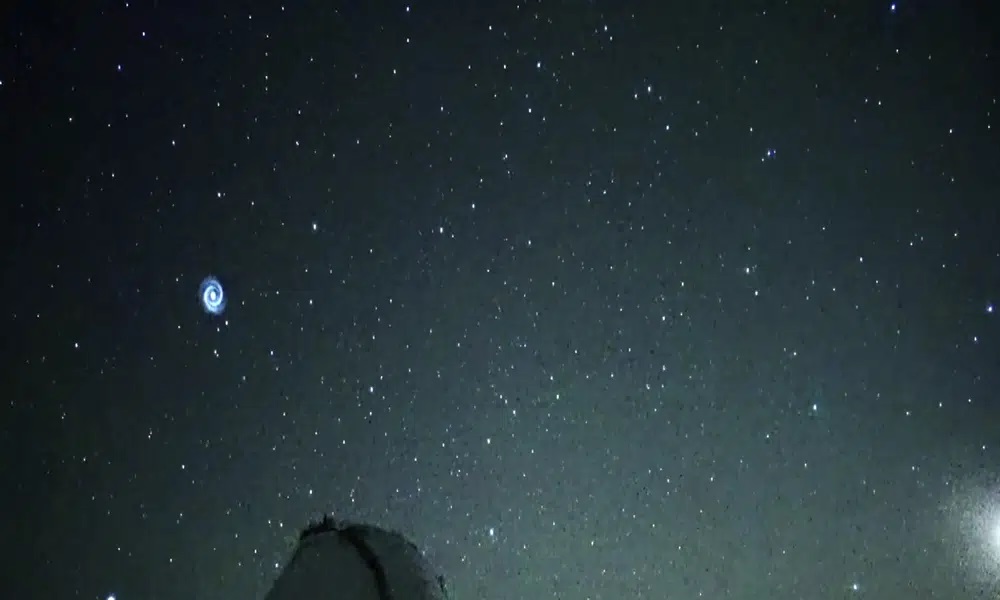
A camera atop Hawaii’s tallest mountain has captured what looks like a spiral swirling through the night sky.
Researchers believe it was from the launch of a military GPS satellite that lifted off earlier on a SpaceX rocket in Florida, AP reported.
The images were captured on Jan. 18 by a camera at the summit of Mauna Kea outside the National Astronomical Observatory of Japan’s Subaru telescope.
A time-lapse video shows a white orb spreading out and forming a spiral as it moves across the sky. It then fades and disappears.
Ichi Tanaka, a researcher at the Subaru telescope, said he was doing other work that night and didn’t immediately see it. Then a stargazer watching the camera’s livestream on YouTube sent him a screenshot of the spiral using an online messaging platform.
“When I opened Slack, that is what I saw and it was a jaw-dropping event for me,” Tanaka said.
He saw a similar spiral last April, also after a SpaceX launch, but that one was larger and more faint.
SpaceX launched a military satellite the morning of Jan. 18 from Florida’s Cape Canaveral Space Force Station.
The location of the spiral matched where the second stage of the SpaceX rocket was expected to be after its launch.
SpaceX didn’t respond to an email sent Friday seeking comment.
Tanaka said the observatory installed the camera to monitor the surroundings outside the Subaru telescope and to share Mauna Kea’s clear skies with the people of Hawaii and the world.
Someone watching the sky in less clear conditions, for example from Tokyo, might not have seen the spiral, he said.
The livestream is jointly operated with the Asahi Shimbun, a major Japanese newspaper, and frequently gets hundreds of viewers. Some tune in to watch meteors streak across the sky.
The summit of Mauna Kea has some of best viewing conditions on Earth for astronomy, making it a favored spot for the world’s most advanced observatories. The summit is also considered sacred by many Native Hawaiians who view it as a place where the gods dwell.







Science & Technology
Swirling, vortex-like patterns observed on the sun’s surface
The researchers said the observations may provide insight into underlying physical processes that impact the dynamics of the sun and other stars, including eruptions from the solar surface that can interfere with the operation of satellites, GPS navigation, power grids and global communications on Earth.
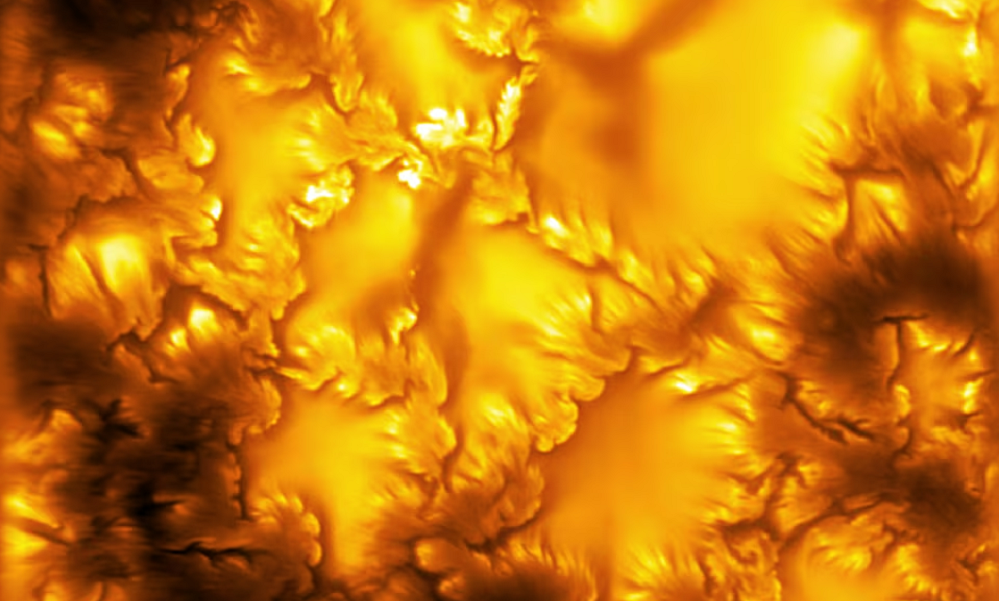
Astronomers have obtained the highest-resolution images to date of our sun’s visible surface, observing swirling, vortex-like patterns in superheated solar gases reminiscent of the shapes depicted in the nocturnal sky in Vincent van Gogh’s 1889 painting “The Starry Night.”
The researchers made the observations of a portion of the sun’s photosphere, a relatively thin layer — about 60 miles (100 km) in depth compared to the overall solar diameter of roughly 865,000 miles (1.4 million km) — using the U.S. National Science Foundation’s Hawaii-based Daniel K. Inouye Solar Telescope, Reuters reported.
The still images and time-lapse video reveal continuously growing whirls of hot plasma, gas heated to temperatures so high that subatomic particles called electrons break free from atoms and form a broth of charged particles. The observed whirls are large on a human scale but small on the scale of a stellar surface, with diameters ranging from about 12 miles (19 km) — the minimum scale detectable by the world’s most powerful solar telescope — up to roughly 100 miles (170 km).
The researchers said the observations may provide insight into underlying physical processes that impact the dynamics of the sun and other stars, including eruptions from the solar surface that can interfere with the operation of satellites, GPS navigation, power grids and global communications on Earth.
The curly, circular patterns do not represent random shapes, but rather are the first detection of a phenomenon called Kelvin-Helmholtz instability, or KHI, on the surface of a star. KHI, first described in the 19th century, refers to a dynamic process that happens when two parallel streams of fluids or gases interact while moving at different velocities.
“The interface can become unstable and develop wave-like vortices that grow in size until they break apart, not unlike waves out on a lake or out on the ocean in windy conditions,” said astronomer Friedrich Wöger, a senior scientist at the National Science Foundation’s National Solar Observatory in Colorado, the Inouye telescope’s instrument program scientist, and co-lead author of the study published on Wednesday in the journal Nature.
Swirling clouds caused by KHI are a well-known, albeit rare, meteorological occurrence on Earth, and also have been observed in the atmospheres of the giant gas planets Jupiter and Saturn, Wöger said.
“The difference from the waves and clouds we know here on Earth is that the two interacting fluids are hot plasma — about 6,000 degrees Kelvin and 10,000 degrees Fahrenheit (5,540 degrees Celsius) — moving within a magnetic field that helps create the conditions for the instability to develop,” Wöger said.
By twisting the solar magnetic field, KHI creates energy that can suddenly unleash an explosion.
‘A TRUE GAME-CHANGER’
Wöger called the discovery of solar KHI “a true game-changer,” saying it opens up a new framework for understanding how the sun energizes its atmosphere.
“The sun and sun-like stars are extremely dynamic systems, characterized by a whole spectrum of rapid, explosive events within their magnetic elements. How these explosions are triggered is one of the main frontiers in modern solar physics,” National Solar Observatory astronomer and study co-lead author David Kuridze said.
The KHI manifestation might help explain why the sun’s outer atmosphere becomes as hot as it does and why magnetic energy accumulates and moves around on the solar surface.
The constant twisting motions generated by KHI can gradually build the energy required to trigger coronal mass ejections and solar flares, Kuridze said. Coronal mass ejections are huge bubbles of gas threaded with magnetic field lines that are expelled from the sun’s surface. Solar flares are gigantic explosions on the sun that propel light, energy and high-speed particles into space.
Aside from the science, the researchers admired the beauty of the new close-up views of the sun.
“Maybe ‘magnificent’ comes closest to describing the aesthetics in the images for us,” Wöger said.
“Interestingly, artists have long captured this fluid dynamic intuition in their work. A famous example is Van Gogh’s ‘The Starry Night,’ where the sky’s vortex structures closely resemble turbulent KHI structures,” Kuridze said. “A similar parallel appears in Hokusai’s famous woodblock print, ‘The Great Wave off Kanagawa,’ where the curling crests of the wave echo the iconic shape of KHI billows. It shows how the fundamental geometry of nature deeply resonates with human art.”
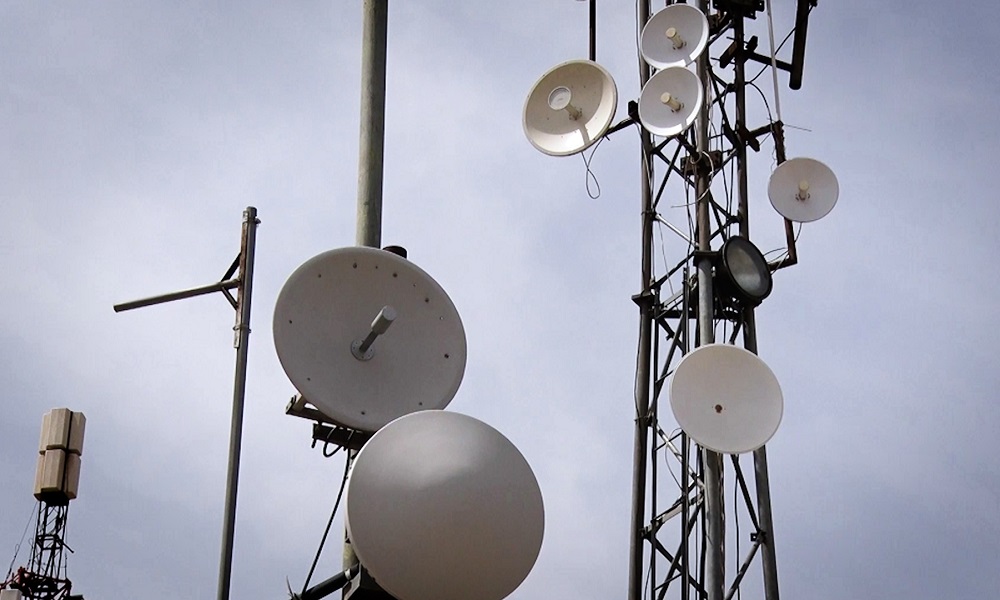
Afghanistan is currently serving as a transit route for internet traffic between South Asia and Central Asia, the Ministry of Communications and Information Technology (MCIT) said, highlighting the country’s growing role in regional digital connectivity.
The ministry said fiber-optic traffic from several South Asian countries is routed through Afghanistan to Central Asian nations via the country’s fiber-optic network.
According to the ministry, nearly $3 billion has been invested in Afghanistan’s fiber-optic and telecommunications sector so far, with expansion efforts continuing.
Officials said Afghanistan offers significant investment opportunities in telecommunications and fiber-optic infrastructure. They added that, alongside expanding domestic communications services, the ministry is working to enhance the country’s capacity to provide transit services for regional countries.
The ministry said Afghanistan is already facilitating the transit of internet traffic from parts of South Asia to Central Asia and stressed that the country’s strategic geographic location positions it as an important digital corridor between the two regions.
“We are currently transiting internet traffic through Afghanistan to South Asian and Central Asian countries,” said Enayatullah Alokozai, spokesperson for the Ministry of Communications and Information Technology. “Afghanistan is a suitable geographical corridor for data transmission.”
Economic analysts say Afghanistan has the potential to become a key hub for regional connectivity. They noted that, in addition to serving as a corridor for energy transmission from Central Asia, the country could also facilitate the large-scale transit of fiber-optic connectivity, internet traffic, and commercial goods.
Representatives of the private sector also said Afghanistan has strong potential to attract further investment in telecommunications and fiber-optic infrastructure. They noted that numerous domestic and international companies are active in the sector, creating direct employment opportunities for thousands of Afghans.
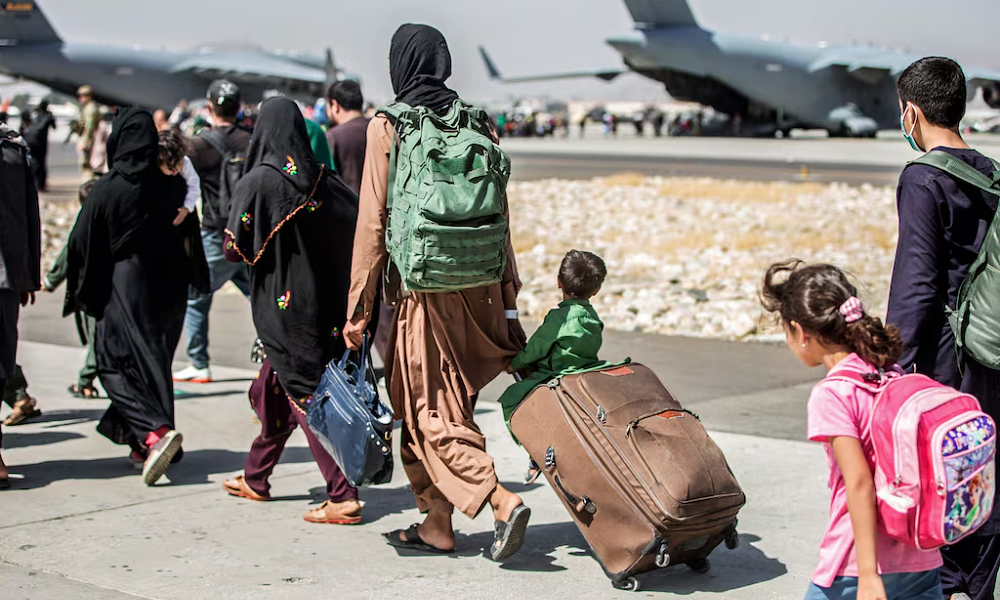
A veteran-led organisation has launched a new artificial intelligence-powered platform designed to help Afghans navigate complex visa and relocation options as thousands remain stranded or at risk nearly five years after the withdrawal of U.S. forces from Afghanistan.
The Visa Pathways and Relocation Information Center (V-PRIC), developed by AfghanEvac, uses artificial intelligence to guide users through possible immigration and protection pathways based on their individual circumstances.
According to AfghanEvac founder and U.S. Navy veteran Shawn VanDiver, the platform attracted more than 30,000 visits during its first week online.
Users begin by answering questions about their current location, whether they worked with the United States, whether they face security risks, and by providing a brief description of their situation. The system then compares that information with a database covering 124 U.S. visa and immigration categories, including 16 relevant to Afghan applicants, as well as relocation options offered by other countries.
VanDiver said the platform is intended to simplify what is often a confusing and constantly changing immigration process. Before using the service, applicants must acknowledge that it does not provide legal advice.
The launch comes as many Afghans who supported the U.S. during its two-decade military presence continue to face uncertainty. AfghanEvac says policy changes have significantly reduced available relocation opportunities, leaving many applicants unable to progress with immigration cases.
According to the organisation, around 1,100 Afghan allies and their family members remain at the Camp As Sayliyah processing facility in Doha, Qatar, despite many having previously received approval to enter the United States. AfghanEvac says travel restrictions have prevented them from completing the process.
VanDiver said the new tool helps users identify obstacles affecting their applications, including whether delays are caused by legal requirements or government policy, while also highlighting possible next steps.
The platform has been trained using legal decisions, executive orders, policy documents and information gathered through AfghanEvac surveys and guidance materials. The organisation says it will continue updating the system as immigration policies evolve.
VanDiver said the tool could also help applicants avoid actions that may complicate future immigration cases, such as pursuing visa interviews when programmes are temporarily suspended.
AfghanEvac recently surveyed more than 1,100 Afghans between January and July this year. Of the 427 respondents still inside Afghanistan, nearly half reported facing direct security threats. Another 427 respondents were in Pakistan awaiting relocation, with many expressing concerns about possible deportation and limited access to healthcare.
The organisation emphasised that the AI platform is intended to complement, rather than replace, professional legal assistance. It encourages applicants to seek legal advice while using the service to better understand the immigration options available to them.


Tahawol: Afghanistan: An Alternative to the Strait of Hormuz?

Saar: Pakistan-Saudi-Turkey Pact: Regional Impact

Ariana Airlines brings $2.3 million Boeing 737 engine from US to Kabul

Israel rejects Trump’s 15-point plan for Gaza, PM Netanyahu says

Afghanistan issues more than 650,000 passports in one year

Pakistan’s governance system has ‘collapsed’: Mohsin Naqvi

India offers 1,000 online scholarships for Afghan students for 2026-27 academic year

Turkey spent over $120 million to prepare airport for Qatar-donated U.S. presidential aircraft

FIFA’s inaugural YouTube Creator Cup to stream live on Ariana Television and Ariana Sport YouTube channels

FIFA World Cup semi-final line-up confirmed
Tahawol: Afghanistan: An Alternative to the Strait of Hormuz?
Saar: Pakistan-Saudi-Turkey Pact: Regional Impact

Tahawol: Escalating disputes over Iran war discussed

Saar: Turkey, Saudi Arabia and Pakistan defense pact reviewed

Tahawol: End of US sanctions waiver for Chabahar Port discussed
-
 Latest News5 days ago
Khalilzad says Pakistan needs ‘reset’ amid economic crisis and rising instability
-

 Latest News4 days ago
First Afghanistan-Ireland ODI abandoned without a ball bowled
-

 Sport5 days ago
Afghanistan aim for winning start against Ireland
-

 Sport4 days ago
Afghanistan holds Russia to 3-3 draw, earns first point at Continental Futsal Championship
-

 Latest News4 days ago
Afghan boxer appears in Greek court over death of Scottish woman
-
 Regional4 days ago
Iran threatens to hit Gulf states if US launches new strikes
-
 Business4 days ago
Uzbekistan’s Fergana region strengthens economic ties with Afghanistan
-
 World2 days ago
US Senate passes Russia sanctions championed by Graham; US House next