Connect with us

Science & Technology

NASA’s first asteroid sample on track for Sunday parachute landing in Utah

Published

on

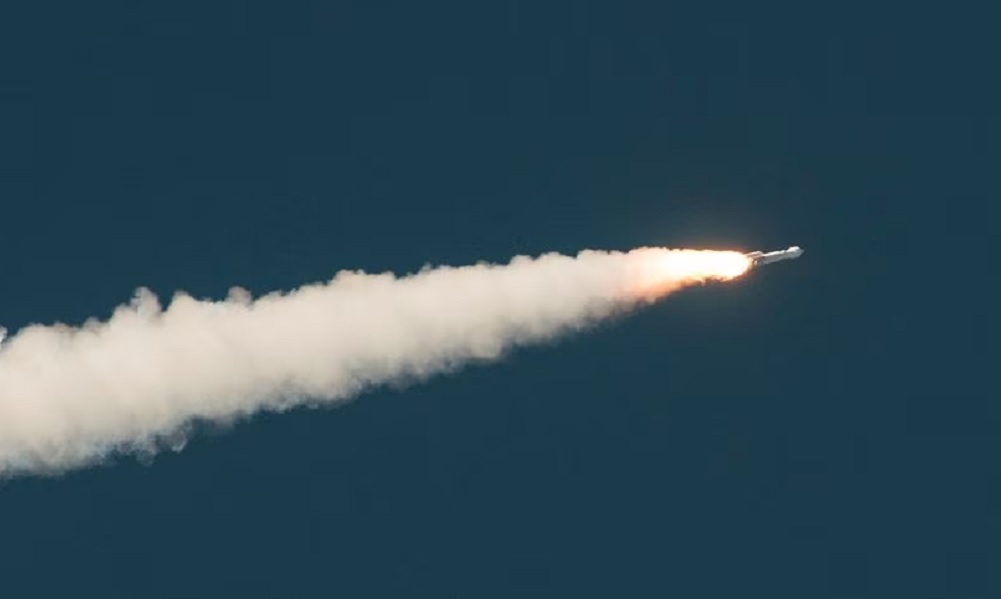
A NASA space capsule carrying a sample of rocky material plucked from the surface of an asteroid three years ago hurtled toward Earth this weekend headed for a fiery plunge through the atmosphere and a parachute landing in the Utah desert on Sunday.

Weather forecasts were favorable and the robotic spacecraft OSIRIS-REx was on course to release the sample-return capsule for final descent as planned, with no further adjustments to its flight path needed, NASA officials said at a news briefing on Friday, Reuters reported.

Mission managers are expecting a “spot-on” touchdown on the U.S. military’s vast Utah Test and Training range, west of Salt Lake City, said Sandra Freund, program manager at Lockheed Martin, which designed and built the spacecraft.

The round, gumdrop-shaped capsule is scheduled to land by parachute at 10:55 a.m. EDT (1455 GMT), about 13 minutes after streaking into the top of the atmosphere at roughly 35 times the speed of sound, capping a seven-year voyage.

If successful, the OSIRIS-REx mission, a joint effort between NASA and scientists at the University of Arizona, would mark the third asteroid sample, and by far the largest, ever returned to Earth for analysis, following two similar missions by Japan’s space agency over the past 13 years.

OSIRIS-REx collected its specimen from Bennu, a carbon-rich asteroid discovered in 1999 and classified as a “near-Earth object” because it passes relatively close to our planet every six years. Scientists put the odds of it striking Earth at 1-in-2,700 in the late 22nd century.

Bennu is small as asteroids go, measuring just 1,600 feet (500 meters) in diameter – slightly wider than the Empire State Building is tall but tiny compared with the cataclysmic Chicxulub asteroid that struck Earth some 66 million years ago, wiping out the dinasours.

Like other asteroids, Bennu is a primordial relic of the early solar system whose present-day chemistry and mineralogy are virtually unchanged since it formed some 4.5 billion years ago. It thus holds valuable clues to the origins and development of rocky planets such as Earth, and may even contain organic molecules similar to those necessary for life to evolve.

“We’re literally looking at geologic materials that formed before Earth even existed,” Dante Lauretta, principal investigator for the mission at the University of Arizona, Tucson, told reporters last month.

OSIRIS-REx launched in September 2016 and reached Bennu in 2018, then spent nearly two years orbiting the asteroid before venturing close enough to sink its robot arm into the loose surface on Oct. 20, 2020, in a grab-and-go maneuver.

The spacecraft embarked on a 1.2-billion-mile cruise back to Earth in May 2021.

The Bennu sample is estimated at 250 grams (8.8 ounces), far surpassing the amount of material carried back from asteroid Ryugu in 2020 and asteroid Itokawa in 2010.

On arrival, the new sample will be flown by helicopter to a “clean room” set up at the Utah test range for initial examination, then transported to NASA’s Johnson Space Center in Houston, to be parceled into smaller specimens promised to some 200 scientists in 60 laboratories around the world.

The main portion of the OSIRIS-REx spacecraft, meanwhile, is expected to sail on to explore yet another near-Earth asteroid.


Science & Technology

Meta turns off Instagram’s private messaging encryption worldwide

Meta said the decision was based on low user adoption, though critics argue optional privacy tools often see limited use because users must manually activate them.

Published

on

Instagram has disabled its end-to-end encrypted (E2EE) direct messaging feature worldwide, marking a major reversal by parent company Meta on its previous commitment to stronger user privacy protections.

The move means Instagram users can no longer send ultra-private direct messages protected by E2EE — a security system that allows only the sender and recipient to read messages. Without the feature, Instagram can technically access the content of direct messages, including photos, videos and voice notes.

Meta had previously promoted encryption as “the future is private.” In 2019, CEO Mark Zuckerberg pledged to expand the technology across the company’s platforms.

Facebook Messenger adopted E2EE in 2023, while Instagram introduced it as an optional feature with plans to make it standard.

However, Meta has now abandoned the wider Instagram rollout and updated the app’s terms in March to confirm encrypted messaging would no longer be supported after 8 May 2026.

Meta said the decision was based on low user adoption, though critics argue optional privacy tools often see limited use because users must manually activate them.

The move has divided opinion. Child protection groups, including the NSPCC, welcomed the change, saying encryption can make it harder to detect child grooming and abuse online.

Privacy advocates criticised the decision. Maya Thomas of Big Brother Watch warned the move weakens online privacy protections and could increase pressure on other social media companies to scale back encryption.

End-to-end encryption remains standard on platforms including WhatsApp, Signal, Apple’s iMessage and Google Messages, while other platforms continue to take mixed approaches to private messaging.

Continue Reading

Science & Technology

James Webb Telescope captures clearest-ever view of exoplanet’s surface

Published

on

Astronomers using NASA’s James Webb Space Telescope have obtained the clearest view yet of the surface of a rocky exoplanet, revealing a scorched, atmosphere-free world that scientists say resembles a giant version of Mercury.

The planet, known as LHS 3844 b and nicknamed “Kua’kua,” appears to be a barren, uninhabitable world with extreme temperature swings and no detectable atmosphere, according to a study published this week in Nature Astronomy.

Researchers said the planet’s surface is likely covered in dark volcanic rock and ancient regolith — loose rocky debris formed over billions of years from relentless bombardment by radiation and micrometeorite impacts.

“This planet is not a nice place,” said astronomer Laura Kreidberg, senior author of the study. “It’s a hellish, barren rock — much more similar to Mercury than Earth.”

Located about 49 light-years away, LHS 3844 b orbits a small red dwarf star and completes a full orbit every 11 hours. The planet is tidally locked, meaning one side permanently faces its star while the other remains in darkness — similar to how the Moon always shows the same face to Earth.

Scientists found the planet’s dayside reaches roughly 1,340 degrees Fahrenheit (725 degrees Celsius), while the nightside showed almost no detectable heat.

Using Webb’s infrared instruments, researchers were able to directly analyze light coming from the planet’s surface — a major breakthrough for exoplanet science.

“Different rocks have different spectral fingerprints,” said lead author Sebastian Zieba. “Dark volcanic rocks like basalt matched our observations much better than brighter rocks like granite.”

The findings mark a new phase in exoplanet research, shifting beyond atmospheric studies toward direct analysis of alien geology and surface composition.

Since becoming operational in 2022, the Webb telescope has transformed scientists’ understanding of planets beyond the solar system, helping identify atmospheric chemistry, weather patterns and now even the nature of distant planetary surfaces.

Researchers said the absence of an atmosphere on LHS 3844 b means there is little protection from stellar radiation and virtually no possibility of liquid water — a key ingredient for life.

“So overall, this is almost certainly not a habitable world,” Zieba said.

Continue Reading

Science & Technology

Afghanistan launches first 5G trial in Kabul to boost telecom services

According to ministry spokesperson Enayatullah Alokozai, AWCC has upgraded 74 telecom antennas in Kabul to 5G on a trial basis.

Published

on

Afghanistan has launched its first-ever 5G telecommunications trial in Kabul, marking a major milestone in efforts to modernise the country’s digital infrastructure.

The announcement followed a meeting between Hamdullah Nomani, Minister of Communications and Information Technology, and Aliullah Sarwari, head of the Afghan Wireless Communication Company (AWCC), where discussions focused on expanding telecom coverage, improving service quality, and extending connectivity to remote regions.

According to ministry spokesperson Enayatullah Alokozai, AWCC has upgraded 74 telecom antennas in Kabul to 5G on a trial basis. Once technical preparations and testing are completed, the company plans to extend 5G services to other provinces.

Officials also reported steady progress on broader infrastructure development. Eight telecom sites approved during previous official visits to northern and southeastern provinces have been completed, one is nearing completion, and construction continues on two additional sites expected to become operational soon.

In parallel, the Afghanistan Telecom Regulatory Authority (ATRA) has approved eight more telecom sites under the Telecom Development Fund (TDF), with implementation scheduled in the coming months.

Sarwari noted that since the beginning of 2026, AWCC has built and activated 46 telecom sites using its development budget, while work continues on a further 186 sites nationwide.

He also thanked the Ministry of Communications and Information Technology for its ongoing support in facilitating sector growth and improving service delivery.

Nomani meanwhile emphasised that telecommunications play a crucial role in national development and said the government remains committed to working closely with operators to expand modern, high-quality digital services.

Officials added that cooperation between the ministry, regulators, and telecom companies will continue across all operational and regulatory areas to strengthen Afghanistan’s communications network.

Continue Reading
Advertisement
Advertisement
Advertisement
Advertisement

Trending

Copyright © 2025 Ariana News. All rights reserved!