
Latest News
Abandoning Afghanistan now, amid crisis, would be ‘historic mistake’

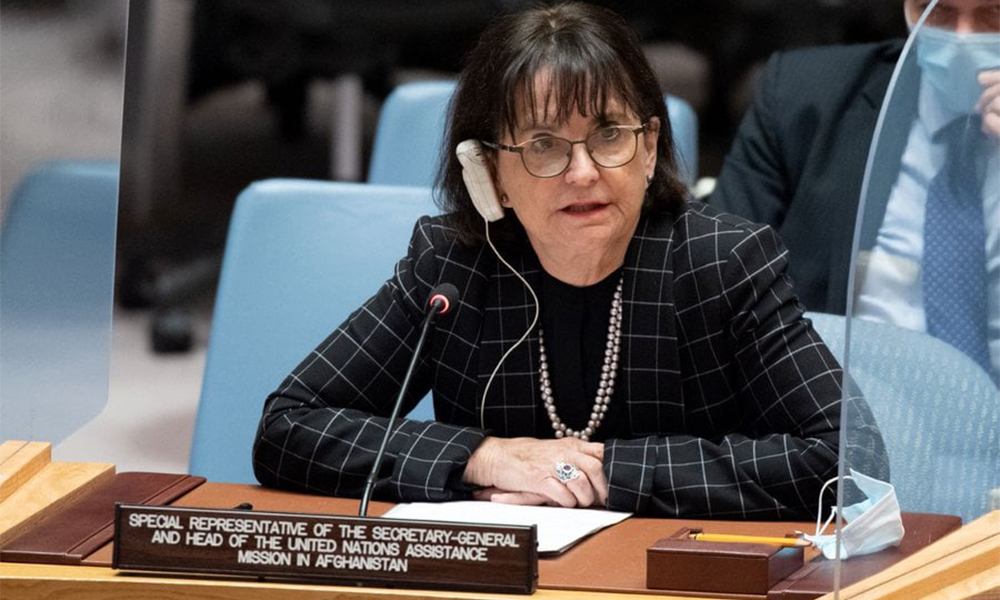
Urgent steps must be taken to address the looming humanitarian crisis in Afghanistan and stave off economic collapse, speakers at Wednesday’s UN Security Council meeting on Afghanistan said.
“To abandon the Afghan people now would be a historic mistake — a mistake that has been made before with tragic consequences,” said Deborah Lyons, the Secretary-General’s Special Representative and Head of the United Nations Assistance Mission in Afghanistan (UNAMA), who said that the Islamic Emirate of Afghanistan’s (IEA) takeover has left the Afghan people feeling abandoned, forgotten and punished by circumstances that are not their fault.
Lyons said that engagement with the IEA administration over the past three months in Kabul and the provinces have been “generally useful and constructive”, and that the new government want to have a United Nations presence and international recognition, and is looking to overcome the trust deficit between them and the international community.
She said gaps remained however, including the issue of inclusiveness in the government.
According to Lyons, UNAMA has not shied away from raising difficult issues with the IEA, particularly on women’s rights and girls’ education.
She said the IEA has taken cognizance of such concerns, but they have made it clear that for now there are limits to concessions they are willing to make on some issues.
Lyons also said the IEA has not been able to stem the expansion of the Islamic State (ISIS-K/Daesh), which has become increasingly active, “stepping up attacks from 60 in 2020 to 334 in 2021.” She said the group has gained ground across all provinces.
Addressing the dire humanitarian situation in the country, she said it is preventable, as the paralyzed economy is largely due to financial sanctions.
With the winter approaching, she said, up to 23 million Afghans will be in crisis or emergency levels of food insecurity. In addition, while the risk of famine was once restricted to rural areas, 10 out of 11 of Afghanistan’s most densely populated urban areas are now anticipated to be at emergency levels of food insecurity, she said.
Lyons cautioned that the continuing deterioration of the economy threatens to heighten the risk of extremism, adding that the paralysis of the banking sector could push more of the financial system into unregulated informal money exchanges which can facilitate terrorism, trafficking and drug smuggling. “Such pathologies will first affect Afghanistan and then infect the region,” she warned.
According to the UN, close to 23 million people need urgent humanitarian assistance and poverty is widespread, with Afghanistan poised to experience “near-universal poverty” — a 97 percent poverty rate by the middle of 2022.
Council members noted that with the economy on the brink of collapse, aid alone cannot adequately address the crisis. In turn they urged that the UNSC must find ways to address the current banking problem and continue to exempt humanitarian and service-delivery operations from sanctions.
They also said the dormant peace process that began in Doha must be resuscitated, hold the IEA to commitments they made and hold it accountable for past and ongoing violations of human rights.
The Council must also engage Afghans not as victims, but as stakeholders in building sustainable peace in Afghanistan, the members urged.
In the Council discussion, members also called for immediate and unhindered assistance. Some delegates condemned the recent spate of terrorist attacks, while others raised concerns about the repression of the rights of women, protesters and journalists, and reports of human rights violations, including arbitrary executions.
China’s delegate said Afghanistan must be able to pursue a sound path towards development and called on the World Bank and the International Monetary Fund (IMF) to consider the resumption of financial support.
“When teachers and doctors have not received salaries for half a year, where does one begin to speak of girls’ education, or fighting the pandemic?”, he asked, adding that such measures are morally unacceptable and worsen the humanitarian crisis.
Pakistan’s representative also called for the lifting of the freeze on Afghanistan’s assets, noting that his country has committed $30 million in assistance to the country, together with wheat, rice, emergency medical supplies, and other essential items.












Kazakhstan’s Foreign Minister Mukhtar Tileuberdi has called for pragmatic and coordinated international engagement with Afghanistan, saying the country’s long-term stability is closely linked to the security and sustainable development of Central Asia.
Speaking during the general debate of the 81st session of the United Nations General Assembly in New York on Friday, Tileuberdi said humanitarian assistance to Afghanistan remains essential but alone cannot break the cycle of poverty, displacement and dependency.
He said Kazakhstan supports a “pragmatic, coordinated and step-by-step” approach to international engagement with Afghanistan, with the United Nations playing a central role.
Tileuberdi also said Kazakhstan is working with the UN to operationalize the United Nations Regional Centre for the Sustainable Development Goals for Central Asia and Afghanistan in Almaty.
He said the success of the centre should be measured by the results and assistance it delivers to the region.


Abu Muslim Farah defeat Khurasan Faryab 2-0 in ACL season six

Saar: Concerns over Pakistan’s political crisis discussed

Afghanistan Champions League: Omar Zawak Herat beat Toofan Herat 1-0

Blast in Pakistan’s Dera Ismail Khan kills 11, injures 30

Ariana Afghan Airlines increases Kabul-Delhi cargo flights

Saudi energy group signs major Afghanistan deals covering gas exploration and pipeline plans

Trump floats idea of renaming Atlantic or Pacific Ocean

US hits Egyptian bank branches with Iran sanctions as war marks six months

Nepal flood rescue mission enters critical phase as thousands remain missing

Iranian clubs to face Gulf opponents at neutral venues in Asian Champions League Elite
Saar: Concerns over Pakistan’s political crisis discussed

Exclusive interview with Abdul Latif Mansoor, Minister of MRRD

Tawsia: Overview of Afghanistan’s iron mines

Tahawol: Discussion on fresh Pakistani airstrikes on Afghanistan

Saar: Calls for international support for Afghanistan discussed
-

 World5 days ago
CNN, MS NOW and Politico sue Trump, challenging White House ban
-

 Latest News3 days ago
Ariana Afghan Airlines ranks seventh among 45 Central Asian airlines
-

 Latest News5 days ago
UN reiterates call for respect for international law after Kunar airstrikes
-

 Regional4 days ago
US and Iran hold first talks since June after Trump’s ‘annihilation’ threat
-

 Latest News4 days ago
Silk Road highway in Wakhan corridor now reaches the China border
-

 Regional3 days ago
Iran airlines cancel flights as US sanctions hit
-

 Latest News5 days ago
Afghan Official: Pakistan’s airstrikes will not go unanswered
-

 Sport5 days ago
Afghan boxing referee heads to China for international festival