
Latest News
Concerns raised after NDS chief and Taliban issue warnings to the media


A number of media advocates said on Wednesday that warnings issued against the media by both government and the Taliban could undermine the hard-won gains in press freedom in Afghanistan over the past 20 years.
Concerns were raised after the National Security Directorate (NDS) chief Ahmad Zia told Parliament on Wednesday that a number of Afghan media outlets were broadcasting or publishing “propaganda in favor of the Taliban.”
The Taliban in turn threatened local media and said they would “face the consequences” for reporting biased stories in favor of the government.
Responding to this, the US Embassy and the UK Embassy in Afghanistan issued a joint statement on Wednesday night condemning the Taliban’s attempts “to silence journalists”.
The embassies said: “The Taliban today, two days after World Press Freedom Day, threatened the Afghan media accusing them of being proxies for the government and ordering them to alter their reporting or they would ‘face the consequences.”
“We know the Taliban propaganda machine constantly manipulates the truth in order to deflect blame for the atrocities they commit onto others and to avoid responsibility for their actions.
“We strongly support Afghanistan’s independent media. We condemn in the strongest possible terms the ongoing violence and threats against the media, and the Taliban’s attempts to silence journalists,” the statement read.
This comes after MPs said that NDS chief Ahmad Zia said in Parliament on Wednesday that Afghan media “should be aware of the enemy’s psychological war.”
MP Arif Rahmani tweeted that Zia claimed a number of politicians, experts, and media outlets publicize propaganda in favor of the Taliban. However, he reportedly warned that these individuals and entities would “be treated as a terrorist.”
According to Rahmani, the NDS Chief further said that propaganda broadcast by a number of television channels in favor of the Taliban “is shocking.”
He said “this is not freedom of speech, but it is an abuse of freedom of expression; We will not tolerate it.”
In response to Rahmani’s tweet, the Taliban, in turn, warned Afghan media outlets against publishing or broadcasting one-sided reports.
Zabiullah Mujahid, a spokesman for the group said in a series of tweets: “For several days, the Taliban have been witnessing one sided-propaganda and publications by some media outlets.”
He stated that the NDS is directly involved in such activities, adding: “Media must be aware of maintaining their neutrality” and avoid becoming a “propaganda tool” for the government in such a sensitive situation in the country.
Mujahid stated that if the media continue to broadcast or publish “misleading news and incorrect information” their objectivity could be questioned.
He said the same applies to the spreading of false news and misinformation by the media and journalists.
Should this continue, the onus will be on media executives to deal with the consequences and warned media executives and media workers against publicizing one-sided news in favor of the government.
Meanwhile, the media advocacy organization, NAI, and Afghanistan Free Press Hub said the remarks by the NDS Chief and the Taliban are concerning.
“The NDS Chief has accused some media of cooperating with the Taliban. He has to clarify which media outlets [he is referring to] and which media outlets have done this. A general accusation against all media is against the law. The Taliban also warned the media. This situation risks the work of the media in Afghanistan,” NAI Chief Executive Mujib Khilwatgar said.







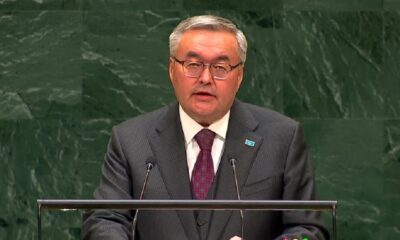




Kazakhstan’s Foreign Minister Mukhtar Tileuberdi has called for pragmatic and coordinated international engagement with Afghanistan, saying the country’s long-term stability is closely linked to the security and sustainable development of Central Asia.
Speaking during the general debate of the 81st session of the United Nations General Assembly in New York on Friday, Tileuberdi said humanitarian assistance to Afghanistan remains essential but alone cannot break the cycle of poverty, displacement and dependency.
He said Kazakhstan supports a “pragmatic, coordinated and step-by-step” approach to international engagement with Afghanistan, with the United Nations playing a central role.
Tileuberdi also said Kazakhstan is working with the UN to operationalize the United Nations Regional Centre for the Sustainable Development Goals for Central Asia and Afghanistan in Almaty.
He said the success of the centre should be measured by the results and assistance it delivers to the region.


Saar: Concerns over Pakistan’s political crisis discussed

Afghanistan Champions League: Omar Zawak Herat beat Toofan Herat 1-0

Blast in Pakistan’s Dera Ismail Khan kills 11, injures 30

Ariana Afghan Airlines increases Kabul-Delhi cargo flights

Khalilzad questions Pakistan’s commitment to Afghan welfare

Saudi energy group signs major Afghanistan deals covering gas exploration and pipeline plans

Trump floats idea of renaming Atlantic or Pacific Ocean

US hits Egyptian bank branches with Iran sanctions as war marks six months

Nepal flood rescue mission enters critical phase as thousands remain missing

Iranian clubs to face Gulf opponents at neutral venues in Asian Champions League Elite
Saar: Concerns over Pakistan’s political crisis discussed

Exclusive interview with Abdul Latif Mansoor, Minister of MRRD

Tawsia: Overview of Afghanistan’s iron mines

Tahawol: Discussion on fresh Pakistani airstrikes on Afghanistan

Saar: Calls for international support for Afghanistan discussed
-

 World5 days ago
CNN, MS NOW and Politico sue Trump, challenging White House ban
-

 Latest News3 days ago
Ariana Afghan Airlines ranks seventh among 45 Central Asian airlines
-

 Latest News4 days ago
UN reiterates call for respect for international law after Kunar airstrikes
-
 Latest News5 days ago
Khalilzad condemns Pakistan airstrikes, says current strategy is not working
-

 Regional3 days ago
US and Iran hold first talks since June after Trump’s ‘annihilation’ threat
-

 Latest News3 days ago
Silk Road highway in Wakhan corridor now reaches the China border
-

 Latest News4 days ago
Afghan Official: Pakistan’s airstrikes will not go unanswered
-

 Sport4 days ago
Afghan boxing referee heads to China for international festival