
Latest News
Karzai claims Afghanistan is being played by global powers

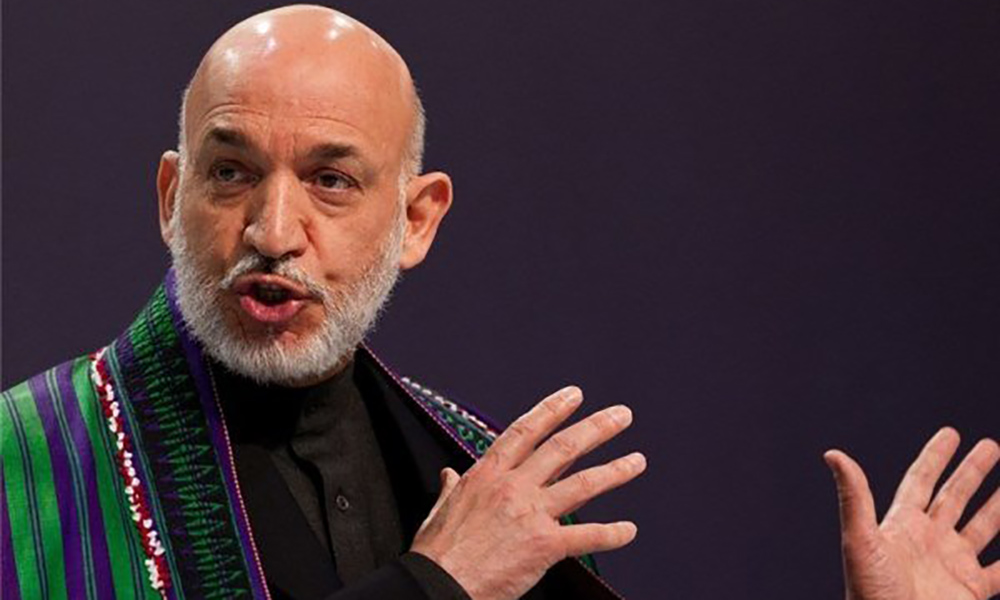
Former Afghan president Hamid Karzai said on Tuesday that he has suspected for “a long time” that the United States and some of its allies have tried to create a weakened Afghanistan with a splintered government.
Addressing an online forum of Russia’s Valdai International Discussion Club, Karzaid said: “I have been suspecting for a long time that there was an intention in Afghanistan by the United States and some of its allies to create a weakened Afghanistan where there is government in name in Kabul, and then there are splinters of governments or authorities around the country.
“This is something we have been working against . Some proposals of this nature were made to my government at the time to allow the Taliban to take one or two provinces to accommodate them and then to negotiate from there which I rejected and outrightly neutralized,” he said.
“Now in the past two months we see the situation moving in that direction and an official indication of this came in the remarks of the US President Mr Joe Biden. When he recently spoke on Afghanistan he referred to Afghanistan in two ways; one was that Afghanistan was never a unified country in his words and the other one was that Afghanistan may not have one government.
“That’s what he precisely said. Now we don’t see this as an accidental remark. I see this more as something that probably someone is thinking about doing,” Karzai said.
He questioned why a country, such as the US, would go as far as suggesting that Afghanistan may not have one government unless there is a plan and a thought behind it.
“If this is true, and the signs are there, this means Afghanistan is used for a larger global game in this region where all the major powers of the world are situated,” he said.
He said a loosely governed Afghanistan needs to be avoided, adding he hopes Russia and other major regional powers will help prevent this.
“I have been urging the United States of America that if they are sincere towards peace in Afghanistan, if they really want peace in Afghanistan, then that is only possible if they engage with Russia and with other major powers in this region so we can have peace, not only peace but a stable and unified Afghanistan,” he said.
Also participating in the discussion was Russia’s Special Presidential Envoy for Afghanistan Zamir Kabulov who said if no real progress is seen in the process of national reconciliation, the military-political balance in Afghanistan will be reformatted in favor of the Taliban.
“And then their takeover in the country will become a very real prospect,” Kabulov said.
“So far, the Taliban is unable to capture big administrative centers in provinces. However, I don’t rule out that in the near future they will be able to take control of two or three administrative centers but they are not strong enough to seize and, importantly, to establish long-term control of the country’s big provinces,” he said.
Kabulov said however that this process impacts the Kabul government, but that the Taliban’s offensive will not lead to the collapse of the entire government.












Kazakhstan’s Foreign Minister Mukhtar Tileuberdi has called for pragmatic and coordinated international engagement with Afghanistan, saying the country’s long-term stability is closely linked to the security and sustainable development of Central Asia.
Speaking during the general debate of the 81st session of the United Nations General Assembly in New York on Friday, Tileuberdi said humanitarian assistance to Afghanistan remains essential but alone cannot break the cycle of poverty, displacement and dependency.
He said Kazakhstan supports a “pragmatic, coordinated and step-by-step” approach to international engagement with Afghanistan, with the United Nations playing a central role.
Tileuberdi also said Kazakhstan is working with the UN to operationalize the United Nations Regional Centre for the Sustainable Development Goals for Central Asia and Afghanistan in Almaty.
He said the success of the centre should be measured by the results and assistance it delivers to the region.


Abu Muslim Farah defeat Khurasan Faryab 2-0 in ACL season six

Saar: Concerns over Pakistan’s political crisis discussed

Afghanistan Champions League: Omar Zawak Herat beat Toofan Herat 1-0

Blast in Pakistan’s Dera Ismail Khan kills 11, injures 30

Ariana Afghan Airlines increases Kabul-Delhi cargo flights

Saudi energy group signs major Afghanistan deals covering gas exploration and pipeline plans

Trump floats idea of renaming Atlantic or Pacific Ocean

US hits Egyptian bank branches with Iran sanctions as war marks six months

Nepal flood rescue mission enters critical phase as thousands remain missing

Iranian clubs to face Gulf opponents at neutral venues in Asian Champions League Elite
Saar: Concerns over Pakistan’s political crisis discussed

Exclusive interview with Abdul Latif Mansoor, Minister of MRRD

Tawsia: Overview of Afghanistan’s iron mines

Tahawol: Discussion on fresh Pakistani airstrikes on Afghanistan

Saar: Calls for international support for Afghanistan discussed
-

 World5 days ago
CNN, MS NOW and Politico sue Trump, challenging White House ban
-

 Latest News4 days ago
Ariana Afghan Airlines ranks seventh among 45 Central Asian airlines
-

 Latest News5 days ago
UN reiterates call for respect for international law after Kunar airstrikes
-

 Regional4 days ago
US and Iran hold first talks since June after Trump’s ‘annihilation’ threat
-

 Latest News4 days ago
Silk Road highway in Wakhan corridor now reaches the China border
-

 Regional3 days ago
Iran airlines cancel flights as US sanctions hit
-

 Latest News5 days ago
Afghan Official: Pakistan’s airstrikes will not go unanswered
-
 Regional5 days ago
G7 foreign ministers call on Iran to stop arming Houthis