
Latest News
Khalilzad wraps up regional trip, highlights need to keep republic intact

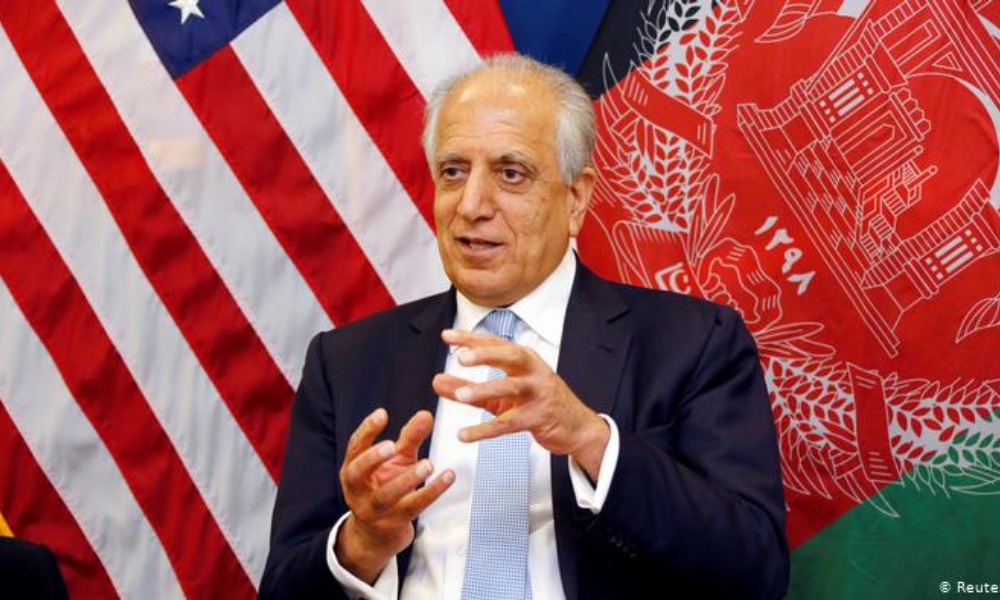
US peace envoy Zalmay Khalilzad said in a series of tweets he has wrapped up his latest trip – to Tashkent, Doha, Kabul, and Dushanbe – with a stop in Berlin – which was focused on building regional consensus on the Afghan Peace Process.
Khalilzad said there is “a unique international consensus for peace, rooted in the support for a negotiated settlement, an end to violence, and rejection of any attempt to impose a military solution”.
He said: “Afghan leaders from all sides of the conflict should seize this opportunity and negotiate a political settlement to end their 40 yearlong war.”
Khalilzad also stated that “if the Taliban do not choose peace, a future based on consensus and compromise, then we will stand with Afghans who strive to keep the Republic intact. Republic political unity is a must.”
“International consensus does not stop at peace. The world remains steadfast in its support of Afghanistan as the country enters a new phase,” Khalilzad said.
In addition to this, the US State Department also issued a joint communique by the US, the European Union, NATO, Norway and the UK on the Afghan Peace Process.
According to the communique, special envoys and special representatives of the United States of America, European Union, France, Germany, Italy, NATO, Norway, and the United Kingdom met in Berlin on Thursday where they exchanged views on the current status of the Afghanistan peace process and discussed ways to support the Afghan people’s desire for a just and lasting peace.
The participants confirmed that such a peace can only be achieved through an inclusive, negotiated political settlement among Afghans and highlighted the need to accelerate the pace of the Afghan-led and Afghan-owned peace negotiations and committed to work with the Afghan government and the Taliban, and other Afghan political and civil society leaders to reach a comprehensive and sustainable peace agreement and political compromise that ends the war.
The participants called for the immediate resumption, without pre-conditions, of substantive negotiations on the future of Afghanistan with the aim to develop and negotiate realistic compromise positions on power sharing that can lead to an inclusive and legitimate government and a just and durable settlement.
They also strongly condemned the continued violence in Afghanistan “for which the Taliban are largely responsible” and demanded all parties to take immediate and necessary steps to reduce violence and in particular, to avoid civilian casualties in order to create an environment conducive to reaching a political settlement.
Participants called upon the Taliban to stop their undeclared spring offensive, to refrain from attacks against civilians, and to stop immediately all attacks in the vicinity of hospitals, schools, universities, mosques and other civilian areas.
In particular, participants demanded an immediate end to the campaign of targeted assassinations against civil society leaders, religious scholars, journalists and other media workers, human rights defenders, healthcare personnel, judicial employees and other civilians.
The participants also reiterated that during the withdrawal of foreign troops, the safety of international forces must be ensured and that any Taliban attacks on the troops during this period will be met with a forceful response.
Participants stressed that the process of the troop withdrawal must not serve as an excuse for the Taliban to suspend the peace process and that good-faith political negotiations must proceed in earnest.











Kazakhstan’s Foreign Minister Mukhtar Tileuberdi has called for pragmatic and coordinated international engagement with Afghanistan, saying the country’s long-term stability is closely linked to the security and sustainable development of Central Asia.
Speaking during the general debate of the 81st session of the United Nations General Assembly in New York on Friday, Tileuberdi said humanitarian assistance to Afghanistan remains essential but alone cannot break the cycle of poverty, displacement and dependency.
He said Kazakhstan supports a “pragmatic, coordinated and step-by-step” approach to international engagement with Afghanistan, with the United Nations playing a central role.
Tileuberdi also said Kazakhstan is working with the UN to operationalize the United Nations Regional Centre for the Sustainable Development Goals for Central Asia and Afghanistan in Almaty.
He said the success of the centre should be measured by the results and assistance it delivers to the region.


Trump rejects Iranian proposal to open Hormuz and end fighting

Abu Muslim Farah defeat Khurasan Faryab 2-0 in ACL season six

Saar: Concerns over Pakistan’s political crisis discussed

Afghanistan Champions League: Omar Zawak Herat beat Toofan Herat 1-0

Blast in Pakistan’s Dera Ismail Khan kills 11, injures 30

Saudi energy group signs major Afghanistan deals covering gas exploration and pipeline plans

Trump floats idea of renaming Atlantic or Pacific Ocean

US hits Egyptian bank branches with Iran sanctions as war marks six months

Nepal flood rescue mission enters critical phase as thousands remain missing

Iranian clubs to face Gulf opponents at neutral venues in Asian Champions League Elite
Saar: Concerns over Pakistan’s political crisis discussed

Exclusive interview with Abdul Latif Mansoor, Minister of MRRD

Tawsia: Overview of Afghanistan’s iron mines

Tahawol: Discussion on fresh Pakistani airstrikes on Afghanistan

Saar: Calls for international support for Afghanistan discussed
-

 Latest News4 days ago
Ariana Afghan Airlines ranks seventh among 45 Central Asian airlines
-

 Latest News5 days ago
UN reiterates call for respect for international law after Kunar airstrikes
-

 Regional4 days ago
US and Iran hold first talks since June after Trump’s ‘annihilation’ threat
-

 Latest News4 days ago
Silk Road highway in Wakhan corridor now reaches the China border
-

 Regional3 days ago
Iran airlines cancel flights as US sanctions hit
-

 Latest News5 days ago
Afghan Official: Pakistan’s airstrikes will not go unanswered
-

 Regional5 days ago
G7 foreign ministers call on Iran to stop arming Houthis
-

 Sport5 days ago
Afghan boxing referee heads to China for international festival