Latest News
Mujahid: The Islamic Emirate believes in freedom of press
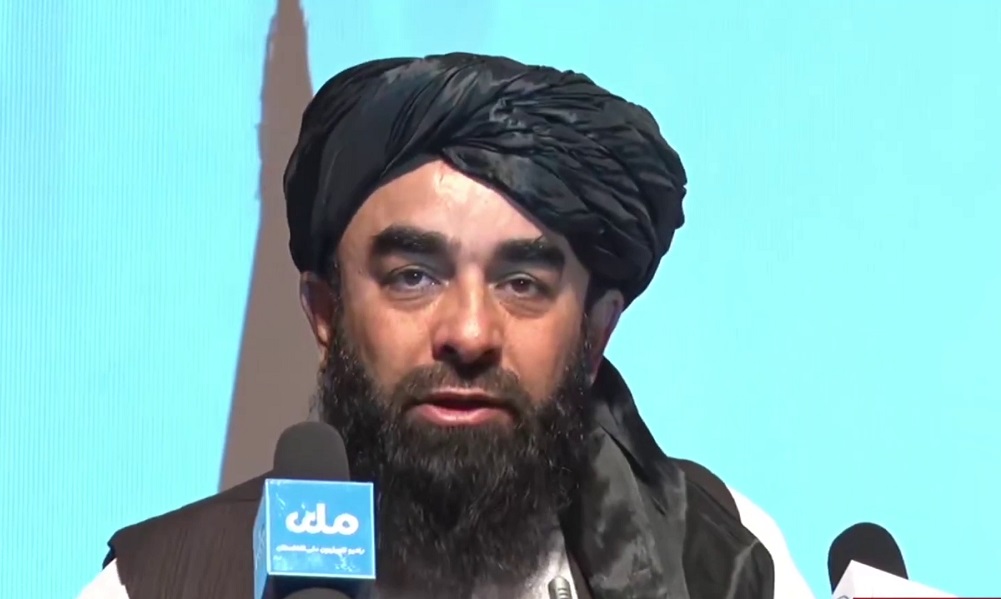
The spokesman of the Islamic Emirate said on Sunday that the government believes in freedom of the press and supports media outlets where content is in line with Sharia and national interests.
Zabihullah Mujahid said this while speaking at a seminar organized by the Ministry of Higher Education.
“If we observe the Islamic principles, national interests and prevent spreading of rumors and pure propaganda of intelligence activities, the government strongly supports the press and media, and if the media operates within this framework, it will not have any problems, rather it will be supported, and that media will be the real media of our country,” Mujahid said.
He also called on officials to listen to criticism reflected by the media.
“May government officials listen to criticism with patience. If it is not true, they should respond, and if it is true, they should bring reforms. This is the cooperation of society with the government. When this cooperation is brought together by the media, we can have an advanced and stable country.”
Mujahid also emphasized the importance of impartiality of the media and said that the media should be a neutral bridge between the government and the people so that trust in the media increases and the rulers can address the problems of the people.
“The responsibility of the media is that they should be neutral and not biased as they act as a medium between the government and the people. When they criticize the government or have an objection or question about the government, they should raise it as a third party. When the media acts as a third party, the government also trusts the media,” he said.
The spokesman of the Islamic Emirate also said that national unity and establishing relations with the world are part of Afghanistan’s national interests, and the media has an obligation to strengthen national unity in the country and not allow division.
He added that the media do not have absolute freedom anywhere in the world and are subject to laws, and Afghanistan, which has an Islamic system, has its own laws which apply to the media.

Latest News
Afghan minister says ‘outsiders’ should not claim to support Afghanistan’s independence
The meeting was attended by governors of Sar-e-Pul and Samangan provinces, local officials, religious scholars, and a number of local residents.
Minister of Borders, Ethnic Affairs and Tribes Noorullah Noori has said that those who interfered in Afghanistan over the past twenty years should now not claim to support a “free and independent Afghanistan.”
According to a statement, Noori made the remarks during a public gathering titled “Unity and Coordination with the People” held in the Kohistanat district of northern Sar-e-Pul province, during his official visit to the province.
The meeting was attended by governors of Sar-e-Pul and Samangan provinces, local officials, religious scholars, and a number of local residents.
Noori stated that under the Islamic system, the beliefs, history, freedom, and values of the Afghan people are protected and safeguarded. He added that those who, over the past twenty years, tested the Afghan people for their own “malicious objectives” should not now claim to support Afghanistan’s independence.
He further emphasized that the people of Afghanistan are not aligned with the Islamic Emirate out of compulsion, but rather support the Islamic system based on faith, ideology, culture, and political belief.
Participants of the gathering also stressed the importance of strengthening the Islamic system and enhancing national unity. They stated that the current system enjoys domestic legitimacy among the Afghan people and that those plotting against it are not accepted by society.
They further added that they will continue to defend the existing system through unity and solidarity and will not allow insecurity or external interference in Afghanistan’s internal affairs.
International Sports
FIFA World Cup group stage wraps up; moves into high-stakes knock out round
With the safety net of the group stage now gone, every match will produce either jubilation or heartbreak.
The group stage of the FIFA World Cup 2026 has officially concluded, with the tournament now shifting into the high-stakes knockout round where every match becomes do-or-die.
The Round of 32 gets underway today, with one of the tournament’s biggest surprise stories taking centre stage as South Africa face co-hosts Canada at SoFi Stadium in Los Angeles.
While traditional football powerhouses such as Argentina, Brazil, France, Germany, Spain, England and the Netherlands safely progressed to the knockout phase, this year’s expanded 48-team tournament has also produced one of African football’s greatest World Cup campaigns.
For the first time in tournament history, nine African nations have qualified for the knockout rounds, underlining the continent’s growing strength on football’s biggest stage.
Morocco once again demonstrated why they remain one of Africa’s elite sides, finishing second behind Brazil in Group C with seven points after an impressive campaign that included a draw against the five-time world champions.
Ghana also lived up to expectations by advancing from a difficult Group L, while Senegal secured qualification from Group I after another composed and disciplined tournament.
However, the biggest headlines belonged to Africa’s emerging football nations.
South Africa completed one of the stories of the tournament by reaching the knockout rounds for the first time after defeating South Korea 1-0 in a dramatic final group match. Bafana Bafana, who were given little chance of progressing before the competition began, have become one of the World Cup’s surprise packages.
Ivory Coast also reached the last 32 for the first time after recovering from defeat to Germany with convincing victories over Ecuador and Curaçao.
Egypt booked their place after earning a crucial draw against Iran, while Algeria secured qualification following an entertaining 3-3 draw with Austria.
Cape Verde has perhaps captured the imagination of football fans more than any other African nation. The island nation remained unbeaten through the group stage, earning draws against Spain, Uruguay and Saudi Arabia to advance in their World Cup debut knockout appearance. Veteran goalkeeper Vozinha produced a series of memorable performances, including a standout display against Spain.
The Democratic Republic of Congo also made history, recording their first-ever World Cup victory with a 3-1 win over Uzbekistan to secure a place in the knockout rounds.
Africa’s representatives now face a daunting but exciting set of Round of 32 fixtures. South Africa meet Canada in the opening knockout match on Sunday, Morocco take on the Netherlands, Ghana face Colombia, Ivory Coast battle Norway, DR Congo play England, Senegal meet Belgium, Algeria face Switzerland, Egypt take on Australia, and Cape Verde will test themselves against defending champions Argentina.
The knockout stage also features an impressive mix of football’s traditional heavyweights and emerging nations. Hosts Canada, Mexico and the United States all advanced, alongside Argentina, Brazil, France, Germany, Spain, England, Belgium, Portugal, Colombia, Japan, Australia, Switzerland, Sweden, Norway, Paraguay, Ecuador, Bosnia-Herzegovina and Morocco.
With the safety net of the group stage now gone, every match will produce either jubilation or heartbreak. For Africa, however, the tournament has already become one to remember. Nine nations remain in contention, carrying not only their own ambitions but the hopes of an entire continent into the World Cup’s decisive rounds.
Fans across Afghanistan can tune in to Ariana Radio and Television Network (ATN) daily to watch this exciting event unfold as ATN has the exclusive rights to broadcast the event across the country live.
Football fans are encouraged to follow Ariana Television and Ariana News’ social media pages for updates, latest stats and match schedules so as not to miss out on the action.
Latest News
Afghanistan remains central to SCO–UN talks in New York Consultations
According to the SCO Secretariat, the meeting was held on June 26 at the United Nations Headquarters in New York, where both sides exchanged views on a wide range of issues related to mutual cooperation.
The Secretariat of the Shanghai Cooperation Organization (SCO) says that Afghanistan and efforts to ensure stability in the country were among the key topics discussed during the fourth round of consultations with the United Nations Secretariat.
According to the SCO Secretariat, the meeting was held on June 26 at the United Nations Headquarters in New York, where both sides exchanged views on a wide range of issues related to mutual cooperation.
The United Nations delegation provided updates on its work under the “Climate, Peace and Security” agenda, ongoing efforts to stabilize Afghanistan, and support for Central Asian countries in maintaining sustainable peace and stability in the region.
Meanwhile, the SCO Secretariat briefed the UN side on preparations for the upcoming Bishkek Summit, the outcomes of ministerial meetings held under Kyrgyzstan’s chairmanship, and progress on institutional reforms within the organization.
The SCO Secretariat added that the consultations were conducted in a constructive atmosphere.
-
Latest News2 days agoTAPI project sees rapid progress in Afghanistan
-
International Sports5 days agoKnockout picture begins to take shape at FIFA World Cup 2026
-
International Sports2 days agoFIFA World Cup: Iran held by Egypt after controversial late goal Is disallowed
-
Latest News5 days agoAfghanistan’s SCO participation blocked over one member’s objection, Kabulov says
-
International Sports4 days agoFIFA World Cup: Messi turns 39, shows no signs of stopping
-
Latest News5 days agoEU allocates 20 million euros to support returnees in Afghanistan
-
Regional5 days agoIran’s Pezeshkian says without missiles his country would be ‘just like Gaza’
-
Latest News1 day agoDelawar says Afghanistan has achieved security and unity after 47 years