Connect with us

Latest News

Over $50 million damages incurred so far in massive border crossing fire

Published

on

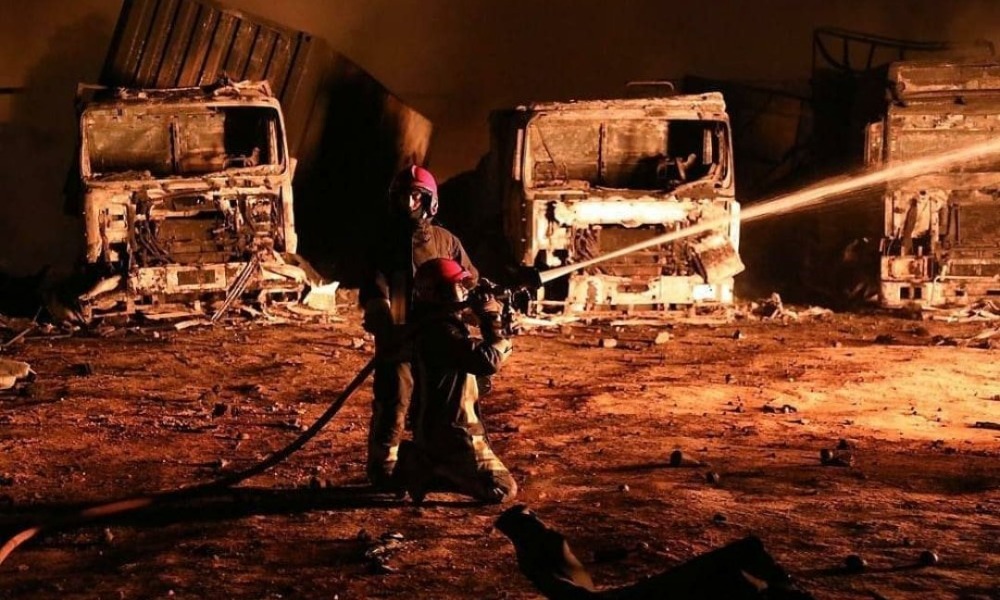
The enormous fire that destroyed more than 500 trucks at the Islam Qala port facility in Herat province, along the border with Iran, has left business owners reeling as financial losses are estimated to be over $50 million.

The massive fire burned for over 24 hours after a fuel tanker reportedly exploded at midday on Saturday.

Explosions continued for hours and two very large ones, just after 1 pm local time on Saturday, were seen from space, NASA reported.

The fire quickly spread through the facility destroying trucks and Herat officials, who were unable to bring the fire under control, eventually appealed to Iran for help.

Iranian firefighters managed to extinguish the blaze on Sunday afternoon, sources confirmed.

Health officials meanwhile said that at least 50 people who sustained burn wounds were transferred to hospitals in Iran.

The cause of the fire has not yet been established but officials said an investigating team has been assigned to the case.

Business owners however blasted the government on Sunday and said corruption among customs officials, the lack of standard regulations around vehicle checks, long border crossing processes and lack of facilities at the land port was of serious concern.

Younus Qazizada, the head of the Herat Chamber of Commerce and Industries, said the fire had caused millions of dollars in damage. “Preliminary investigations show that more than $50 million of damage has been caused by the fire so far,” he said.

The Islam Qala border crossing is around 120km west of the city of Herat and is a major transit route between Afghanistan and Iran.

The US allows Afghanistan to import fuel and oil from Iran as part of a special concession that exempts Kabul from US sanctions against Iran.


Latest News

TAPI project sees rapid progress in Afghanistan

Published

on

Afghanistan’s Islamic Emirate says work on the TAPI Pipeline is advancing steadily, with major infrastructure activities continuing at a rapid pace across the country.

Zabihullah Mujahid said around 130 kilometers of the route have been leveled so far, while 91 kilometers of pipeline have already been installed.

He said the total distance from the border of Turkmenistan to the Herat Industrial Park covers 153 kilometers, where the pipeline will extend.

According to Mujahid, completion of the project is expected to bring major economic transformation to Herat, with thousands of factories projected to become operational.

The 1,814-kilometer pipeline, including 816 kilometers passing through Afghanistan to Pakistan, is designed to transport 33 billion cubic meters of gas annually. Work on the Afghan section began in September 2024, with 52 percent completed so far, while the Herat section is expected to be finished by the end of 2026.

Once operational, the project is expected to provide Afghanistan with millions of dollars in annual transit revenue, while the country will also receive 500 million cubic meters of gas initially, increasing to 1 billion and later 1.5 billion cubic meters in future phases.

Continue Reading

Latest News

Ashura observed across Afghanistan with calls for unity and justice

Published

on

Afghanistan marked the 10th of Muharram, the Day of Ashura, with religious ceremonies held across Kabul and several other provinces, as thousands of mourners gathered to commemorate the martyrdom of Imam Hussain (RA), the grandson of Prophet Muhammad (PBUH).

Ashura commemorates one of the most significant events in Islamic history, when Imam Hussain (RA) and 72 of his loyal companions were martyred in the Battle of Karbala. The occasion is observed annually across the Muslim world through prayers, mourning ceremonies, and acts of charity.

Former Afghan President Hamid Karzai described Ashura as an opportunity to strengthen national unity and solidarity. In a message marking the occasion, he expressed hope that Afghans would draw inspiration from the spiritual significance of Ashura and work together for the

progress, prosperity, and development of a united Afghanistan enriched by knowledge and education.

Religious scholars also emphasized that the uprising of Imam Hussain (RA) continues to symbolize justice, sacrifice, unity, and resistance against oppression, carrying a timeless message for Muslim societies and humanity as a whole.

Meanwhile, officials of the Islamic Emirate attending Ashura commemorations said all necessary measures had been taken to ensure religious ceremonies were held peacefully and securely across the country.

The Ministry of Interior also confirmed that extensive security measures had been implemented for Ashura, with large numbers of security personnel deployed to protect mourners, mosques, Hussainiyas, and other venues hosting commemorative events.

In Kabul and several other provinces, Ashura ceremonies concluded peacefully as worshippers observed the occasion through prayers, religious gatherings, and the distribution of food and charity in memory of the martyrs of Karbala.

Continue Reading

Latest News

Afghanistan records historic 95% drop in opium production: UNODC

Afghan authorities maintain that the cultivation, production, and trafficking of narcotics in the country have been reduced to near zero under current enforcement measures.

Published

on

The United Nations Office on Drugs and Crime (UNODC) says Afghanistan’s anti-narcotics campaign has achieved a “historic record” following a 95% reduction in opium poppy cultivation over the past three years, while warning that the growing production of synthetic drugs is emerging as a major global concern.

In an interview with Ariana News, the UNODC representative in Afghanistan said the narcotics situation in the country has changed significantly since the 2022 ban on the cultivation and production of illicit drugs, with sustained reductions recorded between 2023 and 2025.

UNODC representative Polleak Ok Serei described the development as unprecedented, saying the 95% reduction in poppy cultivation represents a major global milestone.

“In the past three years — 2023, 2024, and 2025 — the 95% reduction in opium poppy cultivation has been maintained. This is a remarkable achievement and a truly historic record. Previous efforts lasted only one year,” he said. “This is not only important for Afghanistan, but for the entire world, as Afghanistan previously produced around 80% of the global illicit opium supply.”

He added that following these developments, UNODC has adjusted its programs, shifting greater focus toward alternative livelihoods for farmers who previously depended on poppy cultivation.

According to him, while these efforts have shown progress, they remain insufficient due to Afghanistan’s broader humanitarian, economic, and environmental challenges.

UNODC also warned that the shift from traditional narcotics to synthetic drugs is creating new challenges for health systems, requiring updated medical responses and treatment approaches.

“We have had to adapt our activities accordingly,” the UN official said. “We are focusing heavily on alternative livelihoods for farmers, because those previously dependent on this production need new sources of income. We also had to reassess health interventions, particularly due to the shift from traditional drugs to synthetic drugs, which requires different medical approaches.”

The UN agency stressed that drug trafficking is a transnational issue requiring coordinated international cooperation among law enforcement and judicial authorities.

“Drug trafficking is a cross-border phenomenon. There are traffickers operating not only inside Afghanistan but also outside the country. Therefore, international cooperation between police and judicial authorities is essential,” he said.

UNODC called on neighboring countries and the international community to increase cooperation and investment in long-term solutions, including rural livelihoods, addiction treatment, and dismantling trafficking networks.

The statement comes as UNODC’s World Drug Report 2026 highlights rapid changes in global drug markets, driven by technology, instability, and the emergence of new synthetic substances.

According to the report, global drug production and trafficking patterns are shifting significantly, particularly in the opioid market. While Afghanistan’s opium production has sharply declined since 2022, production increases in countries such as Myanmar have not fully offset global supply changes, leading traffickers to increasingly turn toward synthetic opioids such as fentanyl and other highly potent substances.

The report warns that these new synthetic drugs can be significantly more powerful and deadly than traditional narcotics, posing serious risks to public health and security worldwide.

UNODC also noted that rising global demand for drugs such as methamphetamine and cocaine is expanding trafficking routes into new regions, including Africa and Asia, further complicating international control efforts.

Meanwhile, Afghan authorities maintain that the cultivation, production, and trafficking of narcotics in the country have been reduced to near zero under current enforcement measures.

Continue Reading
Advertisement
Advertisement
Advertisement
Advertisement

Trending

Copyright © 2025 Ariana News. All rights reserved!


Warning: Undefined array key "slug" in /var/www/vhosts/ariananews.af/httpdocs/wp-includes/class-wp-theme-json.php on line 2117

Warning: Undefined array key "slug" in /var/www/vhosts/ariananews.af/httpdocs/wp-includes/class-wp-theme-json.php on line 2117

Warning: Undefined array key "slug" in /var/www/vhosts/ariananews.af/httpdocs/wp-includes/class-wp-theme-json.php on line 2117