
Latest News
Tajik President calls for ‘security belt’ around Afghanistan

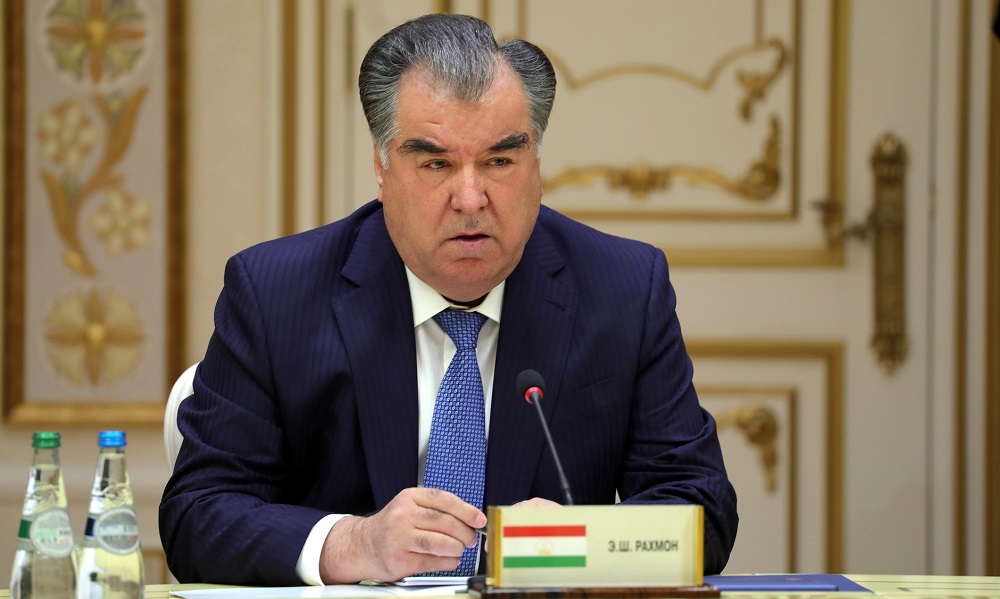
Tajikistan’s President Emomali Rahmon has again expressed concern over security threats posed by Afghanistan to the region and has called for a “security belt” to be built around the country.
Addressing delegates attending an International and Regional Border Security and Management Cooperation to Counter Terrorism conference on Tuesday in Dushanbe, Rahmon said “the transfer of terrorist fighters from the war-torn areas of the Middle East to other regions and the strengthening of the positions of international terrorist organizations in Afghanistan poses a serious threat to the Central Asian states.”
He said Tajikistan and Afghanistan share a 1,400 kilometer border that includes “complicated mountainous terrain”.
Rahmon said that over the past two years, Tajikistan has built and put into use more than 175 border facilities.
“It is worth mentioning that at the same time the construction of 30 other facilities is going on, and we need to build another 300 of this kind of facilities in the future.
“In this regard, urgent efforts would be important to implement the initiative of Tajikistan – the concept of [a] ‘Security Belt’ around Afghanistan in order to prevent and reduce the consequences of dangers and threats,” he said.
This comes just days after the Regional Anti-Terrorism Structure (RATS) of the Shanghai Cooperation Organisation (SCO) decided on joint measures by member countries to counter threats posed by international terrorist groups operating from Afghanistan.
The decision was taken at a meeting of the council of RATS that was hosted by India in New Delhi last week.
The meeting was attended by senior officials of all the member nations including China and Pakistan, India’s media reported.
However, the Islamic Emirate of Afghanistan (IEA) has repeatedly reaffirmed its commitment to not allow terrorist groups to use Afghanistan soil to attack other countries.
The IEA has also stated that no terrorist organization is operating out of Afghanistan.
In addition, the IEA has on a number of occasions carried out operations to eliminate militant elements in the country, including Daesh members.












Kazakhstan’s Foreign Minister Mukhtar Tileuberdi has called for pragmatic and coordinated international engagement with Afghanistan, saying the country’s long-term stability is closely linked to the security and sustainable development of Central Asia.
Speaking during the general debate of the 81st session of the United Nations General Assembly in New York on Friday, Tileuberdi said humanitarian assistance to Afghanistan remains essential but alone cannot break the cycle of poverty, displacement and dependency.
He said Kazakhstan supports a “pragmatic, coordinated and step-by-step” approach to international engagement with Afghanistan, with the United Nations playing a central role.
Tileuberdi also said Kazakhstan is working with the UN to operationalize the United Nations Regional Centre for the Sustainable Development Goals for Central Asia and Afghanistan in Almaty.
He said the success of the centre should be measured by the results and assistance it delivers to the region.


Abu Muslim Farah defeat Khurasan Faryab 2-0 in ACL season six

Saar: Concerns over Pakistan’s political crisis discussed

Afghanistan Champions League: Omar Zawak Herat beat Toofan Herat 1-0

Blast in Pakistan’s Dera Ismail Khan kills 11, injures 30

Ariana Afghan Airlines increases Kabul-Delhi cargo flights

Saudi energy group signs major Afghanistan deals covering gas exploration and pipeline plans

Trump floats idea of renaming Atlantic or Pacific Ocean

US hits Egyptian bank branches with Iran sanctions as war marks six months

Nepal flood rescue mission enters critical phase as thousands remain missing

Iranian clubs to face Gulf opponents at neutral venues in Asian Champions League Elite
Saar: Concerns over Pakistan’s political crisis discussed

Exclusive interview with Abdul Latif Mansoor, Minister of MRRD

Tawsia: Overview of Afghanistan’s iron mines

Tahawol: Discussion on fresh Pakistani airstrikes on Afghanistan

Saar: Calls for international support for Afghanistan discussed
-

 World5 days ago
CNN, MS NOW and Politico sue Trump, challenging White House ban
-

 Latest News4 days ago
Ariana Afghan Airlines ranks seventh among 45 Central Asian airlines
-

 Latest News5 days ago
UN reiterates call for respect for international law after Kunar airstrikes
-

 Regional4 days ago
US and Iran hold first talks since June after Trump’s ‘annihilation’ threat
-

 Latest News4 days ago
Silk Road highway in Wakhan corridor now reaches the China border
-

 Regional3 days ago
Iran airlines cancel flights as US sanctions hit
-

 Latest News5 days ago
Afghan Official: Pakistan’s airstrikes will not go unanswered
-
 Regional5 days ago
G7 foreign ministers call on Iran to stop arming Houthis