
Latest News
U.N. chief tells Security Council: Afghanistan ‘hanging by thread’

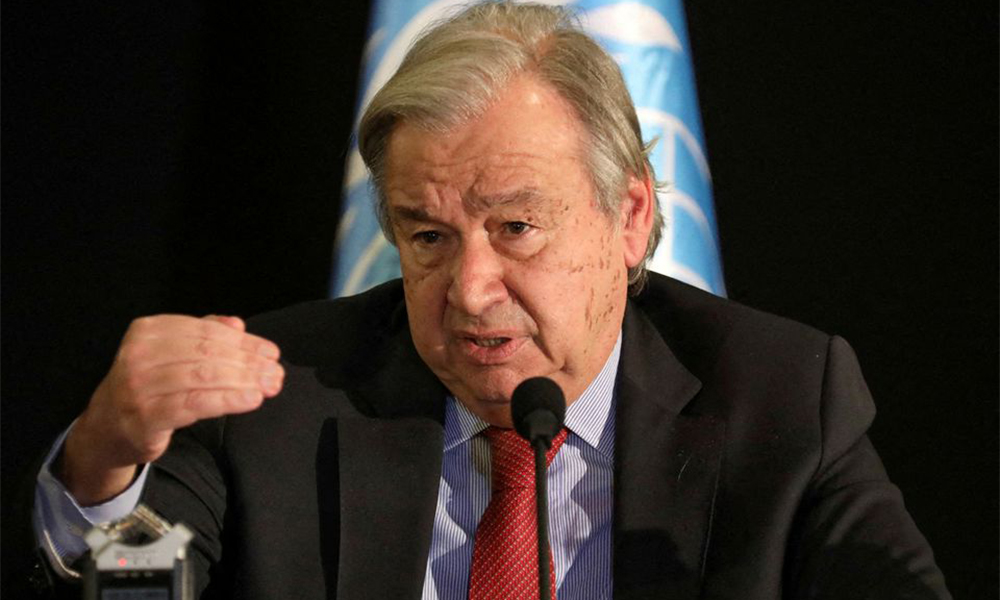
Afghanistan is “hanging by a thread,” United Nations Secretary-General Antonio Guterres told the Security Council on Wednesday, calling for countries to authorize all transactions needed to carry out humanitarian activities in the Islamic Emirate-ruled state, Reuters reported.
He also pushed for a suspension of any rules or conditions constricting “lifesaving” aid operations as millions in the country suffer extreme hunger, education and social services are on the brink of collapse, and a lack of liquidity limits the capacity of the United Nations and aid groups to reach people in need.
“We need to give financial institutions and commercial partners legal assurance that they can work with humanitarian operators without fear of breaching sanctions,” said Guterres, noting that the 15-member council last month adopted a humanitarian exemption to U.N. sanctions tied to Afghanistan.
Some $9.5 billion in Afghan central bank reserves remain blocked abroad and international development support has dried up since the Islamic Emirate of Afghanistan (IEA) seized power in August. Donors seek to use the money as leverage over the IEA on issues including human rights, Reuters reported.
“There is compelling evidence of an emerging environment of intimidation and a deterioration in respect for human rights. This suggests that the consolidation of government authority may be leading toward control of the population by fear,” the U.N. special envoy on Afghanistan, Deborah Lyons, told the council.
In December, donors to a frozen World Bank-administered Afghan Reconstruction Trust Fund agreed to transfer $280 million to the World Food Program and U.N. children’s agency UNICEF to support nutrition and health in Afghanistan. Guterres said the remaining $1.2 billion in the fund needed “to be freed up urgently to help Afghanistan’s people survive the winter.”
The U.S. ambassador to the United Nations, Linda Thomas-Greenfield, told the council that Washington had moved to ensure that U.S. sanctions do not impede humanitarian activity and it is examining various options to ease the liquidity crunch.”
U.N. aid chief Martin Griffiths and International Committee of the Red Cross President Peter Maurer met virtually with U.S. Secretary of State Antony Blinken earlier this month on Afghanistan, read the report.
Dominik Stillhart, ICRC director of operations, said “intense” discussions between the United Nations, the ICRC, the World Bank and key donor countries were centered on a “humanitarian exchange facility” that would be supported or managed by the World Bank and allow for cash to be injected into the Afghan economy, Reuters reported.
He told reporters that money could be deposited in the facility and “under certain conditions that cash could be made available to traders in Afghanistan,” though he said it was a stopgap measure because “it needs to be the central bank that has to be capacitated to discharge these functions.”
Thomas-Greenfield said that “ultimately, a functioning Afghan economy will require an independent and technically competent central bank that meets international banking standards.”
Stillhart said agreement was needed between the U.N., World Bank and key donors to “kick-start this facility,” noting that the discussion was not related to the unfreezing of Afghan assets or changes to sanctions on the IEA.
He said a separate idea was also being discussed that would involve using money from the World Bank-administered Afghan Reconstruction Trust Fund to pay non-security public sector employees.
According to Reuters the United Nations earlier this month appealed for $4.4 billion in humanitarian aid for Afghanistan in 2022. On Wednesday, it said it needed a further $3.6 billion for health and education, basic infrastructure, promotion of livelihoods and social cohesion, specifically the needs of women and girls.







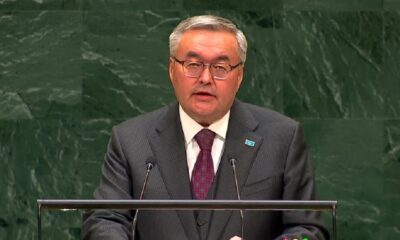




Kazakhstan’s Foreign Minister Mukhtar Tileuberdi has called for pragmatic and coordinated international engagement with Afghanistan, saying the country’s long-term stability is closely linked to the security and sustainable development of Central Asia.
Speaking during the general debate of the 81st session of the United Nations General Assembly in New York on Friday, Tileuberdi said humanitarian assistance to Afghanistan remains essential but alone cannot break the cycle of poverty, displacement and dependency.
He said Kazakhstan supports a “pragmatic, coordinated and step-by-step” approach to international engagement with Afghanistan, with the United Nations playing a central role.
Tileuberdi also said Kazakhstan is working with the UN to operationalize the United Nations Regional Centre for the Sustainable Development Goals for Central Asia and Afghanistan in Almaty.
He said the success of the centre should be measured by the results and assistance it delivers to the region.


Saar: Concerns over Pakistan’s political crisis discussed

Afghanistan Champions League: Omar Zawak Herat beat Toofan Herat 1-0

Blast in Pakistan’s Dera Ismail Khan kills 11, injures 30

Ariana Afghan Airlines increases Kabul-Delhi cargo flights

Khalilzad questions Pakistan’s commitment to Afghan welfare

Saudi energy group signs major Afghanistan deals covering gas exploration and pipeline plans

Trump floats idea of renaming Atlantic or Pacific Ocean

US hits Egyptian bank branches with Iran sanctions as war marks six months

Nepal flood rescue mission enters critical phase as thousands remain missing

Iranian clubs to face Gulf opponents at neutral venues in Asian Champions League Elite
Saar: Concerns over Pakistan’s political crisis discussed

Exclusive interview with Abdul Latif Mansoor, Minister of MRRD

Tawsia: Overview of Afghanistan’s iron mines

Tahawol: Discussion on fresh Pakistani airstrikes on Afghanistan

Saar: Calls for international support for Afghanistan discussed
-

 World5 days ago
CNN, MS NOW and Politico sue Trump, challenging White House ban
-

 Latest News3 days ago
Ariana Afghan Airlines ranks seventh among 45 Central Asian airlines
-

 Latest News4 days ago
UN reiterates call for respect for international law after Kunar airstrikes
-
 Latest News5 days ago
Khalilzad condemns Pakistan airstrikes, says current strategy is not working
-

 Regional3 days ago
US and Iran hold first talks since June after Trump’s ‘annihilation’ threat
-

 Latest News3 days ago
Silk Road highway in Wakhan corridor now reaches the China border
-

 Latest News4 days ago
Afghan Official: Pakistan’s airstrikes will not go unanswered
-

 Sport4 days ago
Afghan boxing referee heads to China for international festival