
Latest News
UN chief urges foreign community not to abandon Afghansitan

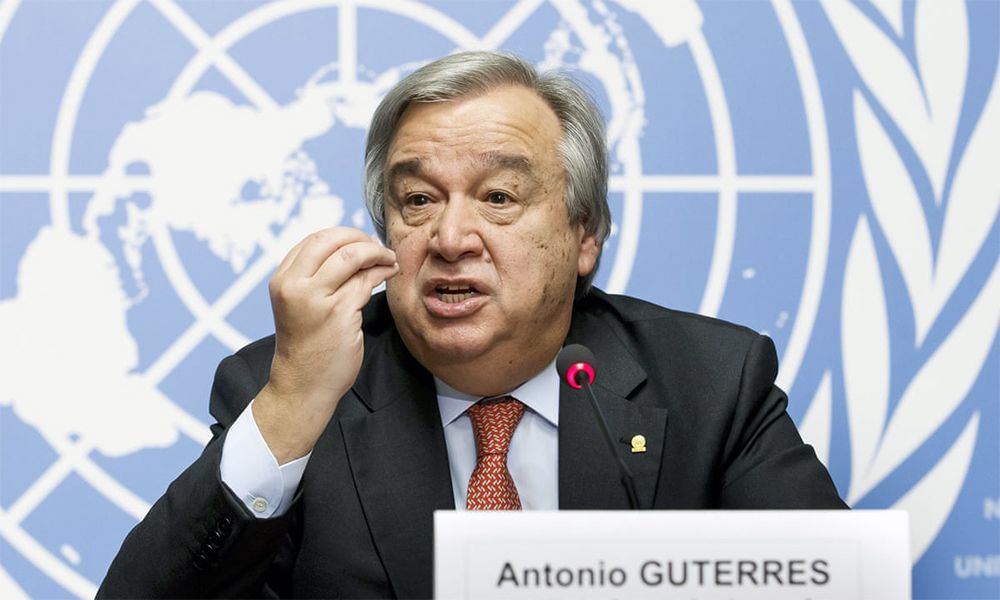
UN Secretary-General António Guterres has urged the international community not to abandon Afghanistan and also called on the Islamic Emirate of Afghanistan (IEA) to expand opportunity and security for Afghans, uphold human rights, and demonstrate real commitment to be part of the international community.
Guterres also tweeted this week that “daily life has become a frozen hell for the people of Afghanistan.
“As a matter of moral responsibility — and regional and global security and prosperity — we cannot abandon them.
“They need peace. They need hope. They need help. And they need it now,” he said.
Addressing the UN Security Council on Wednesday, he said: “At this moment, we need the global community – and this Council – to put their hands on the wheel of progress, provide resources, and prevent Afghanistan from spiraling any further.”
According to him, Afghanistan has long been unfairly used as a platform for political agendas, geopolitical advantage, ideological dominance, brutal conflicts and terrorism.
“As a matter of moral responsibility – and regional and global security and prosperity – we cannot abandon the people of Afghanistan.”
He also highlighted the situation of women and girls and appealed for the release of women activists who were recently arrested.
Guterres also urged countries to suspend rules and conditions that constrict both the Afghan economy and lifesaving humanitarian operations.
“At this moment of maximum need, these rules must be seriously reviewed,” he said, emphasizing the need to pay public service salaries. He also welcomed the Council’s recent adoption of a humanitarian exemption to the UN sanctions regime for Afghanistan.
The Secretary-General underscored the need to “jump-start” the Afghan economy through increased liquidity, including by freeing-up frozen currency reserves and through cash injections.
“Our team in Afghanistan stands ready to work with Member States and others to establish accountability systems to ensure that funds go to the Afghan people most in need, and are not diverted,” he said.
On another note, Guterres appealed to the IEA to demonstrate real commitment to be part of the international community. “The window for trust-building is open. But this trust must be earned,” he said.
“I make an equally urgent plea to the Taliban (IEA) leadership to recognize and protect the fundamental human rights that every person shares,” Guterres said.
He further encouraged the IEA “to seize this moment and garner international trust and goodwill by recognizing – and upholding – the basic human rights that belong to every girl and woman.”
He warned that “Afghanistan is hanging by a thread” as millions of impoverished citizens struggle to survive amid deteriorating humanitarian conditions.
“We urge the Taliban (IEA) to seize this moment and garner international trust and goodwill by recognizing — and upholding — the basic human rights that belong to every girl and woman,” Guterres said.
He expressed concern about recent reports of arrests of women activists, saying: “I strongly appeal for their release.”
Over half of all Afghans face “extreme levels of hunger,” Guterres told the council, and “some families are selling their babies to purchase food.”
IEA officials recently held talks with Western powers in Oslo to address the humanitarian crisis, with Western diplomats linking humanitarian aid to Afghanistan to an improvement in human rights.
Wednesday’s session of the 15-member Security Council sought to clarify the mandate of the UN political mission in Afghanistan.
The mandate expires March 17 and must be reviewed to account for the Taliban’s return to power.
Meanwhile, the deputy spokesman of the Islamic Emirate Bilal Karimi said all opportunities “are available for Afghan women and there are no problems for Afghan women”.






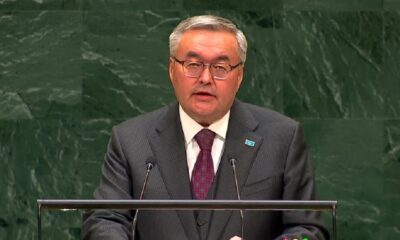




Kazakhstan’s Foreign Minister Mukhtar Tileuberdi has called for pragmatic and coordinated international engagement with Afghanistan, saying the country’s long-term stability is closely linked to the security and sustainable development of Central Asia.
Speaking during the general debate of the 81st session of the United Nations General Assembly in New York on Friday, Tileuberdi said humanitarian assistance to Afghanistan remains essential but alone cannot break the cycle of poverty, displacement and dependency.
He said Kazakhstan supports a “pragmatic, coordinated and step-by-step” approach to international engagement with Afghanistan, with the United Nations playing a central role.
Tileuberdi also said Kazakhstan is working with the UN to operationalize the United Nations Regional Centre for the Sustainable Development Goals for Central Asia and Afghanistan in Almaty.
He said the success of the centre should be measured by the results and assistance it delivers to the region.


Afghanistan Champions League: Omar Zawak Herat beat Toofan Herat 1-0

Blast in Pakistan’s Dera Ismail Khan kills 11, injures 30

Ariana Afghan Airlines increases Kabul-Delhi cargo flights

Khalilzad questions Pakistan’s commitment to Afghan welfare

India, UN envoy discuss Afghanistan’s humanitarian needs

Saudi energy group signs major Afghanistan deals covering gas exploration and pipeline plans

Trump floats idea of renaming Atlantic or Pacific Ocean

US hits Egyptian bank branches with Iran sanctions as war marks six months

Nepal flood rescue mission enters critical phase as thousands remain missing

Iranian clubs to face Gulf opponents at neutral venues in Asian Champions League Elite

Exclusive interview with Abdul Latif Mansoor, Minister of MRRD

Tawsia: Overview of Afghanistan’s iron mines

Tahawol: Discussion on fresh Pakistani airstrikes on Afghanistan

Saar: Calls for international support for Afghanistan discussed

Tahawol: Opening of the 81st UN General Assembly Session
-

 World4 days ago
CNN, MS NOW and Politico sue Trump, challenging White House ban
-

 Latest News3 days ago
Ariana Afghan Airlines ranks seventh among 45 Central Asian airlines
-

 Latest News4 days ago
UN reiterates call for respect for international law after Kunar airstrikes
-
 Latest News5 days ago
Khalilzad condemns Pakistan airstrikes, says current strategy is not working
-

 Regional3 days ago
US and Iran hold first talks since June after Trump’s ‘annihilation’ threat
-

 Latest News3 days ago
Silk Road highway in Wakhan corridor now reaches the China border
-

 Latest News4 days ago
Afghan Official: Pakistan’s airstrikes will not go unanswered
-

 Sport4 days ago
Afghan boxing referee heads to China for international festival