
Latest News
Ghani adamant about handing over power to elected successor

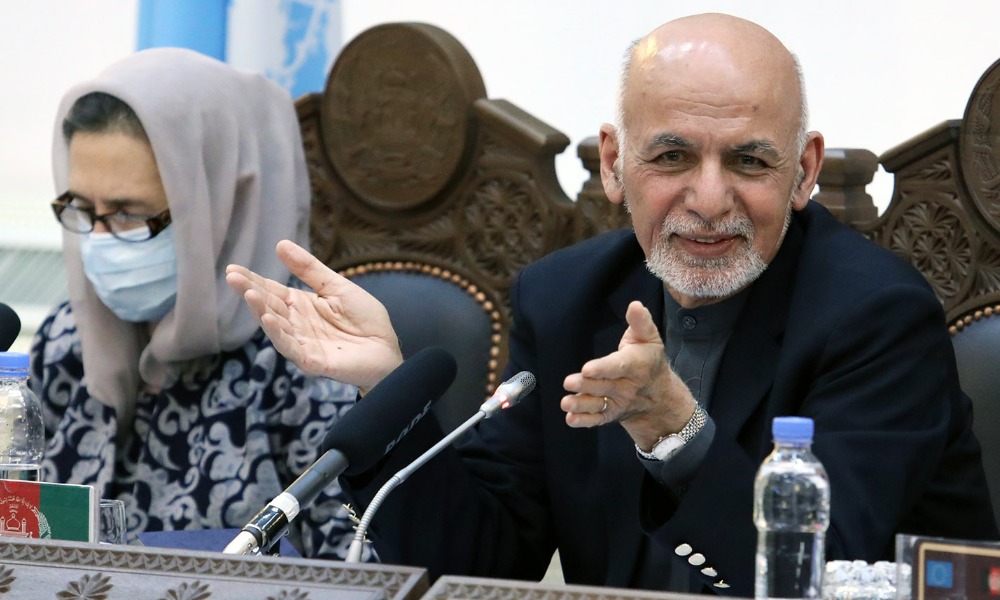
President Ashraf Ghani said on Saturday his basic goal is to be able to hand over power to an elected successor so as to honor all Afghans for the sacrifices they have made.
In an interview with CNN, Ghani said he hopes to do this “through the will of the people.”
“This is crucial to enable us to both honor the sacrifice of our civilians, our activists, and others.”
He also stated that if the goal of a sovereign, democratic, united Afghanistan is maintained then the current peace process will be able to move forward.
“But if the objective of the Taliban is to dominate and give us the peace of the grave, then that will have very negative consequences.
“Our society is united in seeking peace but we want to have a positive peace,” Ghani said.
Also in the interview was First Lady Rula Ghani who said the constructive participation of women at the Doha peace talks was a positive development.
She said the female peace negotiators for the Afghan Republic’s team were actively involved in the talks and had progressed from representing only women, to representing all of Afghanistan.
She said: “The Taliban are our brothers and our sisters and as Afghans, they have the right to come and live in Afghanistan,” adding that the question that needed to be asked was whether the Taliban had the right to bring their own way of thinking and impose it on the rest of the population.
She also said if the Taliban have political ambition “they can do it through the electoral process”.
The president meanwhile said: “We are in an open moment; the incoming [Joe] Biden administration is an immense opportunity – to work with us a) to define what the US security interests in Afghanistan and the region are – no one wants a return to a heavy footprint.”
He said the second point was that it was essential to end 40 years of conflict and thirdly, the peace process needs to be truly owned and led by the Afghan people.
Ghani also said the scale and scope of US presence in Afghanistan needs to be defined. “Here the most critical issue is how to marry a conditions-based approach with a time-based approach,” he said.
“My basic goal is to be able to hand power through the will of the people to my elected successor. This is crucial to enable us to both honor the sacrifice of our civilivilans, our activists, and others,” Ghani stated.
He also stated, “one thing needs to be clear Afghan society is not willing to go back and we are not the type of society that the Taliban type approach of the past can be imposed on us.”
“That was the peace of the graveyard, he said.
Ghani stated the country wants “a positive peace where all of us can overcome our past and embrace each other and rebuild an Afghanistan where all peace and countries can interact.”
On the issue of troops withdrawal, Ghani said: “We are on the frontline of your (US) security,” and stated the key issue is not about charity but about responsibility.
He asked the question of what is the threat of terrorism? Also is it a system or is it individuals?
He also said that since 2015, US lives lost in Afghanistan totals 98, “while we the Afghan people have lost over 40,000 civilians and military”.
But if “US would like to withdraw [troops], all we ask for is a process that is predictable,” and one that is mutually agreed upon, he stated.












Kazakhstan’s Foreign Minister Mukhtar Tileuberdi has called for pragmatic and coordinated international engagement with Afghanistan, saying the country’s long-term stability is closely linked to the security and sustainable development of Central Asia.
Speaking during the general debate of the 81st session of the United Nations General Assembly in New York on Friday, Tileuberdi said humanitarian assistance to Afghanistan remains essential but alone cannot break the cycle of poverty, displacement and dependency.
He said Kazakhstan supports a “pragmatic, coordinated and step-by-step” approach to international engagement with Afghanistan, with the United Nations playing a central role.
Tileuberdi also said Kazakhstan is working with the UN to operationalize the United Nations Regional Centre for the Sustainable Development Goals for Central Asia and Afghanistan in Almaty.
He said the success of the centre should be measured by the results and assistance it delivers to the region.


Abu Muslim Farah defeat Khurasan Faryab 2-0 in ACL season six

Saar: Concerns over Pakistan’s political crisis discussed

Afghanistan Champions League: Omar Zawak Herat beat Toofan Herat 1-0

Blast in Pakistan’s Dera Ismail Khan kills 11, injures 30

Ariana Afghan Airlines increases Kabul-Delhi cargo flights

Saudi energy group signs major Afghanistan deals covering gas exploration and pipeline plans

Trump floats idea of renaming Atlantic or Pacific Ocean

US hits Egyptian bank branches with Iran sanctions as war marks six months

Nepal flood rescue mission enters critical phase as thousands remain missing

Iranian clubs to face Gulf opponents at neutral venues in Asian Champions League Elite
Saar: Concerns over Pakistan’s political crisis discussed

Exclusive interview with Abdul Latif Mansoor, Minister of MRRD

Tawsia: Overview of Afghanistan’s iron mines

Tahawol: Discussion on fresh Pakistani airstrikes on Afghanistan

Saar: Calls for international support for Afghanistan discussed
-

 World5 days ago
CNN, MS NOW and Politico sue Trump, challenging White House ban
-

 Latest News4 days ago
Ariana Afghan Airlines ranks seventh among 45 Central Asian airlines
-

 Latest News5 days ago
UN reiterates call for respect for international law after Kunar airstrikes
-

 Regional4 days ago
US and Iran hold first talks since June after Trump’s ‘annihilation’ threat
-

 Latest News4 days ago
Silk Road highway in Wakhan corridor now reaches the China border
-

 Regional3 days ago
Iran airlines cancel flights as US sanctions hit
-

 Latest News5 days ago
Afghan Official: Pakistan’s airstrikes will not go unanswered
-
 Regional5 days ago
G7 foreign ministers call on Iran to stop arming Houthis