
Latest News
UN urgently needs cash in Afghanistan, but struggles for solution

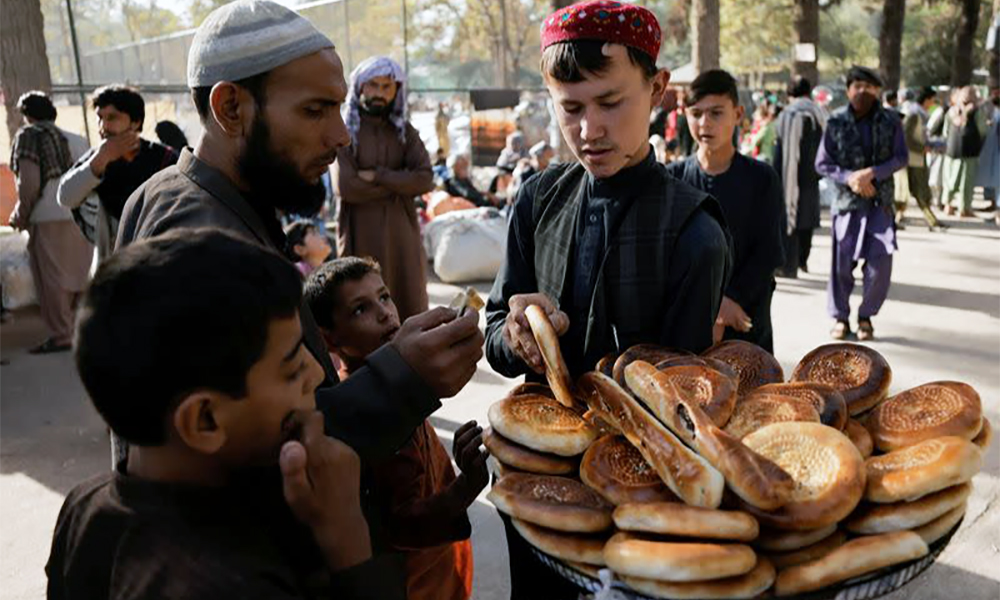
The United Nations cannot get enough cash into Afghanistan to deliver humanitarian aid to millions of people on the brink of starvation and is struggling to develop options to help stabilize the collapsing economy, U.N. officials said.
Ultimately political solutions are needed, a senior U.N. official told Reuters on condition of anonymity, an apparent reference to sanctions relief and for governments and institutions to free up billions of dollars of Afghan assets held overseas.
In the meantime U.N. agencies are scrambling to find ways to get large amounts of U.S. dollars into Afghanistan to combat a liquidity crisis that has taken hold since the Islamic Emirate of Afghanistan (IEA) ousted the Western-backed government in August.
The U.N. official shared with Reuters some of the options being suggested.
The delivery of U.S. dollars to Afghanistan has stopped since the IEA seized power and if countries or international financial institutions don’t step up then the United Nations might have to fill the gap, said the official.
One suggested option is using Afghanistan International Bank, which could bring in and store money, but there are issues with insurance, the U.N. official said.
The United Nations is also aware that no one option will work and several avenues to get enough cash into Afghanistan are needed, the official said.
U.N. Secretary-General Antonio Guterres has called for the International Monetary Fund to agree on waivers or mechanisms to get money into Afghanistan. The IMF has blocked the IEA from accessing some $440 million in new emergency reserves.
Much of the Afghan central bank’s $10 billion in overseas assets have been frozen as well, most of it in the United States. The U.S. Treasury has said there are no plans to release the money.
“We need to work together to make the economy breathe again and to help people survive,” Guterres said on Wednesday. “Injecting liquidity into the Afghan economy can be done without violating international laws or compromising principles.”
The United Nations has repeatedly warned that Afghanistan’s economy is on the brink of collapse and would likely further fuel a refugee crisis.
When asked about U.N. efforts to get cash into Afghanistan, Mary-Ellen McGroarty, head of the World Food Programme in Afghanistan, told reporters on Tuesday: “The U.N. collective is looking at what potential solutions we could have, but flying in money to the country is not on the table yet.”
“What we are using at the moment is the limited liquidity that is in the country,” she said. “But the longer this goes on … we’re finding it’s becoming more and more difficult.”
Some 8.7 million people are “one step away from starvation,” said McGroarty, adding: “There is a tsunami of destitution, incredible suffering and hunger spiraling out of control.”
The IEA is facing growing international pressure for an inclusive and representative Afghan government and to uphold human rights, particularly those of women and girls in return for international recognition and freeing up aid and reserves.
Donors and institutions are also seeking to avoid running afoul of U.N. and unilateral sanctions on the IEA.
The United Nations is appealing for countries “to provide humanitarian financial exemptions to allow funds to reach aid organizations in the country,” said U.N. spokesman Stephane Dujarric, without naming names.
U.N. agencies and aid groups are currently using informal money-moving networks – known as hawalas – and small amounts of cash in banks to pay staff salaries and for other smaller scale purchases, Dujarric told Reuters.
“These modalities are not sufficient for the large scale operations requiring cash payments or cash assistance in-country, however,” said Dujarric, adding that the United Nations was talking to international financial institutions to find a solution that would expand aid operations.
A key part of U.N. plans to inject money into Afghanistan is by providing cash directly to poor Afghan families.







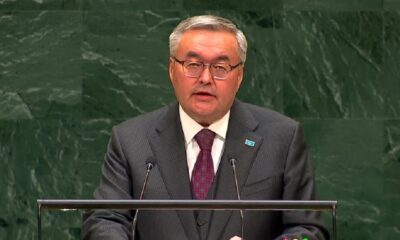




Kazakhstan’s Foreign Minister Mukhtar Tileuberdi has called for pragmatic and coordinated international engagement with Afghanistan, saying the country’s long-term stability is closely linked to the security and sustainable development of Central Asia.
Speaking during the general debate of the 81st session of the United Nations General Assembly in New York on Friday, Tileuberdi said humanitarian assistance to Afghanistan remains essential but alone cannot break the cycle of poverty, displacement and dependency.
He said Kazakhstan supports a “pragmatic, coordinated and step-by-step” approach to international engagement with Afghanistan, with the United Nations playing a central role.
Tileuberdi also said Kazakhstan is working with the UN to operationalize the United Nations Regional Centre for the Sustainable Development Goals for Central Asia and Afghanistan in Almaty.
He said the success of the centre should be measured by the results and assistance it delivers to the region.


Saar: Concerns over Pakistan’s political crisis discussed

Afghanistan Champions League: Omar Zawak Herat beat Toofan Herat 1-0

Blast in Pakistan’s Dera Ismail Khan kills 11, injures 30

Ariana Afghan Airlines increases Kabul-Delhi cargo flights

Khalilzad questions Pakistan’s commitment to Afghan welfare

Saudi energy group signs major Afghanistan deals covering gas exploration and pipeline plans

Trump floats idea of renaming Atlantic or Pacific Ocean

US hits Egyptian bank branches with Iran sanctions as war marks six months

Nepal flood rescue mission enters critical phase as thousands remain missing

Iranian clubs to face Gulf opponents at neutral venues in Asian Champions League Elite
Saar: Concerns over Pakistan’s political crisis discussed

Exclusive interview with Abdul Latif Mansoor, Minister of MRRD

Tawsia: Overview of Afghanistan’s iron mines

Tahawol: Discussion on fresh Pakistani airstrikes on Afghanistan

Saar: Calls for international support for Afghanistan discussed
-

 World5 days ago
CNN, MS NOW and Politico sue Trump, challenging White House ban
-

 Latest News3 days ago
Ariana Afghan Airlines ranks seventh among 45 Central Asian airlines
-

 Latest News4 days ago
UN reiterates call for respect for international law after Kunar airstrikes
-
 Latest News5 days ago
Khalilzad condemns Pakistan airstrikes, says current strategy is not working
-

 Regional3 days ago
US and Iran hold first talks since June after Trump’s ‘annihilation’ threat
-

 Latest News3 days ago
Silk Road highway in Wakhan corridor now reaches the China border
-

 Latest News4 days ago
Afghan Official: Pakistan’s airstrikes will not go unanswered
-

 Sport4 days ago
Afghan boxing referee heads to China for international festival