Connect with us

Regional

Gem stone and minerals processing center opens in Badakhshan 

Published

on

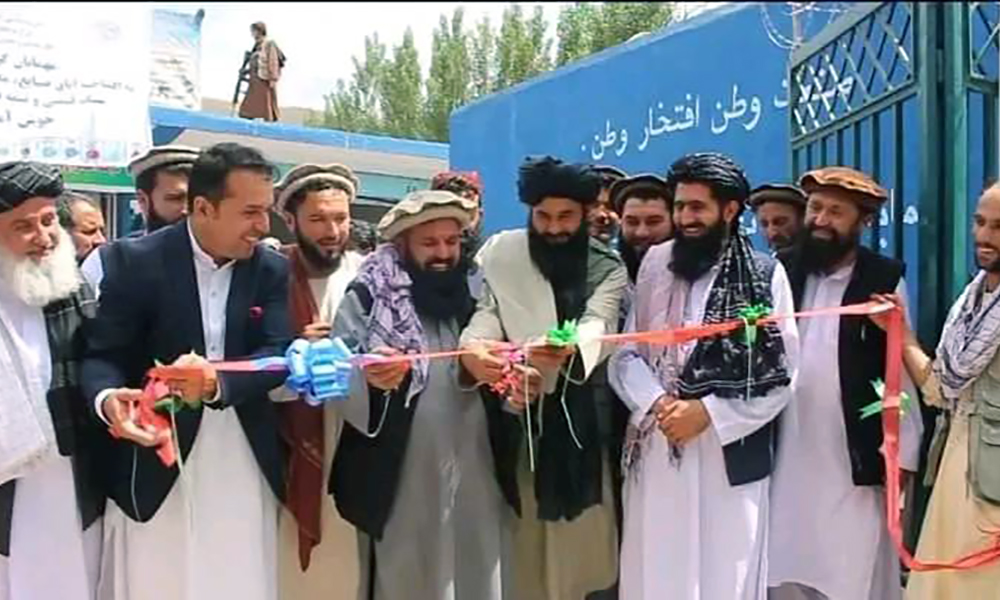
For the first time the Chamber of Industries and Mines, as well as a center for processing and selling gem stones and minerals have been established in Badakhshan province.

During his visit to Badakhshan province, the acting Minister of Economy inaugurated the new chamber and the gem stone center.

The purpose of establishing this center is to process precious and semi-precious stones for sale on the national and international markets.

The acting minister of economy, Din Mohammad Hanif, said at the opening of the center that although millions of dollars had flowed into Afghanistan in recent years, no basic work had been done to make Afghanistan self sufficient.

Hanif said billions of dollars had been spent in recent years, but added that aid has not been effective in rescuing Afghanistan from financial dependence. 

One example of this was that Afghanistan pays other countries $340 million for electricity. 

“One is the opening of the Chamber of Industries and Mines, and second is the opening of the processing center, and we take this as a good omen, and the Badakhshan that you see is really hopeful, and we have to move forward step by step,” said Hanif.

The executive director of the Chamber of Industry and Commerce says that Badakhshan has a huge assortment of gem stones and natural minerals, which will be processed through the new center and sold on both domestic and international markets. 

“Badakhshan is one of the richest provinces in the world. In the past, people knew little about Badakhshan. Badakhshan has ruby and lapis lazuli, but you should know that in Badakhshan there are more expensive things which other countries do not have,” said Rahimullah Samandar, executive director of the Chamber of Industry and Commerce.

Residents of Badakhshan also hope that the establishment of this center and the extraction of natural resources, especially precious stones, will provide them with jobs and employment.

Regional

US and Iran conclude high-level talks in Switzerland, mediators say

The parties agreed to a mechanism to end the fighting in Lebanon and opened a communications line to help ensure safe passages for commercial ships through the contested strait, the statement said.

Published

on

The first round of talks between high-ranking U.S. and Iranian officials in Switzerland ended Monday, mediators said, after a tense opening marked by Tehran’s announcement ​it had again closed the Strait of Hormuz and U.S. President Donald Trump repeating his threats to resume attacks on Iran.

A joint statement from mediating nations Qatar and Pakistan said the U.S. and Iran agreed ‌to a roadmap toward a final deal within 60 days. Technical talks will continue for the rest of the week in the Qatari-owned Swiss mountain resort of Buergenstock, according to the statement, which was released by the Qatari foreign ministry, Reuters reported.

The parties agreed to a mechanism to end the fighting in Lebanon and opened a communications line to help ensure safe passages for commercial ships through the contested strait, the statement said.

U.S. Vice President JD Vance had opened talks with Iranian officials on Sunday under the terms of a memorandum of understanding reached last week to extend a tenuous ceasefire from April for ​at least another 60 days. The discussions continued until the early hours of Monday.

In a post on social media, Iranian Foreign Minister Abbas Araqchi said his country had secured waivers for oil and petrochemical exports, the release of ​some frozen assets and the launch of a reconstruction and development plan for Iran.

The White House had no immediate comment when asked if talks had wrapped for now.

Just before talks officially began ⁠on Sunday, Fox News reported that Trump said he told Iranian officials “you won’t have a country” if they tried to close the strait again. Trump also reiterated an earlier threat that the U.S. would take over the waterway and possibly charge a toll ​of its own, Fox News said.

U.S. and Iranian sources provided separate accounts of the discussions in Switzerland.

Iran’s semi-official Tasnim news agency, citing an informed source, said that after Trump’s threats became public, the Iranian delegation refused to return to the room where talks were ​held, though messages were still being traded via Pakistani and Qatari mediators.

According to Tasnim’s source, Iranians said that the start of negotiations on nuclear matters required the delivery of other parts of the MOU, including the release of frozen assets and U.S. waivers authorizing Iranian oil exports.

“The Iranians never left and are still here meeting and negotiating deep into the night,” a U.S. diplomat involved in the talks told Reuters. “We’ve talked about the Strait, Lebanon, nuclear issues, and details of implementing the MOU, among other topics.”

High-level discussions are expected to wrap up on Monday, with technical staff remaining ​to conduct further talks, according to a U.S. official.

The agreement called for reopening the Strait of Hormuz, a choke point for global energy shipments, and ending all hostilities, including in Lebanon, where Israel has continued to launch deadly strikes as Iranian ally Hezbollah ​fires at Israeli targets.

Iran, arguing that the U.S. had failed to meet its commitment to halt fighting in Lebanon, said on the weekend that it had again stopped maritime traffic through the strait and that Sunday’s talks would not cover substantive issues such as Iran’s nuclear ‌programme.

At the talks ⁠in Switzerland, where U.S. and Iranian officials met in the presence of Qatari mediators, Vance played down the impact of violence in Lebanon, saying progress had been made towards ending hostilities there.

“These things are always a little bit messy,” he said.

Back in the United States, Trump threatened to resume attacks on Iran if it did not rein in its allies.

“Iran must immediately stop their highly paid PROXIES in Lebanon from causing trouble,” Trump wrote on social media, apparently referring to Hezbollah. “If they don’t, we’ll hit Iran very hard again, just like we did last week, only harder!!!”

Even as Trump was threatening Iran, Vance told reporters the U.S. president had “asked us to turn over a new leaf to transform our relationship with the people of Iran.”

A U.S. diplomat late Sunday said discussions included “clarifying ​some of the confusing messaging from Iran on the Strait ​and building deconfliction mechanisms to ensure the Strait will remain ⁠fully open.”

IRAN CITES LEBANON AS REASON TO CLOSE STRAIT

Despite the announcement of a new ceasefire in Lebanon on Friday, there has been scant sign of an end to fighting there. Iran said on Saturday that as a result, it had again shut the strait, whose closure for nearly four months caused the biggest disruption of global energy supplies in history.

U.S. officials disputed that the strait ​was closed, but commercially available shipping data showed an immediate impact.

Five vessels passed the strait on Sunday, a sharp drop from the 26 ships spotted a day earlier, data from ​analytics firm Kpler showed. The data ⁠may exclude vessels that switch off their transponders while travelling in the Gulf.

Iran’s Fars news agency cited a military source as saying on Sunday that no new permits were being issued for ships to cross until further notice.

Trump said he agreed to last week’s memorandum of understanding to avert a global economic depression from high oil prices caused by the strait’s closure. Oil prices had tumbled over the past week to levels unseen since the war started on February 28 with U.S.-Israeli attacks on Iran.

Brent crude futures rose more than $1 to $81.66 a ⁠barrel in early ​Monday trading, following the rocky start to the peace talks.

Sunday appeared to be the quietest day in Lebanon for some time, with no reports of ​major violence by nightfall, after two days of heavy Israeli strikes and fire from Hezbollah fighters on Israeli positions.

More than 1 million people have fled their homes in Lebanon since Israel invaded in March to pursue Hezbollah fighters who fired across the border in support of Tehran.

Reuters journalists in southern Lebanon on Sunday ​saw some of the heaviest traffic since the memorandum was signed, with residents returning to their homes. Some stood beside cars backed up on the highway and waved Hezbollah flags.

Continue Reading

Regional

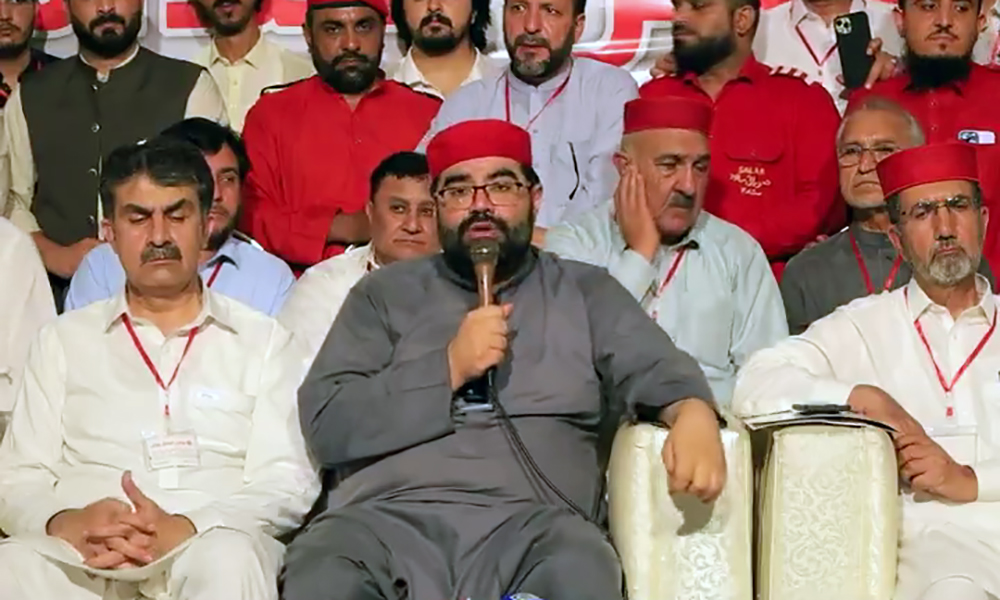
Pakistani Kashmir faces shutdown as protests leave more than 20 dead

Regional police chief Liaqat Ali Malik said four officers had been killed and 97 ​wounded in clashes with protesters, while 515 people had been detained.

Published

on

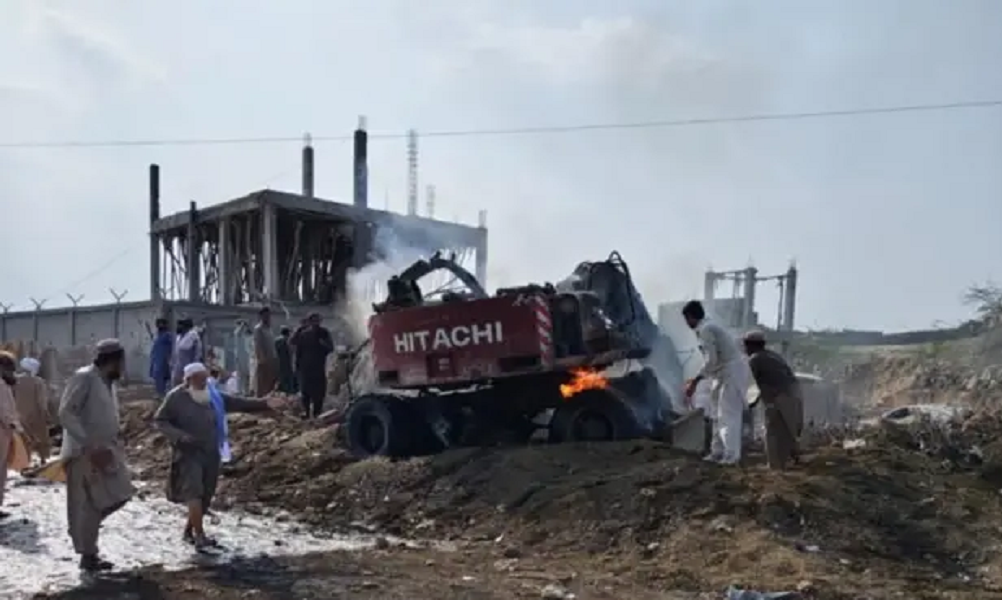
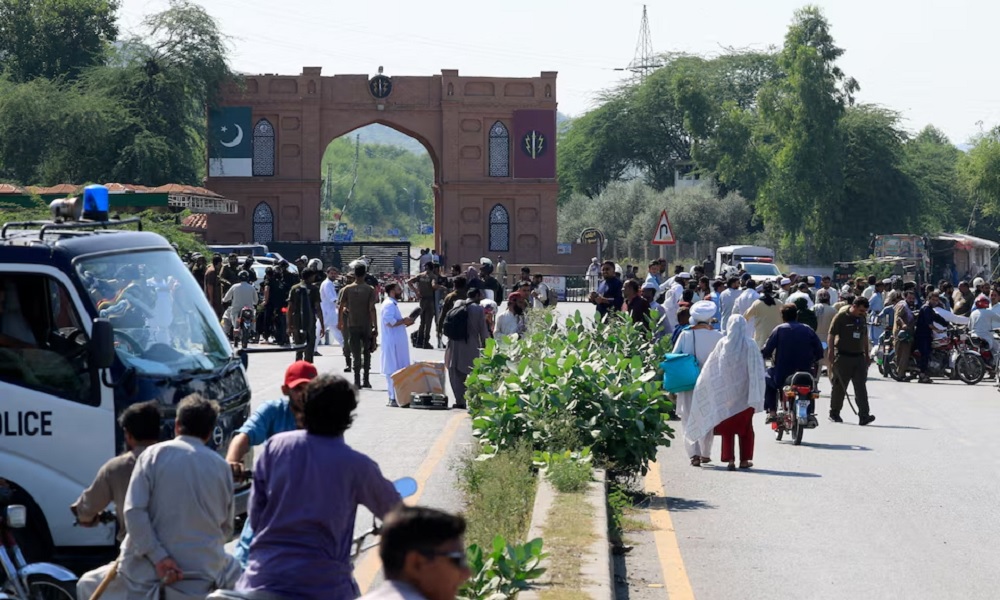
A territory-wide shutdown in Pakistan-administered Kashmir has brought daily life to a standstill after the region’s deadliest unrest in years left at least 24 people ​dead in nearly two weeks of protests, Reuters reported.

The confrontation between local authorities and ‌supporters of the recently banned Joint Awami Action Committee, or JAAC, poses a sensitive challenge for Islamabad, which frequently criticises Delhi’s handling of dissent in Indian-administered Kashmir but is now facing anger in the territory under ​its own control.

The unrest began ahead of a June 9 strike called by ​the JAAC in protest against the reservation of 12 seats for refugees in ⁠the July 27 elections to the region’s 45-seat legislative assembly. The refugees live in Pakistan after ​being displaced from Indian-administered Kashmir.

Protests had already grown in the days before the shutdown, with ​government officials, speaking on condition of anonymity, saying at least 20 civilians were killed between June 6 and June 14 and dozens more wounded.

Regional police chief Liaqat Ali Malik said four officers had been killed and 97 ​wounded in clashes with protesters, while 515 people had been detained.

Thousands of JAAC supporters are ​now camped out on the outskirts of Rawalakot, about 100 km (62 miles) south of Muzaffarabad, the regional capital.

The government ‌has ⁠responded by shutting main roads, blocking the internet and restricting media access to much of Kashmir.

In Muzaffarabad’s Upper Adda commercial district, menial labourers sit idle beneath a red-brick monument, waiting for work that has not come.

“Since June 9, I have not ​earned a single rupee,” ​said day labourer Ikhlaq ⁠Ahmed, 27, from a remote village.

The usually busy Upper Adda, once filled with grocers by day and food stalls by night, is ​mostly silent.

Medical stores and some grocers have begun opening for limited ​hours, and fruit ⁠and vegetable sellers have cautiously returned, but other businesses remain closed, read the report.

Bank notices blame the government’s suspension of internet and satellite services for the closure of ATMs and banking operations, while petrol stations are also ⁠shut due ​to an official order.

For workers like motorcycle taxi driver ​Asif Naz, the crisis is unbearable.

“Those with resources may sustain it,” he said, “but for blue-collar workers like us, ​it is self-slaughter.”

Continue Reading

Regional

US and Iran presidents sign ceasefire agreement, but Trump says he could still resume attacks

The 14-point agreement extends a ceasefire announced in April by another 60 days, including in Lebanon, to allow the two sides to negotiate a final truce.

Published

on

The U.S. and Iran released the text of an interim agreement their presidents have signed to end their war on Wednesday, with U.S. President Donald Trump threatening to resume attacks and kill Iranian officials if they failed to honour their ​commitments, Reuters reported.

Trump, attending the G7 with other leaders in France, also withdrew at least one of his stated rationales for attacking Iran in the first place, saying it would be “unfair” for Tehran not to have ballistic missiles, having previously ‌vowed to obliterate them.

“We’re going to bomb the hell out of them if they violate the agreement,” Trump said of Iran at a press conference. “I don’t want them to. I want them to honor the agreement.” He also called Iranians “smart people” as U.S. and Iranian negotiators work on a permanent truce over the coming 60 days, which Trump said he hoped would usher in peace in the Middle East and lower oil prices.

Earlier, he had said: “If I don’t like it, if they don’t behave, we’ll go right back to dropping bombs right smack in the middle of their head, OK?”

Iran’s leaders did not address the new threats while celebrating the ​moment, releasing photographs of what is believed to be the first agreement signed by both a U.S. and Iranian president since the Islamic Republic’s founding in 1979.

“Everything we sought to achieve through military action, we obtained several times over through negotiation; it ​was not even comparable,” Iran’s lead negotiator Mohammad Baqer Qalibaf told state television about the agreement, which includes the unfreezing of billions of dollars in Iranian assets.

The U.S. and Israel launched the war on Iran ⁠on February 28, assassinating the 86-year-old Supreme Leader Ayatollah Ali Khamenei and military leaders on the first day. It quickly spiralled into a regional conflict that has killed more than 7,000 people, mostly in Iran and Lebanon; driven up energy prices; renewed inflationary pressures and sparked concerns about a ​major food supply crisis in developing countries.

The 14-point agreement extends a ceasefire announced in April by another 60 days, including in Lebanon, to allow the two sides to negotiate a final truce. Both Trump and Iranian President Masoud Pezeshkian have digitally signed the memorandum in English and Farsi, U.S. and Iran ​officials said, with Iran’s foreign ministry saying the agreement was already in effect as of Wednesday, read the report.

Trump signed just before a grand dinner with French President Emmanuel Macron at the Palace of Versailles, the site of the signing of the eponymous treaty that formally ended World War One.

The memorandum includes an immediate end to the war on all fronts, including Lebanon, the full resumption of maritime traffic “with no charge” in the Strait of Hormuz, the lifting of a U.S. blockade of Iranian ports, the waiving of U.S. sanctions on Iran, the unfreezing of its assets, and a $300 billion investment fund for the Islamic Republic’s post-war reconstruction.

Oil ​prices fell again on Wednesday on prospects for the reopening of the Hormuz, the slender, vital waterway between Iran and Oman, with Brent crude futures below $80, at their lowest level since the war’s start. They later regained more than 1% after Trump threatened renewed violence.

Iran also undertakes not to ​build nuclear weapons, reaffirming a vow it had made for decades. It also agreed to the on-site “down-blending” of its stockpile of enriched uranium under the supervision of the International Atomic Energy Agency, although Trump had wanted to take it out of the country, which Iran has rejected.

Despite his combative rhetoric, Trump appears ‌to have achieved ⁠little of what he said he wanted in going to war, while Iran appears much closer to sanctions relief worth billions of dollars than before it was attacked.

Iran’s theocratic government remains in place, its stockpile of highly enriched uranium has not been surrendered, its ballistic missile capabilities have not been destroyed and it has not ended its support for anti-Israel militias like Hezbollah in Lebanon.

Trump recanted his February promise to destroy all of Iran’s missiles and “raze their missile industry to the ground.”

“I’m saying that if other countries have them, it’s a little bit unfair for them not to have some,” Trump told reporters in Paris after leaving the summit.

G7 leaders hailed the agreement at their summit, held in the French town of Evian-les-Bains, an hour’s drive along the shore of Lake Geneva from where the U.S. has said a formal signing ceremony for the ​U.S.-Iran agreement was due to be held across the Swiss border on ​Friday, Reuters reported.

But Iranian foreign ministry spokesperson Esmaeil Baghaei cast doubt on ⁠this, telling IRIB’s News Network that, because the two presidents had already signed, “No signing ceremony will be held in Switzerland.”

European leaders share U.S. concerns about Iran’s nuclear program, but never endorsed his decision to go to war without United Nations authorization, and worry Iran has gained leverage by withstanding the superpower onslaught and asserting control over the strait.

The leaders of France, Germany, Britain, Japan, Italy, Canada and the U.S. demanded in ​a joint statement an immediate ceasefire in Lebanon, where the memorandum calls for a halt to hostilities between Israel and the Iran-backed Hezbollah group that have killed thousands of people and displaced more ​than a million more.

Fighting there has abated ⁠but not ceased since the agreement was reached on Sunday, and Israel, which was not part of the negotiations and whose military is occupying southern Lebanon, says it retains the right to use force.

Trump on Wednesday gently rebuked Israeli Prime Minister Benjamin Netanyahu, who has distanced Israel from the U.S.-Iran agreement, over his tactics in Lebanon against Hezbollah. The two men have repeatedly clashed over Israel’s refusal to constrain its pursuit of Hezbollah in Lebanon, where a cessation of hostilities is a key Iranian demand, read the report.

“Netanyahu happens to be a good man, gets a little excited sometimes,” Trump told reporters. “We have ⁠a little dispute ​over Lebanon. I say you can do a little softer touch, Bibi,” he said, using Netanyahu’s nickname. “You don’t have to knock down a building every time somebody walks ​into it that’s from Hezbollah.”

Lebanese state media reported fresh Israeli air strikes and artillery fire in several southern towns throughout Wednesday. Lebanese security sources said Hezbollah had also launched two drone attacks on Israeli forces in the south. The group did not publicly claim the attacks.

Israel later said five of its soldiers had been injured in two Hezbollah ​drone attacks in southern Lebanon.

Continue Reading

Trending

Copyright © 2025 Ariana News. All rights reserved!