
World
Biden says Netanyahu not doing enough to secure hostage deal
Netanyahu, who has accused Hamas of obstructing any agreement, said over the weekend that “whoever murders hostages does not want a deal.”

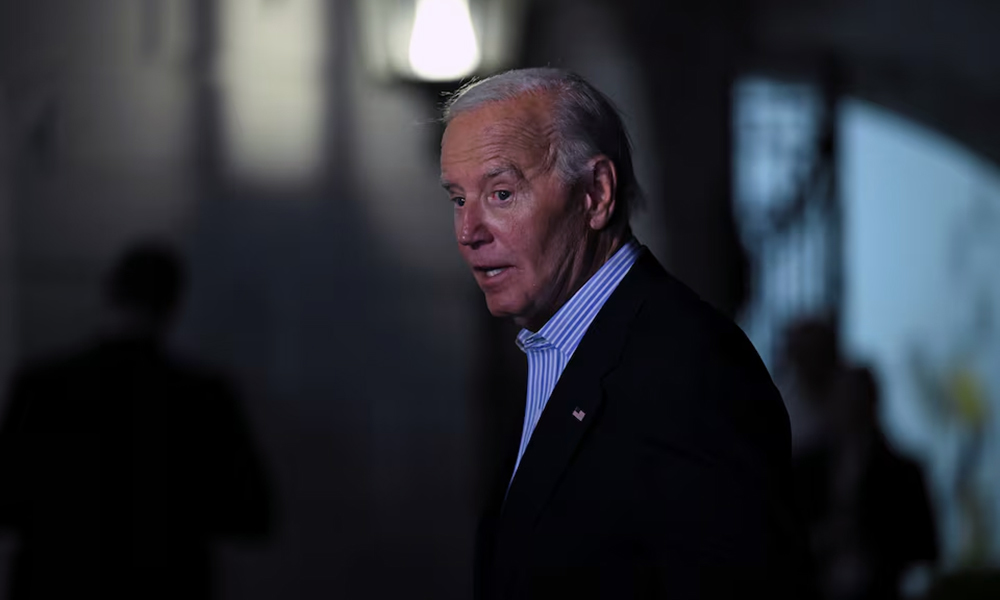
President Joe Biden said on Monday that Israeli Prime Minister Benjamin Netanyahu was not doing enough to secure a deal for the release of hostages held in Gaza by Hamas and the U.S. was close to presenting a final proposal to negotiators working on a hostage and ceasefire agreement.
Biden was speaking to reporters at the White House after Israeli forces over the weekend recovered the bodies of six hostages, including 23-year-old American-Israeli Hersh Goldberg-Polin, from a tunnel in Gaza. Israel’s military said they had been recently killed by Palestinian Hamas militants.
That has sparked criticism of the Biden administration’s Gaza ceasefire strategy and ratcheted up pressure on Netanyahu from Israelis to bring the remaining hostages home.
Asked whether he thought Netanyahu was doing enough to reach a hostage deal, Biden said “No.” He did not elaborate on his remarks.
Netanyahu appeared to push back when asked about Biden’s comments, saying pressure should be applied to Hamas, not Israel, particularly after the hostages’ deaths.
“And now after this we’re asked to show seriousness? We’re asked to make concessions? What message does this send Hamas? It says, kill more hostages,” he told a news conference in Jerusalem.
Netanyahu said he did not believe Biden or anyone serious about achieving peace would ask Israel to make more concessions and that instead it was Hamas that needed to do so.
Asked if he was planning to present a final hostage deal to both sides this week, Biden told reporters: “We’re very close to that.”
“Hope springs eternal,” he added when asked whether a deal would be successful.
Biden said later in the evening that he plans to talk to Netanyahu “eventually” but did not specify a clear timeline when asked. Biden and Netanyahu have spoken several times amid Israel’s war in Gaza.
Biden and Vice President Kamala Harris also met with the U.S. hostage negotiation team, during which the president expressed “devastation and outrage” at the hostages’ murders, and they discussed the next steps in efforts to free the remaining captives, the White House said.
Biden’s fresh criticism of Netanyahu comes as he and Harris, who has replaced the president at the top of the Democratic ticket for the Nov. 5 election, face increased calls for decisive action to end Israel’s nearly 11-month-old war in Gaza.
The conflict has sown divisions among Democrats, with many progressives pressing Biden to restrict or at least place conditions on U.S. weapon supplies to Israel, Washington’s chief Middle East ally.
Senior Israeli sources said it was “remarkable” that Biden was pressuring Netanyahu over a hostage deal rather than Hamas leader Yahya Sinwar.
In response to the Israeli comment, a U.S. official said that while Biden had been clear that Hamas was to blame for the hostages’ deaths, “he is also calling for urgency from the Israeli government in securing the release of the missing remaining hostages.”
Senior Hamas official Sami Abu Zuhri said Biden’s criticism of Netanyahu was “American recognition that Netanyahu was responsible for undermining efforts to reach a deal.”
He said the group would respond positively to a proposal that could secure a permanent ceasefire and full Israeli withdrawal from the Palestinian enclave.
Netanyahu, who has accused Hamas of obstructing any agreement, said over the weekend that “whoever murders hostages does not want a deal.”
Israeli protesters took to the streets on Monday for a second day, and the largest trade union launched a general strike to press the government to reach a deal to return the hostages. Thousands of pro-Palestinian activists opposing U.S. support for Israel held a protest in New York City on Monday.
Months of stop-start negotiations mediated by the U.S., Qatar and Egypt have so far failed to reach an accord on a Gaza proposal laid out by Biden in May.
The latest bloodshed in the decades-old Israeli-Palestinian conflict was triggered on Oct. 7 when Hamas attacked Israel, killing 1,200 and taking about 250 hostages, according to Israeli tallies.
Israel’s subsequent assault on the Hamas-governed enclave has since killed over 40,000 Palestinians, according to the local health ministry, while also displacing nearly the entire population of 2.3 million, causing a hunger crisis and leading to genocide allegations at the World Court that Israel denies.


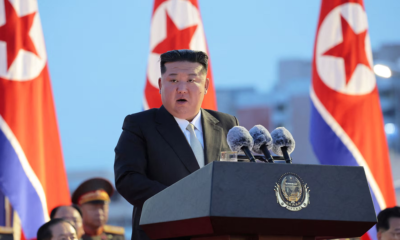

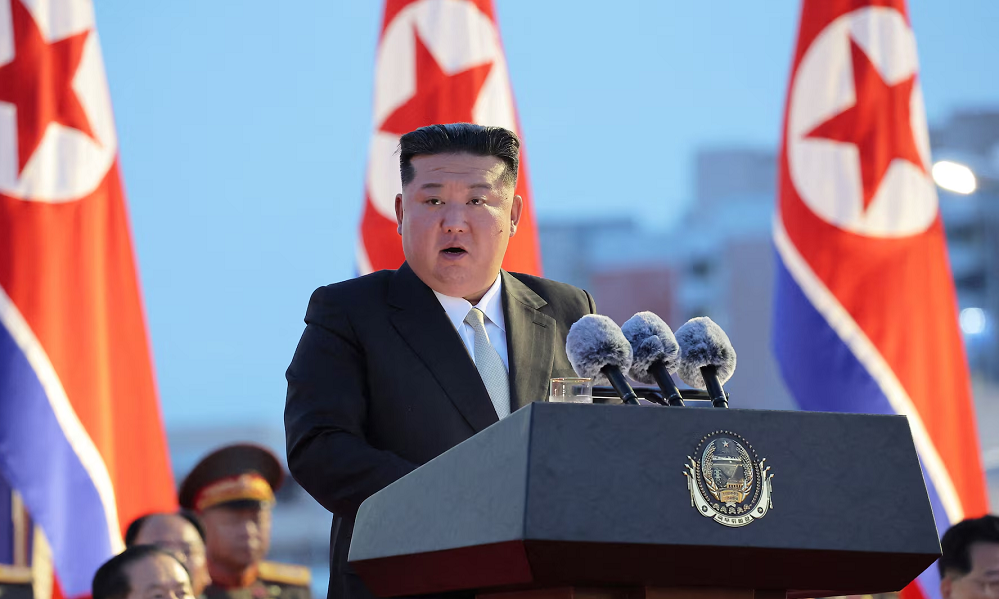
North Korean leader Kim Jong Un said exercising the country’s position as a nuclear state is the only way to cope with an unpredictable and complicated global security situation, KCNA state news agency reported on Tuesday.
“Unimaginable, astonishing incidents and events” are occurring because of the “gangster-like” greed of hegemonic forces, making confrontations around the world more violent, Kim said, blaming the U.S. for worsening bloodshed in Europe and the Middle East, Reuters reported.
He was speaking at a Central Committee meeting of the ruling Workers’ Party, running from Saturday to Monday, KCNA said.
Kim accused the U.S. and South Korea of making the security situation on the Korean Peninsula more dangerous by steadily upgrading their combined nuclear posture, the only purpose of which, he said, is to attack North Korea.
“To steadily expand and strengthen the nuclear forces … and to thoroughly exercise the position of a nuclear weapons state is the most correct and unique way to actively and confidently cope with the unpredictable international military and political situation getting complicated in multiple ways,” KCNA said.
KCNA did not elaborate on specific actions regarding the country’s nuclear arsenal that might be taken.
Kim also ordered the buildup of conventional weapons and accelerated construction of a 10,000-ton strategic guided missile cruiser, KCNA said.
Yang Moo-jin, a professor at the University of North Korean Studies in Seoul, said the comments underscore Pyongyang’s continued rejection of denuclearisation and push for recognition as a nuclear state.
“North Korea is once again reaffirming that denuclearisation talks are off the table,” Yang said, adding it would only engage in negotiations “as a nuclear weapons state on an equal footing,” potentially focusing on arms reduction rather than dismantlement.
Such talks would imply acceptance of a minimum deterrent and require sanctions relief, he said, fundamentally differing from phased denuclearisation proposals, such as those raised by South Korean President Lee Jae Myung to U.S. President Donald Trump at the G7.
Yang said that references in the party meeting to the U.S.-South Korea Nuclear Consultative Group, a body aimed at deterring North Korea’s nuclear threat, and Seoul’s ambitions to develop a nuclear-powered submarine were being used by Pyongyang to justify its nuclear buildup.
North Korea has defied a slew of sanctions imposed by both the United Nations and the U.S. between 2006 and 2017 banning Pyongyang from developing nuclear weapons and ballistic missiles to deliver them. Its stance has alarmed regional powers.
It has declared itself a nuclear state and has said nothing would convince it to abandon its atomic weapons, despite years of diplomatic efforts by the U.S., China and South Korea.
The party meeting also highlighted a push to modernise the coal industry and redevelop mining communities, which Kim described as a strategic priority.
“Coal effectively remains North Korea’s main energy resource,” Yang said, noting plans to upgrade the industry aimed at easing chronic energy shortages.
World
UK’s Starmer says he will resign
Less than two years after he won a landslide election victory that promised to end chaos in British politics, Starmer said it was clear that his party wanted him to go.
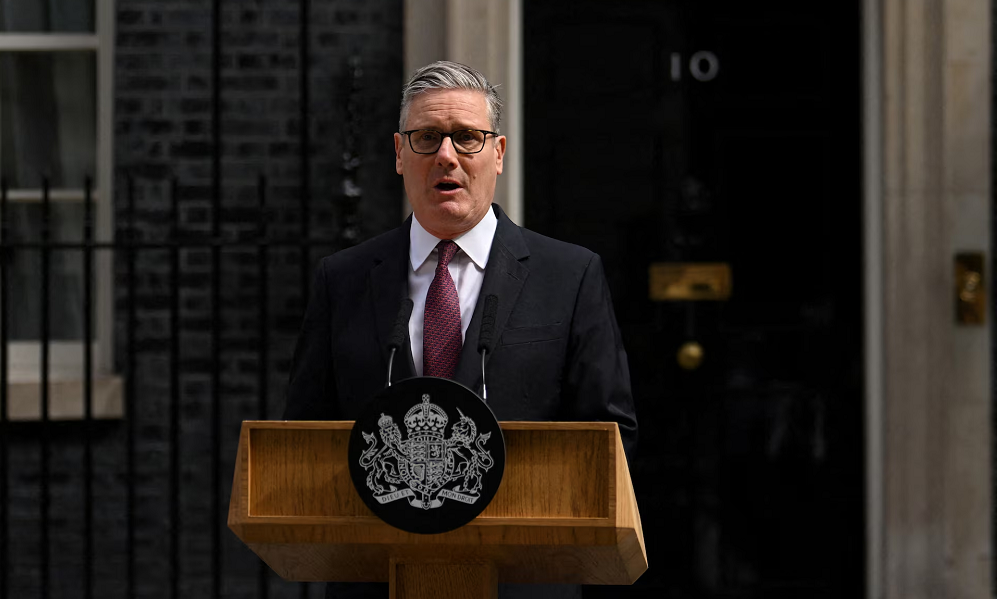
Prime Minister Keir Starmer said on Monday he would resign, with a new leader to be in place by the time parliament returns in September, paving the way for Britain to have its seventh leader in 10 years.
Less than two years after he won a landslide election victory that promised to end chaos in British politics, Starmer said it was clear that his party wanted him to go, Reuters reported.
“The question my party is asking now is whether I am best placed to lead us into the next general election, I have heard the answer of my parliamentary party to that question, and I accept that answer with good grace,” he said.
PRESSURE HAD BEEN BUILDING FOR MONTHS
The threat to Starmer, which had been building for months, increased sharply on Friday when Burnham, the Greater Manchester mayor, decisively won a parliamentary election to return to Westminster, beating a candidate from Nigel Farage’s Reform UK party, which has led national opinion polls for more than a year.
That victory gave hope to Labour lawmakers that Burnham, a career politician known for his communication skills, could transform the fortunes of a party that has lost support under Starmer, whose popularity ratings have sunk to the lowest for any British leader.
Starmer thanked his colleagues for their support, his voice cracking with emotion as he also paid tribute to his wife and children.
The pound and British government bonds were steady in the immediate aftermath of Starmer’s announcement, which investors had widely expected.
Despite the attempt at a smooth handover, the change is not without risk.
Beyond saying that the country needs fundamental change and to bring down the cost of living, Burnham has yet to make clear his approach to foreign affairs, the economy and defence.
Like Starmer, he could find he has little room to manoeuvre, hemmed in by bond market investors opposed to any additional borrowing, and confronted by an angry electorate which believes the country is not working properly.
Britain already has the highest borrowing costs in the Group of Seven wealthy nations due to its high debt and interest payments, years of anaemic economic growth, its struggles to cut spending and the need to invest in areas like defence.
Investors spoken to by Reuters were divided over whether Burnham, who said last September that Britain had to get “beyond this thing of being in hock to the bond markets” would respect the need to reassure markets.
He has since said he was misrepresented.
“In our view, a Burnham premiership would inherit a precarious fiscal situation with few tools to deliver meaningful change,” economists at Citibank said on Friday.
STARMER HAD PLEDGED TO FIGHT ANY CHALLENGE
Starmer had said on Friday he would stand in any formal Labour leadership contest that sought to replace him. But that appeared to change over the weekend.
Whoever replaces Starmer will become Britain’s seventh prime minister since the Brexit vote to leave the European Union which took place 10 years ago this week.
That level of turnover – the highest in Britain in nearly two centuries – underlines the struggle of maintaining the support of voters angry at successive failures to improve living standards, public services and tackle illegal immigration.
The political advisory group Eurasia had said the best outcome could be for Starmer to say he will step down in September, enabling him to attend a UK-European Union reset summit in July and give Burnham time to prepare for government.
World
Trump envoy, Iranian minister head to Switzerland for talks
The development may signal that both sides intend to begin technical negotiations aimed at securing a permanent truce.
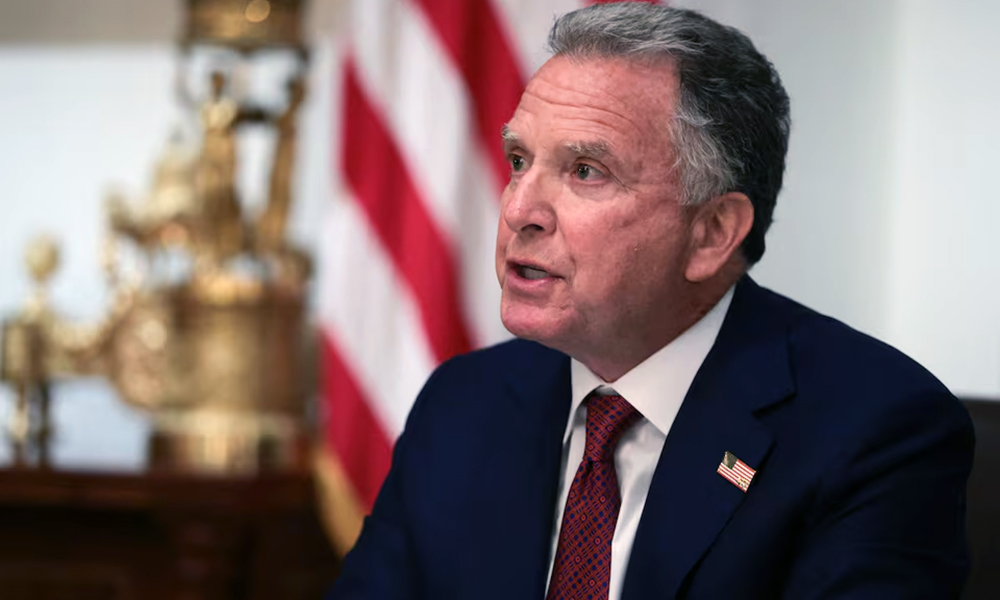
US envoy Steve Witkoff and Iranian Foreign Minister Abbas Araqchi were both headed to Switzerland for talks, Axios said on Friday, as a ceasefire in Lebanon appeared to revive efforts to turn an interim Iran war pact into a lasting regional deal, Reuters reported.
Israel and Hezbollah agreed to a ceasefire in Lebanon on Friday after escalating fighting cast doubt over U.S.-Iran talks critical to reopening the Strait of Hormuz and stabilising oil supplies.
That followed a 14-point memorandum the two sides signed this week to halt fighting and open a 60-day window to resolve disputes over Iran’s nuclear program, as well as other thorny issues needed to forge a more durable deal.
U.S. Vice President JD Vance canceled plans on Thursday to travel to Switzerland for the talks, however, amid rising tension in Lebanon between Israel and Hezbollah, a militant group backed by Iran.
With the ceasefire in place, Witkoff is heading to Switzerland to join Jared Kushner, President Donald Trump’s son-in-law, who is already there, Axios said. Araqchi plans to travel there on Saturday, it added.
The development may signal that both sides intend to begin technical negotiations aimed at securing a permanent truce.
The White House did not respond to questions about Witkoff’s travel.
A senior U.S. official said the ceasefire took effect around 4 p.m. (1300 GMT) in Lebanon following an exchange of fire, adding that negotiators for the United States and Qatar had worked out the agreement with help from Iran, read the report.
Two sources from Hezbollah and a senior Israeli official confirmed the ceasefire to Reuters.
“If Hezbollah does not attack us, then for us it is not a time of war,” the Israeli official said, adding that Israel would keep its forces in southern Lebanon, where it has occupied an area along its northern border.
Two Lebanese security sources said Israel had carried out a dozen airstrikes in the first hour of the ceasefire but none were recorded after 5 p.m.
Lebanon’s health ministry said Israeli strikes after midnight into Friday had killed 47 people and wounded 97, while the Israeli military said four soldiers had been killed in an incident in Lebanon, without giving further details.
The conflict in Lebanon could weigh on negotiations because ending fighting there is a condition for the broader U.S.-Iran accord.
Following Wednesday’s signing of the memorandum of understanding, preparations for technical talks at the Swiss mountaintop resort of Buergenstock were well advanced when the White House said on Thursday that Vance would not attend.
The Swiss foreign ministry said the talks had been postponed but Switzerland stood ready to facilitate them and preparatory work was continuing.
The broad interim deal requires the United States, Iran and their allies to declare an immediate and permanent termination of military operations on all fronts, including in Lebanon.
Israel, left out of the talks, says it is not party to the deal.
Araqchi, in a telephone call with his Pakistani counterpart on Friday, said the United States would be responsible for any violation of its commitments under the deal, including ending the fighting in Lebanon, his ministry said.
Lebanon was sucked into the regional war when Hezbollah opened fire at Israel on March 2, prompting it to launch an offensive against the group and invade the south of the country.
Lebanese President Joseph Aoun condemned the latest Israeli attacks but said the escalation would not hinder efforts to reach a comprehensive ceasefire.
The U.S. State Department said Secretary of State Marco Rubio spoke to Aoun and reiterated the need to disarm Hezbollah, while reaffirming U.S. support for a “fully sovereign” Lebanese state.
It said they also discussed holding a next round of Israel-Lebanon negotiations in Washington from June 23 to June 25. The Lebanese presidency said a comprehensive ceasefire was a fundamental pillar for these talks.
The Iran war, which began on February 28 with U.S. and Israeli air attacks on Iran, has killed at least 7,000 people, mostly in Iran and Lebanon. It also pushed up energy prices, stoking inflation worldwide.
Brent crude ticked higher on Friday, but was set for a weekly fall of about 8% after the Lebanon ceasefire, and oil shipments through the Strait of Hormuz picked up after the signing of this week’s deal.
The strait carried nearly a fifth of global crude oil and liquefied natural gas supplies before it was blockaded by Iran during the war.
The body set up by Iran to manage the strait said on Friday it would waive planned fees during the interim deal’s negotiation period.
The MoU foresees relief for Iran from economic sanctions, the unfreezing of assets worth tens of billions of dollars and immediate U.S. waivers for its exports of oil. It also provides for a $300-billion reconstruction fund for Iran and other financial incentives.
Trump again defended the deal after criticism in Washington, including some from Republican allies in Congress who question whether he conceded too much to end a war unpopular with most Americans ahead of midterm elections in November.
“The War has diminished Iran!” he wrote on social media on Friday, adding, “We didn’t meet out of desperation, Iran did. They are FINISHED! We’ll play out the 60 days. They get no money, not 10 cents!”


Messi breaks World Cup scoring record as Argentina reach knockout stage

UN warns life becoming ‘impossible’ in remote areas of Afghanistan as aid funding falls short

Afghanistan expresses condolences over deadly gas facility blast in Qatar

North Korea’s Kim says country will exercise its position as nuclear state, KCNA reports

Qatar embassy holds roundtable on Afghanistan’s relations with international community

Norway’s Viking-inspired World Cup team photo goes viral

Afghanistan announce squad for India series

Afghanistan, Russia sign military cooperation agreement

Major pharma firms eye investment in Afghanistan

Afghanistan expands oil production as investment in Amu Darya fields grows

Tahawol: Iran-US talks make encouraging progress

Saar: Astana’s New Era of Engagement with Kabul

Saar: Iran vs US Talks Begin – Will Tensions Ease?

Tahawol: Discussion on reopening of Strait of Hormuz

Saar: Afghanistan-Pakistan tense relations disucssed
-
 Business5 days ago
Afghanistan signs $67 million contract for cement production in Samangan
-
 Saar5 days ago
Saar: Trump’s remarks on US military equipment in Afghanistan discussed
-
 Latest News4 days ago
Khalilzad calls for Afghanistan-Pakistan dialogue after airstrikes
-
 Latest News1 day ago
Pakistani truckers return home after 9 months stranded in Afghanistan
-
 Latest News4 days ago
Afghanistan moves to tackle housing shortage with new projects in Kabul
-
 Latest News4 days ago
IEA says Afghan air forces strike ISIS-K targets inside Pakistan
-

 Latest News2 days ago
Turkish report uncovers ISIS-K media unit in Pakistan’s Balochistan
-

 International Sports2 days ago
FIFA Fan Festival tops 2 million visitors so far during World Cup 2026