
Latest News
Khalilzad responds to McCaul’s draft resolution, says Doha agreement claim is ‘flatly untrue’
Khalilzad said the draft resolution states he “baselessly asserted the Taliban would honor their commitments and respect basic human rights.”


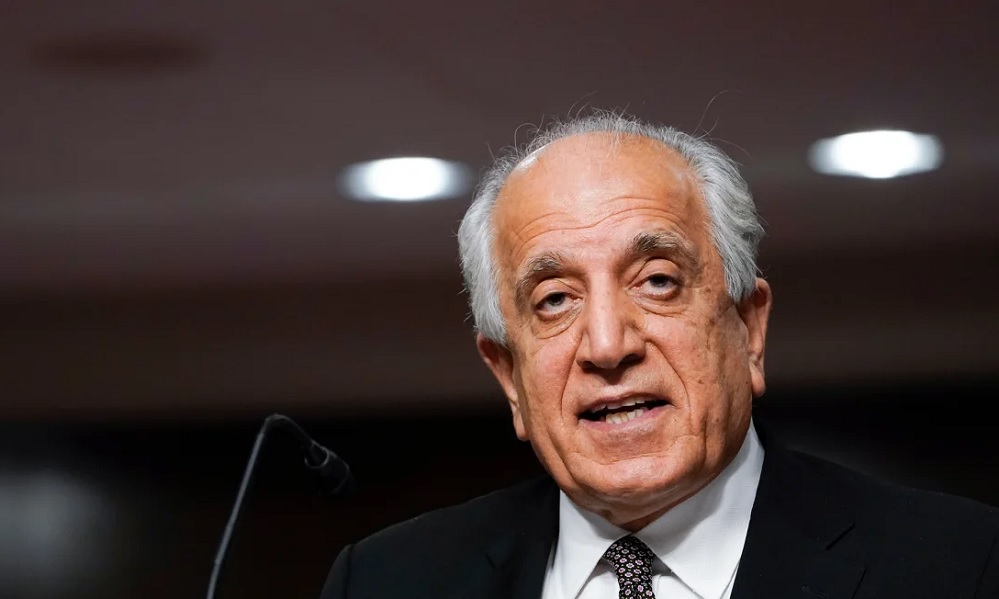
Former US special envoy for Afghanistan, Zalmay Khalilzad said in a post on X early Thursday that a claim in House Foreign Affairs Chairman Michael McCaul’s draft resolution on him having said he “baselessly asserted the Taliban (IEA) would honor commitments” was untrue.
Khalilzad said the draft resolution states he “baselessly asserted the Taliban would honor their commitments and respect basic human rights.”
“This statement is flatly untrue. I never made such a statement. I am surprised that such a claim would be made without documentation – ‘baselessly,’ so to speak,” he said.
On Wednesday, House Republicans voted to censure President Joe Biden and Vice President Kamala Harris for the disastrous U.S. withdrawal from Afghanistan, capping their work in Washington with legislation that carried no legal weight but drove a political point ahead of the November elections.
The resolution condemned Biden, Harris and other officials in the administration for “decision-making and execution failures throughout the withdrawal from Afghanistan” and blamed them for the deaths of 13 U.S. service members who were killed by a suicide bomber at Kabul’s airport during the final days of the evacuation.
With regards to the Doha agreement, the resolution stated: “Whereas, in 2021, under the Biden-Harris administration, Special Representative for Afghanistan Reconciliation, Zalmay Khalilzad, baselessly asserted the Taliban would honor their commitments and respect basic human rights.”
Khalilzad responded by saying in his post on X: “The Doha Agreement that I helped negotiate under President Trump did not deal with human rights.
“It dealt with the terms for the safe military withdrawal including no attacks on US forces, and not allowing terrorists, individuals or groups, including al-Qaida, to use Afghanistan soil to threaten the security of the United States and our allies.
“The Taliban (IEA) had agreed that a new government for Afghanistan – and presumably its human right policies – would subsequently and separately be negotiated between them, the (former) Afghan government, and other Afghans.
“Some such negotiations took place, but no agreements were arrived at before the completion of our withdrawal,” Khalilzad said.
He went on to state that Biden decided not to condition the US withdrawal on a political agreement among Afghans, fearing a return to Islamic Emirate attacks against US forces if Intra-Afghan negotiations dragged on.
“Aside from adding four months to the withdrawal timeline, the Biden Administration did not make any other changes in the Doha Agreement,” he said.
“In addition to not having made any statement about the Taliban (IEA) honoring commitments on human rights, in my appearances before various congressional committees, whenever asked whether I trusted the Taliban (IEA) to honor their commitments in regard to military matters and terrorism, my reply invariably was that we were talking about international relations, an arena in which no one can be trusted, and least of all the Taliban (IEA).
“I emphasized that it was not about trust. The agreement as negotiated was condition-based, not trust-based, and delivering on our commitments in the agreement was linked to the Taliban’s (IEA) delivery on its commitments, which would need to be continuously evaluated and verified.
“I did report that the Taliban (IEA) were – up to the time of my appearances – honoring their commitment not to attack US forces and needed to do more to meet their obligation on terrorism.
“Indeed, several elements of the agreement remain unfulfilled by us because the Taliban (IEA) have not fulfilled some of their commitments,” he said.
Khalilzad concluded by saying: “Undeniably, the final phase of the withdrawal was a disaster.
“The main reasons for this were a.) poor intelligence (we did not foresee that the Afghan government would simply collapse before we had even departed or that its military would essentially dissolve and b.) our own inadequate military planning and execution in light of those unexpected developments.
“Our soldiers performed heroically under the circumstances, which had devolved into chaos in and around Kabul Airport,” he said.







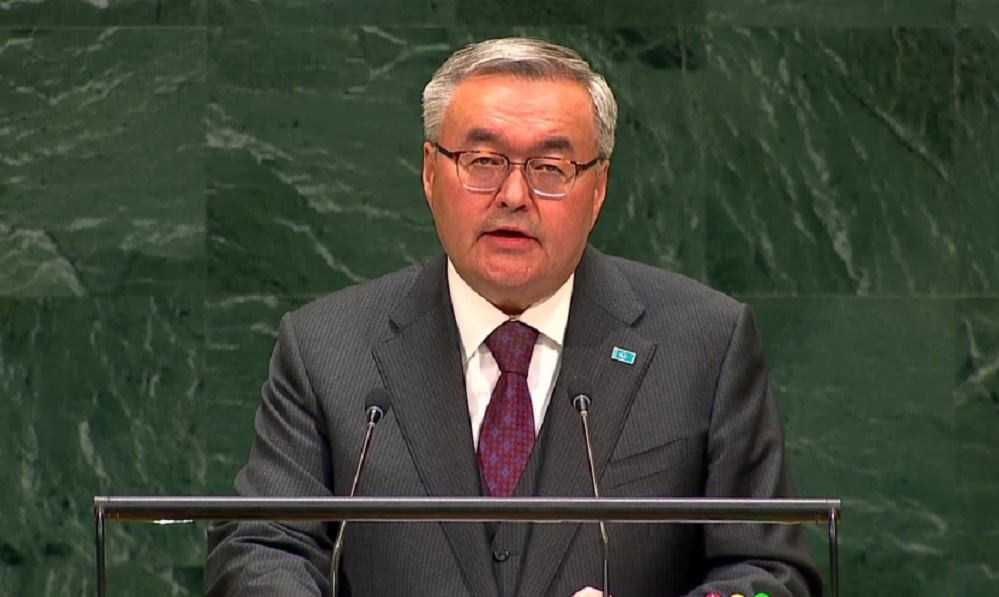
Kazakhstan’s Foreign Minister Mukhtar Tileuberdi has called for pragmatic and coordinated international engagement with Afghanistan, saying the country’s long-term stability is closely linked to the security and sustainable development of Central Asia.
Speaking during the general debate of the 81st session of the United Nations General Assembly in New York on Friday, Tileuberdi said humanitarian assistance to Afghanistan remains essential but alone cannot break the cycle of poverty, displacement and dependency.
He said Kazakhstan supports a “pragmatic, coordinated and step-by-step” approach to international engagement with Afghanistan, with the United Nations playing a central role.
Tileuberdi also said Kazakhstan is working with the UN to operationalize the United Nations Regional Centre for the Sustainable Development Goals for Central Asia and Afghanistan in Almaty.
He said the success of the centre should be measured by the results and assistance it delivers to the region.


Abu Muslim Farah defeat Khurasan Faryab 2-0 in ACL season six

Saar: Concerns over Pakistan’s political crisis discussed

Afghanistan Champions League: Omar Zawak Herat beat Toofan Herat 1-0

Blast in Pakistan’s Dera Ismail Khan kills 11, injures 30

Ariana Afghan Airlines increases Kabul-Delhi cargo flights

Saudi energy group signs major Afghanistan deals covering gas exploration and pipeline plans

Trump floats idea of renaming Atlantic or Pacific Ocean

US hits Egyptian bank branches with Iran sanctions as war marks six months

Nepal flood rescue mission enters critical phase as thousands remain missing

Iranian clubs to face Gulf opponents at neutral venues in Asian Champions League Elite
Saar: Concerns over Pakistan’s political crisis discussed

Exclusive interview with Abdul Latif Mansoor, Minister of MRRD

Tawsia: Overview of Afghanistan’s iron mines

Tahawol: Discussion on fresh Pakistani airstrikes on Afghanistan

Saar: Calls for international support for Afghanistan discussed
-

 World5 days ago
CNN, MS NOW and Politico sue Trump, challenging White House ban
-

 Latest News4 days ago
Ariana Afghan Airlines ranks seventh among 45 Central Asian airlines
-

 Latest News5 days ago
UN reiterates call for respect for international law after Kunar airstrikes
-

 Regional4 days ago
US and Iran hold first talks since June after Trump’s ‘annihilation’ threat
-

 Latest News4 days ago
Silk Road highway in Wakhan corridor now reaches the China border
-

 Regional3 days ago
Iran airlines cancel flights as US sanctions hit
-

 Latest News5 days ago
Afghan Official: Pakistan’s airstrikes will not go unanswered
-
 Regional5 days ago
G7 foreign ministers call on Iran to stop arming Houthis