
Latest News
Gazans bombarded by Israel have no hope and no escape

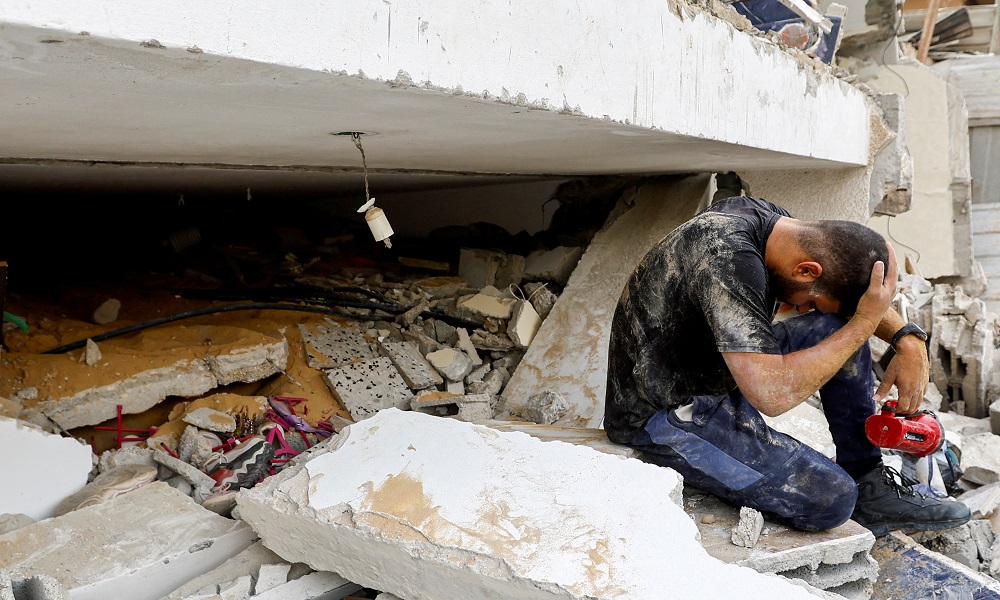
Most of the 2.3 million people in the Gaza Strip have no electricity and no water. And, with hundreds of Israeli strikes raining down on their tiny enclave, they have nowhere to run.
The Palestinian territory, one of the most crowded places on Earth, has been under siege since Saturday in a near-constant bombardment that Gazan health officials say has killed more than 1,000 people. The blitz is retaliation for a devastating attack on Israel by Gaza’s ruling group Hamas which the Israeli military says killed more than 1,200 people, Reuters reported.
Gaza’s sole power station, which had been working intermittently for days, cut out on Wednesday after running out of fuel. Without power, water can’t be pumped into houses. At night there’s nearly total darkness punctuated by fireballs and the pin-pricks of light from phones used as flashlights.
“I lived through all the wars and incursions in the past, but I have never witnessed anything worse than this war,” said Yamen Hamad, 35, a father-of-four, whose home had been destroyed by Israeli strikes on the northern Gaza town of Beit Hanoun.
At a hospital in Khan Younis in southern Gaza, relatives and friends lined up outside the overloaded morgue where bodies were laid out on the floor because coolers were full or had no power.
The mourners were desperate to bury their loved ones swiftly before the unseasonable heat took its toll. They spoke briefly over the bodies, praying for the souls to rest in peace, before they carried them to graves nearby, with stretchers if they were available, or otherwise without.
Reuters interviewed more than three dozen people in Gaza, and most echoed Hamad’s sentiments. They painted a picture of dread and hopelessness in the face of what they described as the worst violence they’d ever seen.
With the strip’s only other border, to Egypt, blocked by Egyptian authorities, the people said they were trapped. They feared the worst was yet to come, including a possible ground invasion, as Israel seeks retribution for the deadliest Palestinian militant attack in the country’s 75-year history.
That surprise raid, launched on Saturday, saw Hamas militants burst out of Gaza and kill hundreds of people, leaving corpses strewn around a music festival and a kibbutz community. Scores of Israelis and others have been taken to Gaza as hostages, some paraded through the streets.
The Hamas attack drew strong condemnation by the United States and other Western governments. The militant group’s 1988 founding charter called for Israel’s destruction, and the group is branded a terrorist organization by Israel, the United States, the European Union, Canada, Egypt and Japan.
Israeli Defence Minister Yoav Gallant has pledged to intensify the military campaign in Gaza, saying on Wednesday that Israel would wipe Hamas “off the face of the Earth”.
Beit Hanoun, near the frontier with Israel, was among the first places hit hard by retaliatory Israeli strikes, with many roads and buildings destroyed and thousands of displaced, according to Hamas and local residents.
There was no escape for Ala al-Kafarneh’s family.
The 31-year-old said he fled the town on Saturday with his pregnant wife, his father, brothers, cousins and in-laws. They drove to Beach Refugee Camp on the coast, where they hoped they would be safer, but air attacks began targeting that area too so they headed to Sheikh Radwan, another district deeper east.
On Tuesday night, an airstrike hit the building where Kafarneh and his family were sheltering, killing all of them except him, he added.
“We escaped from danger into death,” Kafarneh said outside the Shifa hospital in Gaza City, his head cut and a plaster cast running from his shoulder to his wrist. He was sitting on a pavement near hundreds of other people living in the open next to the hospital. Some said they hoped that its presence might offer them some protection from the bombardment.
“I’m homeless now,” said Youssef Dayer, 45, sitting on the ground by the hospital. “Maybe it’s safe. Maybe. It’s a peaceful civilian place, right? Maybe not. Nowhere seems safe,” he added.
Some people outside the hospital had brought blankets or strips of cardboard to sleep on, others had flung themselves straight down onto the bare ground. There were long queues for people to use the few toilets inside the hospital.
More than 175,000 Gazans have fled their homes since Saturday, according to the United Nations. Some aid agencies in Gaza say the conditions are the worst they can remember even after repeated conflicts and 16 years of an Israeli blockade since Hamas took power there in 2007 following a brief civil war with forces loyal to Palestinian President Mahmoud Abbas’ Fatah faction.
“The civilian loss this time … is unprecedented,” said Hisham Muhanna, spokesperson for the International Committee of the Red Cross in Gaza.
At another hospital, Medecins Sans Frontiers doctor Mohammad Abu Mughaseeb said medical supplies had been lacking for years. The intensified Israeli siege meant fast-dwindling stocks would run out in weeks, he said.
“If things continue like this for a few days the health system will collapse,” he said after sleeping at the hospital because his own home had been damaged in a blast.
The lack of electricity has cut off much of the enclave’s water supply. Men and boys stood near one of the few supplies in Khan Younis loading huge tanks onto three-wheeled rickshaws, carts they dragged by hand and a small wagon pulled by a horse.
The Gazan health ministry said hospitals and other medical facilities running on fuel generators were expected to run out of power in the next few days. The ministry said it feared that sewage treatment facilities would also come to a halt, leading to growing waste and disease across the territory.
Hamas, as the de facto government of the Gaza Strip, runs the police, hospitals, ambulance service, plus the civil emergency department.
U.N. schools have become the main places of shelter for Gazans who have fled their homes, with families crowded into classrooms, some sleeping on mattresses others on blankets.
At one school in Gaza City, the sound of blasts frightened the children, keeping them and their parents awake. Many people sat outside in the open, scared they’ll be buried by airstrikes that pancake concrete buildings.
In Khan Younis, an ambulance stood at the end of an alleyway with its siren blaring, a man sat inside cradling his young daughter, their eyes staring wide from faces covered in dust. “Don’t be scared, don’t be scared,” he whispered over and over.






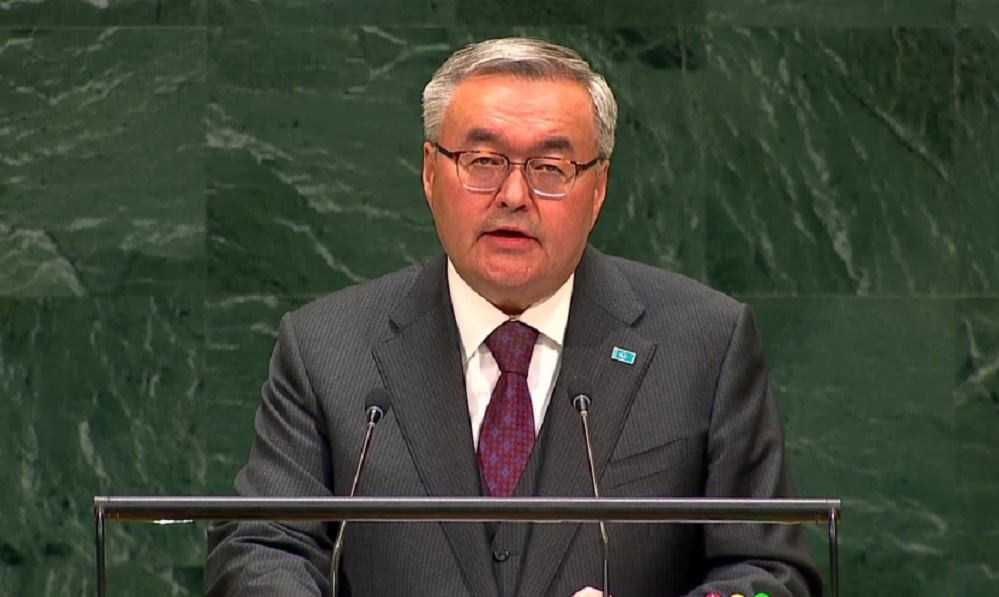
Kazakhstan’s Foreign Minister Mukhtar Tileuberdi has called for pragmatic and coordinated international engagement with Afghanistan, saying the country’s long-term stability is closely linked to the security and sustainable development of Central Asia.
Speaking during the general debate of the 81st session of the United Nations General Assembly in New York on Friday, Tileuberdi said humanitarian assistance to Afghanistan remains essential but alone cannot break the cycle of poverty, displacement and dependency.
He said Kazakhstan supports a “pragmatic, coordinated and step-by-step” approach to international engagement with Afghanistan, with the United Nations playing a central role.
Tileuberdi also said Kazakhstan is working with the UN to operationalize the United Nations Regional Centre for the Sustainable Development Goals for Central Asia and Afghanistan in Almaty.
He said the success of the centre should be measured by the results and assistance it delivers to the region.


Abu Muslim Farah defeat Khurasan Faryab 2-0 in ACL season six

Saar: Concerns over Pakistan’s political crisis discussed

Afghanistan Champions League: Omar Zawak Herat beat Toofan Herat 1-0

Blast in Pakistan’s Dera Ismail Khan kills 11, injures 30

Ariana Afghan Airlines increases Kabul-Delhi cargo flights

Saudi energy group signs major Afghanistan deals covering gas exploration and pipeline plans

Trump floats idea of renaming Atlantic or Pacific Ocean

US hits Egyptian bank branches with Iran sanctions as war marks six months

Nepal flood rescue mission enters critical phase as thousands remain missing

Iranian clubs to face Gulf opponents at neutral venues in Asian Champions League Elite
Saar: Concerns over Pakistan’s political crisis discussed

Exclusive interview with Abdul Latif Mansoor, Minister of MRRD

Tawsia: Overview of Afghanistan’s iron mines

Tahawol: Discussion on fresh Pakistani airstrikes on Afghanistan

Saar: Calls for international support for Afghanistan discussed
-

 World5 days ago
CNN, MS NOW and Politico sue Trump, challenging White House ban
-

 Latest News3 days ago
Ariana Afghan Airlines ranks seventh among 45 Central Asian airlines
-

 Latest News5 days ago
UN reiterates call for respect for international law after Kunar airstrikes
-

 Regional4 days ago
US and Iran hold first talks since June after Trump’s ‘annihilation’ threat
-

 Latest News4 days ago
Silk Road highway in Wakhan corridor now reaches the China border
-

 Regional3 days ago
Iran airlines cancel flights as US sanctions hit
-

 Latest News5 days ago
Afghan Official: Pakistan’s airstrikes will not go unanswered
-

 Sport5 days ago
Afghan boxing referee heads to China for international festival