
Latest News
Iran seizes oil tanker heading for US

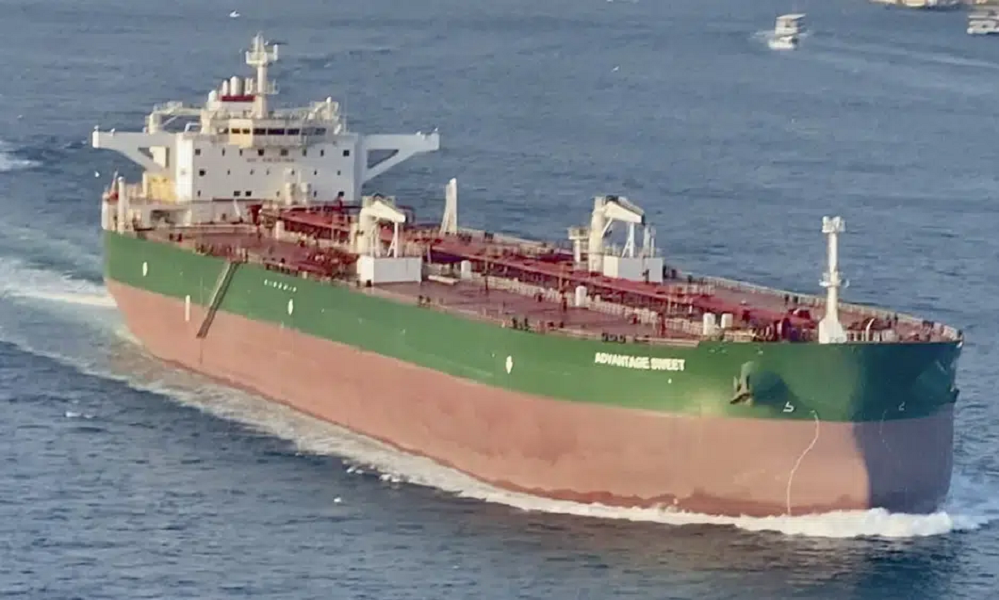
Iran’s navy seized a Marshall Islands-flagged oil tanker in the Gulf of Oman on Thursday heading to the U.S. amid wider tensions over Tehran’s nuclear program, the latest-such capture in a waterway crucial for global energy supplies.
The U.S. Navy’s Mideast-based 5th Fleet identified the vessel as the Advantage Sweet. Satellite tracking data for the vessel from MarineTraffic.com showed it in the Gulf of Oman, just north of Oman’s capital, Muscat, on Thursday afternoon. It had just come from Kuwait and listed its destination as Houston, The Associated Press reported.
The Advantage Sweet issued a distress call at 1:15 p.m. while in international waters as Iran seized the vessel, the Navy said.
“Iran’s actions are contrary to international law and disruptive to regional security and stability,” the 5th Fleet said in a statement. “Iran should immediately release the oil tanker.”
The Navy initially said Iran’s paramilitary Revolutionary Guard seized the vessel, but an American naval aircraft later confirmed that Iran’s navy captured the ship, 5th Fleet spokesman Cmdr. Timothy Hawkins told The Associated Press.
Iran’s state-run IRNA news agency said the seizure came after an “unknown ship collided with an Iranian vessel last night in the Persian Gulf, causing several Iranian crew members to go missing and get injured.” It did not identify the other ship involved in the alleged collision.
The Advantage Sweet had been in the Persian Gulf on Wednesday, but its track showed no unusual behavior as it transited through the Strait of Hormuz, where a fifth of all traded oil passes. Iran has made allegations in other seizures that later fell apart as it became clear Tehran was trying to leverage the capture as a chip to negotiate with foreign nations.
Iran’s “harassing activity within the Persian Gulf and Gulf of Oman is commensurate with an established pattern of behavior that has seen Iran target vessels as a result of ongoing disputes,” maritime security firm Dryad Global said.
The 5th Fleet said the Iranian seizure was at least the fifth commercial vessel taken by Tehran in the last two years.
“Iran’s continued harassment of vessels and interference with navigational rights in regional waters are a threat to maritime security and the global economy,” it added.
U.S. Army Gen. Erik Kurilla, the top U.S. commander for the Middle East, said in a statement that the “illegal seizure” of the tanker was “another in a continuing series of violations by Iran of the international rules-based order.”
The vessel’s manager, a Turkish firm called Advantage Tankers, issued a statement acknowledging the Advantage Sweet was “being escorted by the Iranian navy to a port on the basis of an international dispute.” All the ship’s 24 crew members are Indian.
“The safety and welfare of our valued crew members is our No. 1 priority,” the firm said. “Similar experiences show that crew members of vessels taken under such circumstances are in no danger.”
The ship’s listed owner appeared to be a Chinese company.
Manifest information from data firm Refinitiv showed the Advantage Sweet carried Kuwaiti crude oil for American energy firm Chevron Corp. of San Ramon, California. Chevron said it was “aware of the situation.”
“We are in contact with the vessel operator with the hope of resolving this situation as soon as possible,” Chevron spokesperson Christine Dobbyn said in a statement.












Kazakhstan’s Foreign Minister Mukhtar Tileuberdi has called for pragmatic and coordinated international engagement with Afghanistan, saying the country’s long-term stability is closely linked to the security and sustainable development of Central Asia.
Speaking during the general debate of the 81st session of the United Nations General Assembly in New York on Friday, Tileuberdi said humanitarian assistance to Afghanistan remains essential but alone cannot break the cycle of poverty, displacement and dependency.
He said Kazakhstan supports a “pragmatic, coordinated and step-by-step” approach to international engagement with Afghanistan, with the United Nations playing a central role.
Tileuberdi also said Kazakhstan is working with the UN to operationalize the United Nations Regional Centre for the Sustainable Development Goals for Central Asia and Afghanistan in Almaty.
He said the success of the centre should be measured by the results and assistance it delivers to the region.


Abu Muslim Farah defeat Khurasan Faryab 2-0 in ACL season six

Saar: Concerns over Pakistan’s political crisis discussed

Afghanistan Champions League: Omar Zawak Herat beat Toofan Herat 1-0

Blast in Pakistan’s Dera Ismail Khan kills 11, injures 30

Ariana Afghan Airlines increases Kabul-Delhi cargo flights

Saudi energy group signs major Afghanistan deals covering gas exploration and pipeline plans

Trump floats idea of renaming Atlantic or Pacific Ocean

US hits Egyptian bank branches with Iran sanctions as war marks six months

Nepal flood rescue mission enters critical phase as thousands remain missing

Iranian clubs to face Gulf opponents at neutral venues in Asian Champions League Elite
Saar: Concerns over Pakistan’s political crisis discussed

Exclusive interview with Abdul Latif Mansoor, Minister of MRRD

Tawsia: Overview of Afghanistan’s iron mines

Tahawol: Discussion on fresh Pakistani airstrikes on Afghanistan

Saar: Calls for international support for Afghanistan discussed
-

 World5 days ago
CNN, MS NOW and Politico sue Trump, challenging White House ban
-

 Latest News3 days ago
Ariana Afghan Airlines ranks seventh among 45 Central Asian airlines
-

 Latest News5 days ago
UN reiterates call for respect for international law after Kunar airstrikes
-

 Regional4 days ago
US and Iran hold first talks since June after Trump’s ‘annihilation’ threat
-

 Latest News4 days ago
Silk Road highway in Wakhan corridor now reaches the China border
-

 Regional3 days ago
Iran airlines cancel flights as US sanctions hit
-

 Latest News5 days ago
Afghan Official: Pakistan’s airstrikes will not go unanswered
-

 Sport5 days ago
Afghan boxing referee heads to China for international festival