
Latest News
British imams dismiss concerns over girls’ education in Afghanistan

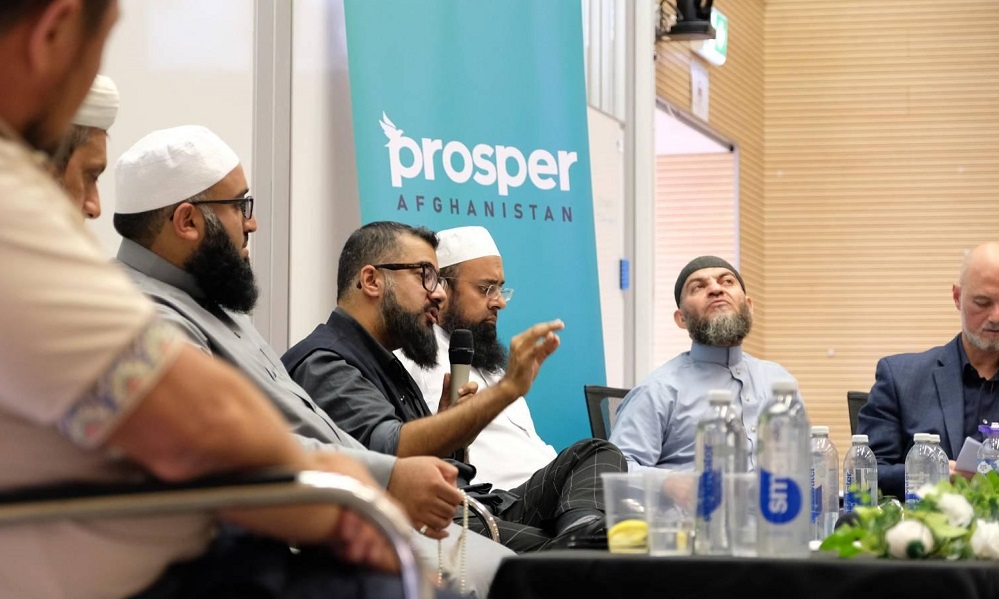
A group of British Muslim scholars who recently visited Afghanistan has accused the mainstream media of completely distorting the reality of what is happening in the country.
Addressing about 250 people at Queen Mary University in London, the scholars spoke about the security and peace that now exists in Afghanistan after so many years of war, as well as the Islamic society that is now being created.
The scholars, who were appearing at the launch of the Prosper Afghanistan organization, also addressed the controversial issue of girls’ education following its suspension at secondary level and above last year.
The scholars who addressed the event were Shaykh Haitham Al Haddad, Shaykh Suliman Gani, Shaykh Hamid Mahmood, Shaykh Ammar al-Madani, Mufti Ismail Satia and Shaykh Abdulkerim Karahanli.
Sheikh Haitham Al Haddad said the level of professionalism of the government leaders he met was “really amazing… They really want to do something for their country and for the Ummah and may Allah help them to do that.”
Mufti Ismail Satia said: “We went to Afghanistan with a very open mind, we did not go siding with anybody. I found Afghan people to be very kind, generous, big-hearted and resilient. But the greater impact it had on me was that it brought back to me the stories of the Sahaba that we read. They reminded me of those who sacrificed for Islam and those who were willing to do anything for Islam. We don’t think people like this exist nowadays but speaking to people over there and the ulema, it made me realize that these people have the same zeal as the Sahaba.”
Sheikh Hamid Mahmood said: “Before leaving for Afghanistan I had never seen anything positive in the mainstream media, but after speaking to members of the Afghan government I realized that they were not just trying to free themselves from physical subjugation and colonialism, but also from financial, economic and intellectual enslavement.”
And Sheikh Ammar al-Madani said: “The image we have of Afghanistan is totally different to the realities on the ground. The happiness and contentment that the people are feeling is totally different to what is being portrayed through media channels. My request is that any information you seek is through proper channels.”
The delegation of prominent British imams and Muslim scholars visited Afghanistan in July and August and was led by the Human Aid and Advocacy charity in coordination with Prosper Afghanistan.
Human Aid & Advocacy said the Muslim leaders traveled to Afghanistan in order to better understand the humanitarian needs of the Afghan people and witness some of the current aid projects established by the charity in the country.
These included an orphanage, a widow’s skills training center, a vocational skills center, and an aid delivery program to Kapisa province.
Regarding the issue of girls’ education, Sheikh Haitham Al-Haddad told the audience that the issue was being used by the West to demonize Afghanistan. He said that in any society emerging from war there is a hierarchy of needs and security and the economy comes first.
“If we are genuinely concerned about Afghanistan the first question should be what is the security situation like? And 2022 was the first year in over 40 years when there was no war whatsoever in the entire area of Afghanistan which is something to be praised.. Secondly, in terms of economy Afghanistan is one of the top ten countries in terms of reducing inflation. And if people are concerned about women they should first ask if women are being harassed?”
Meanwhile, Sheikh Hamd Mahmood said that girls’ education had not been banned per se, but rather “liberal, secular education had been suspended.”
He said the IEA’s Acting Foreign Minister told him that the Islamic Emirate does not consider girls’ education to be haraam, and that all girls are still being educated at primary level. Moreover, he said that girls could continue schooling until university level if they chose to become medical professionals and teachers or if they studied in a Dar Ul Uloom.
Sheikh Hamd cited the minister as saying that western secular influences were being driven into the minds of the students who were speaking against the Sharia and many vices were creeping in, so the ulema were taken aback and took this matter directly to the IEA leader. He said for 20 years they were united on the battlefield and now when it is time to rebuild the country they cannot tolerate division and therefore temporary suspension of liberal, secular education took place.












Kazakhstan’s Foreign Minister Mukhtar Tileuberdi has called for pragmatic and coordinated international engagement with Afghanistan, saying the country’s long-term stability is closely linked to the security and sustainable development of Central Asia.
Speaking during the general debate of the 81st session of the United Nations General Assembly in New York on Friday, Tileuberdi said humanitarian assistance to Afghanistan remains essential but alone cannot break the cycle of poverty, displacement and dependency.
He said Kazakhstan supports a “pragmatic, coordinated and step-by-step” approach to international engagement with Afghanistan, with the United Nations playing a central role.
Tileuberdi also said Kazakhstan is working with the UN to operationalize the United Nations Regional Centre for the Sustainable Development Goals for Central Asia and Afghanistan in Almaty.
He said the success of the centre should be measured by the results and assistance it delivers to the region.


Abu Muslim Farah defeat Khurasan Faryab 2-0 in ACL season six

Saar: Concerns over Pakistan’s political crisis discussed

Afghanistan Champions League: Omar Zawak Herat beat Toofan Herat 1-0

Blast in Pakistan’s Dera Ismail Khan kills 11, injures 30

Ariana Afghan Airlines increases Kabul-Delhi cargo flights

Saudi energy group signs major Afghanistan deals covering gas exploration and pipeline plans

Trump floats idea of renaming Atlantic or Pacific Ocean

US hits Egyptian bank branches with Iran sanctions as war marks six months

Nepal flood rescue mission enters critical phase as thousands remain missing

Iranian clubs to face Gulf opponents at neutral venues in Asian Champions League Elite
Saar: Concerns over Pakistan’s political crisis discussed

Exclusive interview with Abdul Latif Mansoor, Minister of MRRD

Tawsia: Overview of Afghanistan’s iron mines

Tahawol: Discussion on fresh Pakistani airstrikes on Afghanistan

Saar: Calls for international support for Afghanistan discussed
-

 World5 days ago
CNN, MS NOW and Politico sue Trump, challenging White House ban
-

 Latest News3 days ago
Ariana Afghan Airlines ranks seventh among 45 Central Asian airlines
-

 Latest News5 days ago
UN reiterates call for respect for international law after Kunar airstrikes
-

 Regional4 days ago
US and Iran hold first talks since June after Trump’s ‘annihilation’ threat
-

 Latest News3 days ago
Silk Road highway in Wakhan corridor now reaches the China border
-

 Latest News5 days ago
Afghan Official: Pakistan’s airstrikes will not go unanswered
-

 Regional5 days ago
G7 foreign ministers call on Iran to stop arming Houthis
-

 Regional3 days ago
Iran airlines cancel flights as US sanctions hit