
Latest News
Germany and EU allies push for asylum crackdown and more deportations

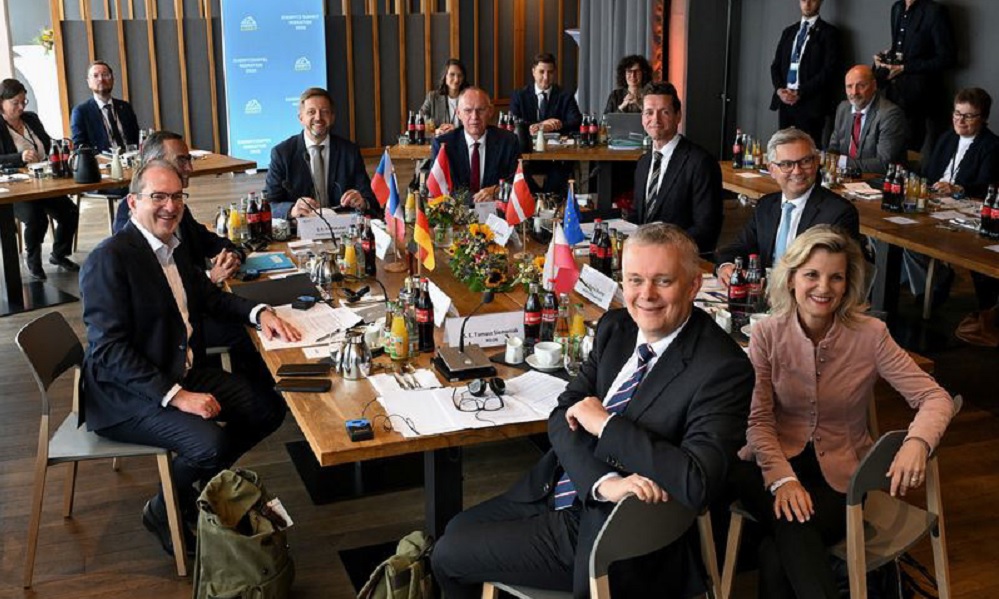
Germany’s Interior Minister Alexander Dobrindt and five European counterparts agreed on a set of goals on Friday to tighten asylum rules in the bloc, including allowing deportations to Afghanistan and Syria.
The meeting at Germany’s highest peak, the Zugspitze, follows Berlin’s decision in May to reject asylum seekers at the border, a policy it said was coordinated with neighbouring countries but drew significant criticism, Reuters reported.
It comes almost exactly a decade after former German Chancellor Angela Merkel opened the country’s borders to nearly a million refugees fleeing war and persecution, a landmark decision that reshaped European politics.
Dobrindt met counterparts from France, Poland, Austria, the Czech Republic and Denmark, as well as EU Home Affairs Commissioner Magnus Brunner.
The agreed asylum policy goals, which require approval from Brussels, include removing legislative obstacles to transferring rejected asylum seekers to secure centres outside the EU and enabling asylum procedures in third countries.
Germany’s new government has already placed curbs on migration including suspending family reunification and resettlement programmes, as it seeks to regain support from voters drawn to the far-right Alternative for Germany, which made historic gains in February’s federal election. On Friday Germany deported 81 Afghan men to Afghanistan.
“We are all concerned that the overburdening of our countries by illegal migration is also contributing massively to the polarization of society. We want to push back this polarization,” Dobrindt said.
Deportations to countries such as Afghanistan and Syria should be reinstated as standard practice, with citizens from countries failing to cooperate on deportations to face visa restrictions, a joint declaration said.
Trade, and development aid will also be used as leverage to boost returns and strengthen migration cooperation, the document said, pressing for increasing deployment of drones and more EU funding for border infrastructure and personnel.
The countries agreed to combat smugglers and work to dismantle human trafficking networks.
Asylum seekers who have already been granted protection in another EU country will be quickly rejected if they claim asylum elsewhere in the bloc.
“Once we seal the external border, there will be no need for internal border controls,” Polish Interior Minister Tomasz Siemoniak said.
Siemoniak said he discussed the border controls Germany introduced unilaterally at its border with Dobrindt, adding that Poland is ready to waive the controls at its border once Germany does the same.












Kazakhstan’s Foreign Minister Mukhtar Tileuberdi has called for pragmatic and coordinated international engagement with Afghanistan, saying the country’s long-term stability is closely linked to the security and sustainable development of Central Asia.
Speaking during the general debate of the 81st session of the United Nations General Assembly in New York on Friday, Tileuberdi said humanitarian assistance to Afghanistan remains essential but alone cannot break the cycle of poverty, displacement and dependency.
He said Kazakhstan supports a “pragmatic, coordinated and step-by-step” approach to international engagement with Afghanistan, with the United Nations playing a central role.
Tileuberdi also said Kazakhstan is working with the UN to operationalize the United Nations Regional Centre for the Sustainable Development Goals for Central Asia and Afghanistan in Almaty.
He said the success of the centre should be measured by the results and assistance it delivers to the region.


Abu Muslim Farah defeat Khurasan Faryab 2-0 in ACL season six

Saar: Concerns over Pakistan’s political crisis discussed

Afghanistan Champions League: Omar Zawak Herat beat Toofan Herat 1-0

Blast in Pakistan’s Dera Ismail Khan kills 11, injures 30

Ariana Afghan Airlines increases Kabul-Delhi cargo flights

Saudi energy group signs major Afghanistan deals covering gas exploration and pipeline plans

Trump floats idea of renaming Atlantic or Pacific Ocean

US hits Egyptian bank branches with Iran sanctions as war marks six months

Nepal flood rescue mission enters critical phase as thousands remain missing

Iranian clubs to face Gulf opponents at neutral venues in Asian Champions League Elite
Saar: Concerns over Pakistan’s political crisis discussed

Exclusive interview with Abdul Latif Mansoor, Minister of MRRD

Tawsia: Overview of Afghanistan’s iron mines

Tahawol: Discussion on fresh Pakistani airstrikes on Afghanistan

Saar: Calls for international support for Afghanistan discussed
-

 World5 days ago
CNN, MS NOW and Politico sue Trump, challenging White House ban
-

 Latest News3 days ago
Ariana Afghan Airlines ranks seventh among 45 Central Asian airlines
-

 Latest News4 days ago
UN reiterates call for respect for international law after Kunar airstrikes
-

 Regional3 days ago
US and Iran hold first talks since June after Trump’s ‘annihilation’ threat
-

 Latest News3 days ago
Silk Road highway in Wakhan corridor now reaches the China border
-

 Latest News4 days ago
Afghan Official: Pakistan’s airstrikes will not go unanswered
-

 Sport4 days ago
Afghan boxing referee heads to China for international festival
-
 Regional4 days ago
G7 foreign ministers call on Iran to stop arming Houthis