
Climate Change
Pakistan, India and Bangladesh bottom in air quality rankings in 2023

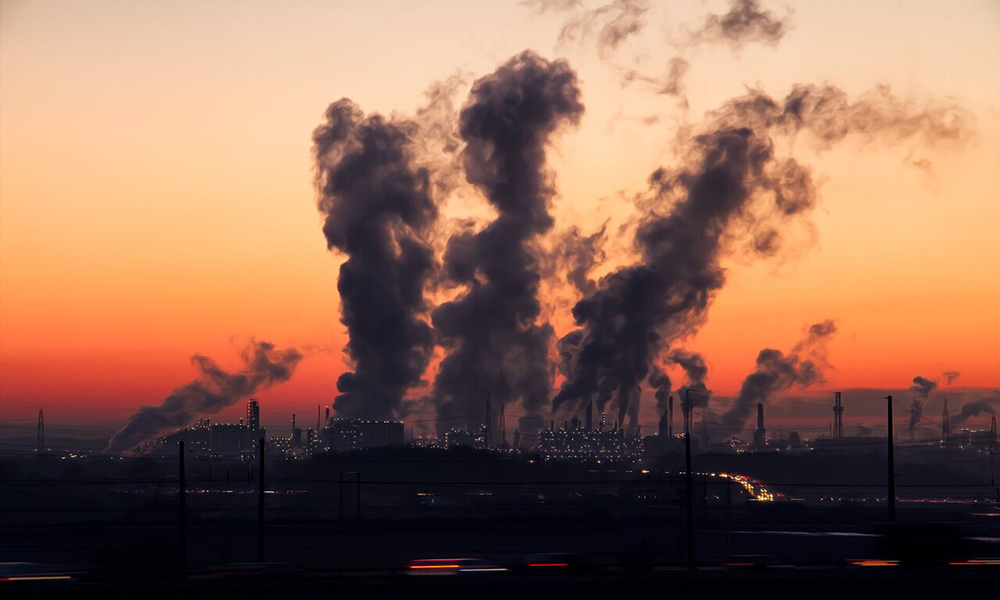
Pakistan remained one of the world’s three smoggiest countries in 2023, as Bangladesh and India replaced Chad and Iran, with particulate matter about 15 times the level recommended by the World Health Organization, data published on Tuesday showed.
Average concentrations of PM2.5 – small airborne particles that damage the lungs – reached 79.9 micrograms per cubic meter in Bangladesh in 2023, and 73.7 micrograms in Pakistan. The WHO recommends no more than 5 micrograms.
“Because of the climate conditions and the geography (in South Asia), you get this streak of PM2.5 concentrations that just skyrocket because the pollution has nowhere to go,” said Christi Chester Schroeder, air quality science manager at IQAir, a Swiss air-monitoring organisation.
“On top of that are factors such as agricultural practices, industry and population density,” she added. “Unfortunately, it really does look like it will get worse before it gets better.”
In 2022, Bangladesh was ranked as having the fifth-worst air quality, and India was eighth.
About 20% of premature deaths in Bangladesh are attributed to air pollution, and related healthcare costs amount to 4%-5% of the country’s GDP, said Md Firoz Khan, an air pollution expert at Dhaka’s North South University.
Indian pollution also increased last year, with PM2.5 levels about 11 times higher than the WHO standard. India’s New Delhi was the worst-performing capital city, at 92.7 micrograms.
Only Australia, Estonia, Finland, Grenada, Iceland, Mauritius and New Zealand met WHO standards in 2023.
The IQAir report was based on data from more than 30,000 monitoring stations in 134 countries and regions.
Chad, the world’s most polluted country in 2022, was excluded from the 2023 listings because of data issues. Iran and Sudan were also taken off the 2023 list.
Afghanistan was meanwhile not included on the list.






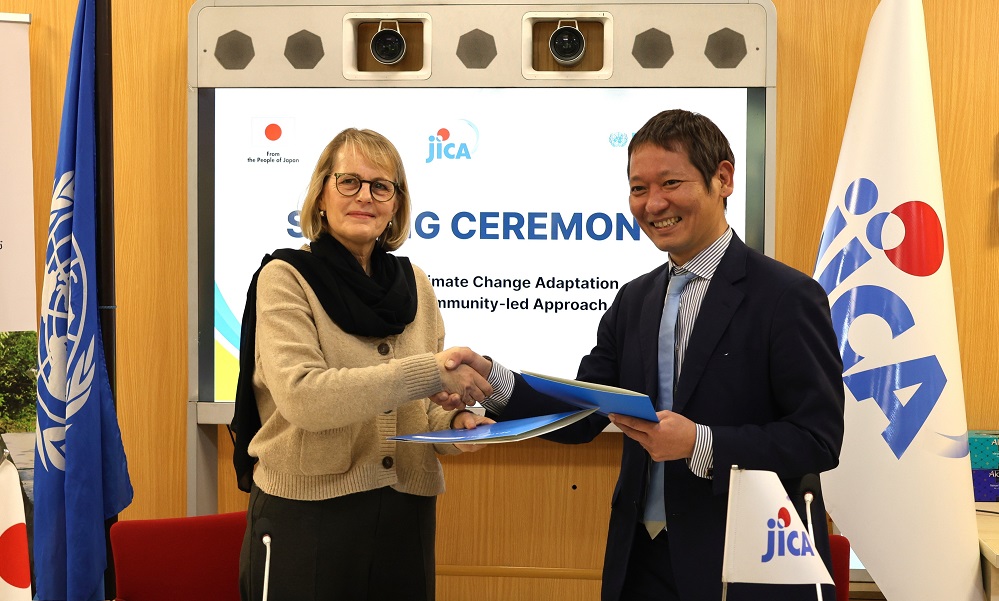
Japan and the UN Office for Project Services (UNOPS) have signed a $9.4 million grant agreement aimed at strengthening climate adaptation and disaster preparedness in Afghanistan.
The agreement, valued at 1.474 billion Japanese yen ($9.4 million) was signed by UNOPS Afghanistan Country Director Katy Ann Webley and Japan International Cooperation Agency (JICA) Afghanistan Chief Representative Sota Tosaka.
The project will be implemented in Kabul province and focuses on improving the capacity of local communities to cope with climate-related disasters.
Using a community-led approach, the programme will support the construction of infrastructure designed to reduce the impact of floods, droughts and other climate risks, alongside training to improve emergency preparedness and response.
Over the next 24 months, UNOPS will carry out activities aimed at enhancing climate risk awareness, strengthening local resilience and protecting livelihoods vulnerable to the effects of climate change.
Climate Change
Winter storm disrupts US travel, triggers thousands of flight cancellations
The disruptions followed a chaotic Sunday, when about 11,000 flights were scrapped—the highest daily total since the COVID-19 pandemic
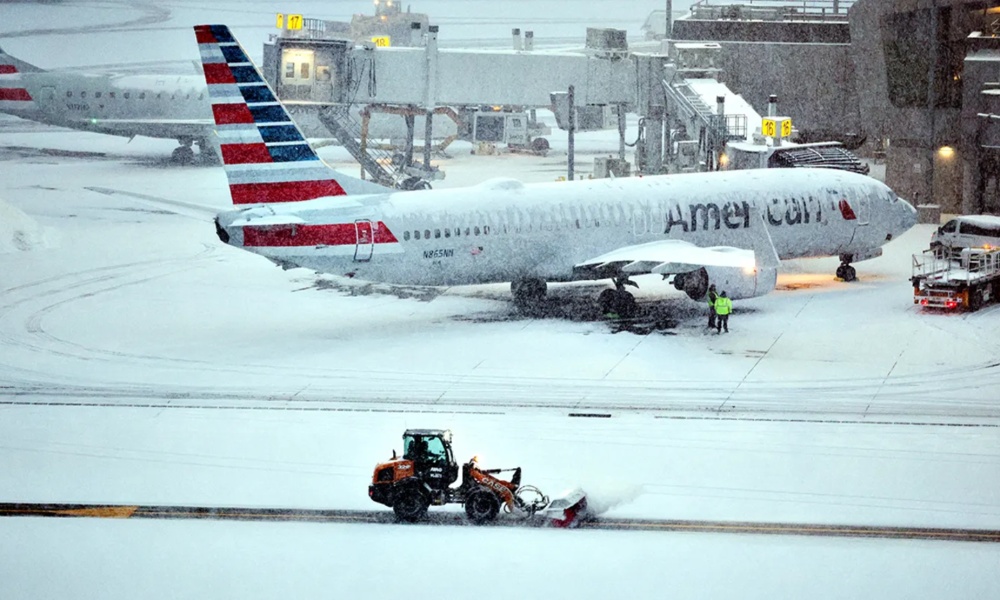
A powerful winter storm sweeping across the United States brought air travel to a near standstill on Monday, forcing airlines to cancel and delay thousands of flights as freezing rain and heavy snowfall battered large parts of the country.
By late afternoon, nearly 19% of scheduled flights had been canceled, according to aviation analytics firm Cirium. Separate data from FlightAware showed around 5,220 U.S. flights were canceled and more than 6,500 delayed by early evening.
The disruptions followed a chaotic Sunday, when about 11,000 flights were scrapped—the highest daily total since the COVID-19 pandemic, Cirium said.
The massive storm dumped up to a foot of snow from New Mexico to New England, paralyzing much of the eastern United States and contributing to at least 18 deaths. Extreme cold is expected to linger in some areas through the week.
American Airlines accounted for the largest share of disruptions on Monday, canceling nearly 1,180 flights and delaying about 1,130, followed by Republic Airways, JetBlue Airways, and Delta Air Lines.
In an advisory, the Federal Aviation Administration (FAA) warned that snow, freezing rain, and low visibility were affecting major hubs, including Boston and the New York metropolitan area. Boston Logan International Airport recorded the highest cancellation rate at 71%, according to Cirium.
American Airlines said the storm disrupted operations at five of its nine hub airports, including its largest base at Dallas–Fort Worth, where freezing temperatures and ice grounded flights.
The carrier requested FAA-approved ground stops for all its flights at Dallas–Fort Worth and Ronald Reagan Washington National Airport to manage gate capacity constraints.
The airline said teams were working around the clock to restore operations, as frustrated passengers flooded social media with requests for updates and assistance.
United Airlines said it had begun restoring flights, with cancellations dropping sharply from 1,019 on Sunday to 320 by Monday evening, FlightAware data showed.
The storm is on track to become the costliest severe weather event since the Los Angeles-area wildfires in early 2025, with preliminary damage and economic losses estimated between $105 billion and $115 billion, according to AccuWeather.
Airline operations remain vulnerable due to the interconnected nature of flight schedules, where cancellations can leave aircraft and crews out of position, slowing recovery efforts. Already, about 285 flights scheduled for Tuesday have been canceled, FlightAware data showed.
Climate Change
FAO warns of dry winter, low snowfall and rising food insecurity risks in Afghanistan
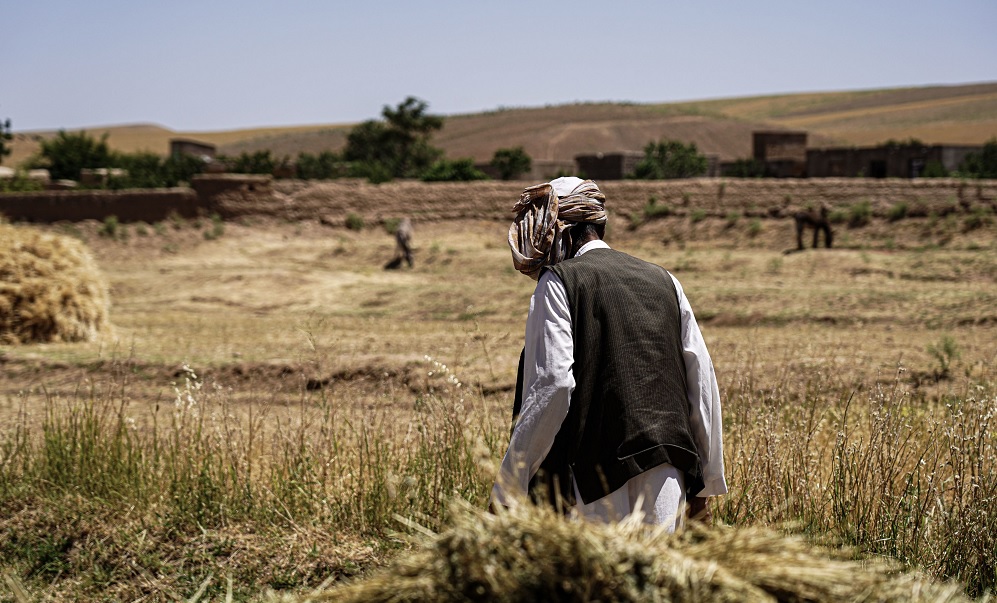
The Food and Agriculture Organization of the United Nations (FAO) has warned that Afghanistan is likely to face a drier and warmer-than-average winter, raising serious concerns about water availability, agricultural production and food security.
In its Seasonal Climate Outlook for December 2025 to February 2026, FAO said a weak La Niña pattern is driving below-average precipitation and above-average temperatures across most parts of the country. The report notes that the 2025/26 wet season has already begun drier and warmer than normal, with widespread soil moisture deficits persisting for another consecutive year
According to FAO, snow accumulation remains exceptionally low, with snow-water-equivalent levels at their lowest point in the past 25 years. This poses a critical hydrological risk, particularly for irrigated wheat-growing areas that depend on snowmelt-fed river systems. Even if precipitation improves later in winter, early deficits are unlikely to be fully offset, the report said
The outlook projects that December, January and February will all carry an elevated risk of below-normal rainfall, especially in northern, northeastern, western and central highland regions. Warmer daytime temperatures combined with cold nights are also expected to increase stress on crops, livestock and vulnerable communities
FAO warned that continued dryness could delay planting and weaken crop establishment for rain-fed winter wheat and barley, potentially reducing yields for the 2026 harvest. In irrigated areas, low snowpack threatens spring water supplies, increasing competition for water and reliance on already stressed groundwater resources.
Rangeland and pasture conditions are also expected to deteriorate, with delayed green-up likely to force herders to depend longer on stored fodder. This could lead to declining livestock health, reduced milk production and increased risk of animal losses toward late winter and early spring, the report said.
FAO and partner assessments caution that consecutive seasons of insufficient rainfall and high temperatures have already weakened agricultural systems and could leave millions of people facing acute food insecurity between late 2025 and early 2026
The UN agency emphasized the need for close monitoring of precipitation, snowpack and crop conditions, calling for timely agricultural support, improved water management and early anticipatory action to mitigate the impacts of the unfolding climate risks.


Tawsia: Efforts to boost Afghanistan’s domestic production and economic diplomacy

Trump extends deadline for striking Iranian energy plants to April 7

IEA says Iranian drivers no longer need visas to enter Afghanistan

Afghans in Iran face growing uncertainty as war enters second month

Russia deems US military presence in Afghanistan unacceptable

Pakistani military jet downed in Afghanistan’s Jalalabad, pilot captured alive

Afghan Air Force conducts airstrikes in Islamabad, other cities

Prominent Muslim scholar issues fatwa calling for Afghanistan-Pakistan ceasefire

Afghan air force strikes key Pakistani military installations in retaliatory operation

IEA: Special circle in Pakistan has launched mission to destabilize region
Tawsia: Efforts to boost Afghanistan’s domestic production and economic diplomacy

Tahawol: Discussion on day 27 of Iran–US war

Saar: Islamic Emirate confident of Durand Line control

Tahawol: Efforts to release Mohammad Rahim from Guantanamo Bay Detention Camp

Saar: End of ceasefire between Afghanistan-Pakistan reviewed
-

 Latest News4 days ago
Pakistan seeks Russian mediation to resolve Afghanistan tensions
-
 Latest News4 days ago
World must re-engage to prevent all-out Afghanistan-Pakistan war: Financial Times
-

 Latest News3 days ago
Around 2.3 million tourists visited Afghanistan’s recreational areas during Eid: Ghufran
-

 Sport3 days ago
Afghanistan squad hit by withdrawals ahead of AFC Asian Cup Qualifiers
-

 Latest News3 days ago
Islamic Emirate releases American prisoner Dennis Coyle
-

 Latest News1 day ago
Tajikistan shifts stance on Afghanistan amid rising border tensions
-
 Latest News4 days ago
Airstrike on Kabul drug rehabilitation centre sparks legal concerns
-
 Regional3 days ago
US allies in Middle East ‘edging closer’ to joining conflict