
Latest News
Sceptics warn Washington’s new peace plan could backfire

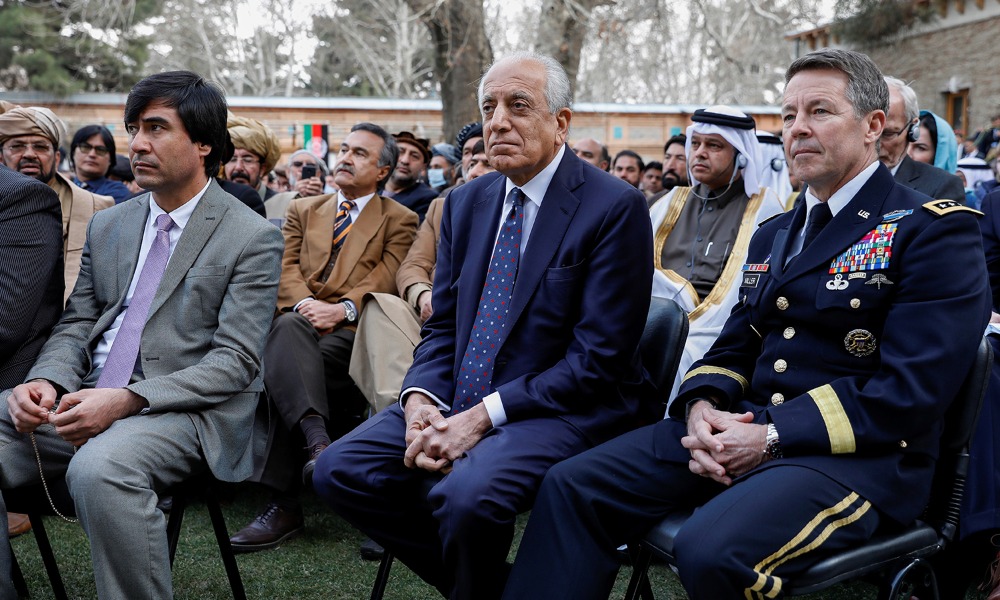
Some Afghan officials have warned that Washington’s aggressive push for a political settlement could backfire, by deadlocking talks, undermining the elected government and plunging the country deeper into violence, the Washington Post reported.
According to the Post, Washington’s approach – nicknamed “moonshot” by some US officials because of its lofty ambitions – is an attempt to get the two sides to agree to a political settlement in just a matter of weeks.
The approach — nicknamed “moonshot” by some U.S. officials referring to its lofty ambitions — is an attempt to reach a peace deal within weeks by applying unprecedented pressure to negotiating teams on both sides of the conflict, the Taliban and the Kabul government.
According to the Post, Afghan officials are concerned a hasty withdrawal of troops without a political settlement could tip the balance – risking a repeat of the mistakes of the 1990s, when Afghanistan was plunged into civil war following the abrupt withdrawal of Soviet troops.
Speaking on condition of anonymity to the Post, Afghan officials acknowledged that current levels of violence and the stalled peace talks between the Afghan Republic and the Taliban in Doha are unacceptable. However they disagreed with the Biden administration’s efforts to speed up the process.
One Afghan official warned: “The consequences for us are the collapse of the state, sudden destruction and a very long and intense civil war.”
“The fact that it has happened in the past once shows it could happen again,” he said.
A second official said “pushing the peace now with this new initiative very rapidly” risks undermining the country’s military.
He said he fears “bringing back the old mujahideen at the expense of the Afghan security forces,” referring to the militant factions and irregular fighters who fought the Soviet forces, then turned on each other during the civil war.
Signs point towards a delay in withdrawing foreign troops
The Post stated however that the accelerated push for a settlement is taking place amid growing indications that the United States is considering postponing the withdrawal of U.S. troops.
But Washington has said a final decision on the future of U.S. troops in Afghanistan has not yet been made.
The Post meanwhile reported that a spokesman for President Ashraf Ghani’s office rejected the suggestion that the president is under greater pressure now from Washington to reach a peace deal.
“If there is any pressure that we feel, it is the pressure from the Afghan people who have been terrorized” since the Soviet invasion in 1979, said Fatima Murchal, Ghani’s deputy spokesperson.
Taliban representatives in Doha also dismissed the implication that the change in approach would have an effect on long-stalled talks.
“Pressure from the United States never works,” said Mohammad Naeem, the spokesman for the Taliban’s political office. “We know this because they have already tried all forms of pressure for 20 years.”
According to the Post, Naeem said the group does not expect the United States to walk away from the 2020 deal, but if it does, “there will be problems, and they will be responsible for that.”
But U.S. officials say the potential risks of inaction outweigh an opportunity to accelerate the process.
The new approach of “moving at a faster pace toward a political agreement,” said one U.S. official, is “the best option for moving forward.”
“Given where we are, the alternative is more dangerous,” he said.
On the recent letter and draft peace proposal sent by US Secretary of State Antony Blinken to Ghani and other officials and to the Taliban, outlining a plan for a transitional government, the Post reported that this all “came as a shock”.
“It’s not what we have been promised,” said an Afghan official with knowledge of the talks, who described the tone of the leaked letter as “upsetting” and contrary to the more consultative approach Kabul was expecting from the Biden administration.
The Afghan government had called on the Biden administration to conduct a full review of the peace agreement signed between the Taliban and the former Trump administration – an agreement that excluded the Afghan government.
But, one peace talks negotiator Fatima Gailani told the Post in reference to Ghani’s government that “they were hoping for a miracle.”
She said Afghan leaders should not have been surprised by the U.S. pressure campaign, given President Joe Biden’s past comments on his desire to end the war in Afghanistan.
Now, she said, the letter and draft peace document “brought reality out into the open” and could act as a wake-up call to unify Afghanistan’s political parties.
The Post also stated that reactions in Kabul to the letter and peace plan appears to be exposing widening political fault lines, rather than signaling moves toward consensus.
Ghani’s main rival, Abdullah Abdullah, the chairman of the High Council for National Reconciliation, welcomed the new U.S. proposal.
His spokesman Mujib Rahman Rahimi said: “It is a positive starting point to boost the peace process and the peace talks.”
“We do not consider the proposal a setback or a step to destabilize the country. Rather, it is a step forward,” Rahimi said.
The new proposal was delivered almost two weeks ago by US peace envoy Zalmay Khalilzad to Ghani, the Abdullah and other politicians and former government leaders. Later in the week Khalilzad met with Taliban representatives in Doha and put the plan to them.
No decisions have yet been made by either side on the proposal.












Kazakhstan’s Foreign Minister Mukhtar Tileuberdi has called for pragmatic and coordinated international engagement with Afghanistan, saying the country’s long-term stability is closely linked to the security and sustainable development of Central Asia.
Speaking during the general debate of the 81st session of the United Nations General Assembly in New York on Friday, Tileuberdi said humanitarian assistance to Afghanistan remains essential but alone cannot break the cycle of poverty, displacement and dependency.
He said Kazakhstan supports a “pragmatic, coordinated and step-by-step” approach to international engagement with Afghanistan, with the United Nations playing a central role.
Tileuberdi also said Kazakhstan is working with the UN to operationalize the United Nations Regional Centre for the Sustainable Development Goals for Central Asia and Afghanistan in Almaty.
He said the success of the centre should be measured by the results and assistance it delivers to the region.


Abu Muslim Farah defeat Khurasan Faryab 2-0 in ACL season six

Saar: Concerns over Pakistan’s political crisis discussed

Afghanistan Champions League: Omar Zawak Herat beat Toofan Herat 1-0

Blast in Pakistan’s Dera Ismail Khan kills 11, injures 30

Ariana Afghan Airlines increases Kabul-Delhi cargo flights

Saudi energy group signs major Afghanistan deals covering gas exploration and pipeline plans

Trump floats idea of renaming Atlantic or Pacific Ocean

US hits Egyptian bank branches with Iran sanctions as war marks six months

Nepal flood rescue mission enters critical phase as thousands remain missing

Iranian clubs to face Gulf opponents at neutral venues in Asian Champions League Elite
Saar: Concerns over Pakistan’s political crisis discussed

Exclusive interview with Abdul Latif Mansoor, Minister of MRRD

Tawsia: Overview of Afghanistan’s iron mines

Tahawol: Discussion on fresh Pakistani airstrikes on Afghanistan

Saar: Calls for international support for Afghanistan discussed
-

 World5 days ago
CNN, MS NOW and Politico sue Trump, challenging White House ban
-

 Latest News3 days ago
Ariana Afghan Airlines ranks seventh among 45 Central Asian airlines
-

 Latest News5 days ago
UN reiterates call for respect for international law after Kunar airstrikes
-

 Regional4 days ago
US and Iran hold first talks since June after Trump’s ‘annihilation’ threat
-

 Latest News3 days ago
Silk Road highway in Wakhan corridor now reaches the China border
-

 Latest News5 days ago
Afghan Official: Pakistan’s airstrikes will not go unanswered
-

 Regional5 days ago
G7 foreign ministers call on Iran to stop arming Houthis
-

 Regional3 days ago
Iran airlines cancel flights as US sanctions hit