
Latest News
Taliban warns Washington against violating Doha agreement

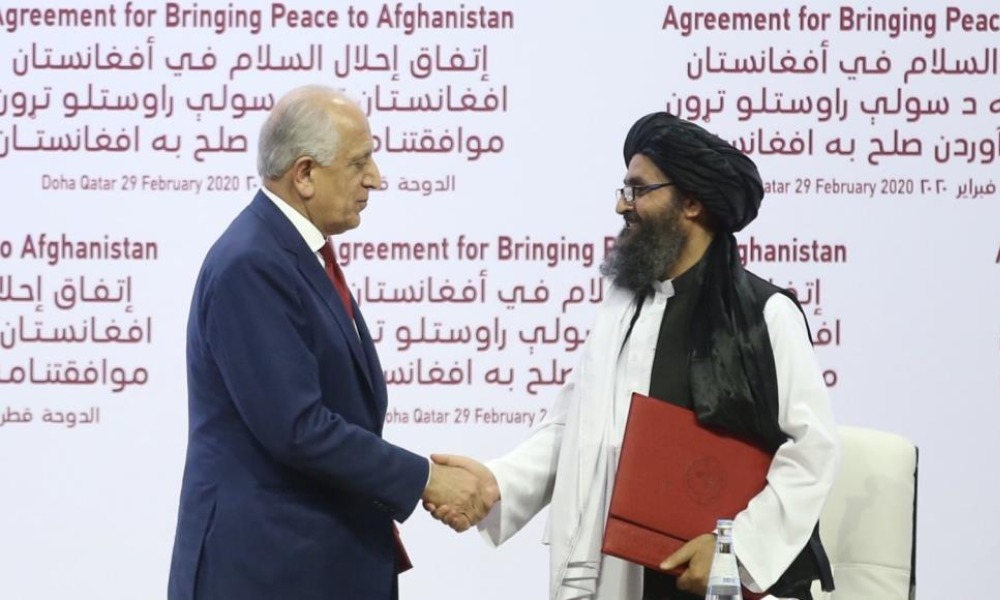
The Taliban urged Washington to uphold its part of the US-Taliban agreement signed a year ago Sunday and stated the release of remaining prisoners and end of blacklists have yet to be implemented.
In a statement issued Sunday to mark the one-year anniversary of the signing of the deal – which the Afghan government was not party to – the Taliban also stated that the implementation of the agreement “must be utilized to improve the situation and pushing it in the wrong direction must be avoided.”
“Practical steps must be undertaken to expedite the ongoing intra-Afghan dialogue process,” the group said.
The Taliban said it is committed to its obligations within the agreement but made it clear in the statement that the implementation of the contents of the agreement is “the sole effective tool for resolving the Afghan issue and establishing peace, that shall be realized under the shade of an Islamic system.”
“The release of remaining prisoners and end of blacklists are part of the agreement that have yet to be implemented,” the statement.
“The Doha agreement has created a practical framework for bringing peace and security to Afghanistan. If any other pathway is pursued as a replacement, then it is already doomed to failure.”
Claiming to have “significantly reduced the level of operations in line with the Doha agreement,” the Taliban stated that “the other side has not fulfilled its obligations in this regard as bombardments, drone strikes, raids and offensive operations that were all prohibit on the basis of the agreement are still continuing, which is mostly causing civilian harm and increasing the levels of violence.”
The Taliban also distanced itself for the wave of targeted attacks and assassinations that have gripped the country over the past few months.
According to the group, “some circles with their interests tied to foreign actors have recently launched a wave of targeted attacks especially against civilians with the aim of showing the situation as teetering on the brink of a crisis, and to create excuses for the continuation of occupation and war.”
The Taliban’s statement comes just three days after US Central Command chief, General Kenneth F. McKenzie said the US still continues to see levels of violence that are way too high.
“I place a large measure of the blame on the Taliban who have continued to mount offensive operations and targeted killings of Afghan officials but the excessive violence has led the government to launch their own defensive operations to protect themselves – the violence while too high on both sides,” McKenzie said.
McKenzie also stressed that there is no sign that the Taliban had severed ties with al-Qaeda, as called for in the US-Taliban agreement.
“In my clear judgment rests largely on the Taliban; we also continue to … look for signs of a Taliban break with al-Qaeda and I have not at this point seen any definitive signs that would lead to believe they’re prepared to or able to honor their obligations,” McKenzie added.
On Tuesday, the UN Assistance Mission Afghanistan (UNAMA) meanwhile stated there had been an increase in civilians killed and injured in Afghanistan since the start of peace talks in September.
In the latest report on civilian casualties, UNAMA said despite the rise in casualties since September the overall numbers for 2020 were down due to lower civilian casualty rates prior to the start of talks.
The Taliban however, reacted to the report and said: ”We reject such incomplete reports based on incorrect information.”
For a seventh consecutive year, UNAMA documented more than 3,000 civilians killed in a single year, with Afghanistan remaining among the deadliest places in the world to be a civilian.












Kazakhstan’s Foreign Minister Mukhtar Tileuberdi has called for pragmatic and coordinated international engagement with Afghanistan, saying the country’s long-term stability is closely linked to the security and sustainable development of Central Asia.
Speaking during the general debate of the 81st session of the United Nations General Assembly in New York on Friday, Tileuberdi said humanitarian assistance to Afghanistan remains essential but alone cannot break the cycle of poverty, displacement and dependency.
He said Kazakhstan supports a “pragmatic, coordinated and step-by-step” approach to international engagement with Afghanistan, with the United Nations playing a central role.
Tileuberdi also said Kazakhstan is working with the UN to operationalize the United Nations Regional Centre for the Sustainable Development Goals for Central Asia and Afghanistan in Almaty.
He said the success of the centre should be measured by the results and assistance it delivers to the region.


Abu Muslim Farah defeat Khurasan Faryab 2-0 in ACL season six

Saar: Concerns over Pakistan’s political crisis discussed

Afghanistan Champions League: Omar Zawak Herat beat Toofan Herat 1-0

Blast in Pakistan’s Dera Ismail Khan kills 11, injures 30

Ariana Afghan Airlines increases Kabul-Delhi cargo flights

Saudi energy group signs major Afghanistan deals covering gas exploration and pipeline plans

Trump floats idea of renaming Atlantic or Pacific Ocean

US hits Egyptian bank branches with Iran sanctions as war marks six months

Nepal flood rescue mission enters critical phase as thousands remain missing

Iranian clubs to face Gulf opponents at neutral venues in Asian Champions League Elite
Saar: Concerns over Pakistan’s political crisis discussed

Exclusive interview with Abdul Latif Mansoor, Minister of MRRD

Tawsia: Overview of Afghanistan’s iron mines

Tahawol: Discussion on fresh Pakistani airstrikes on Afghanistan

Saar: Calls for international support for Afghanistan discussed
-

 World5 days ago
CNN, MS NOW and Politico sue Trump, challenging White House ban
-

 Latest News3 days ago
Ariana Afghan Airlines ranks seventh among 45 Central Asian airlines
-

 Latest News5 days ago
UN reiterates call for respect for international law after Kunar airstrikes
-

 Regional4 days ago
US and Iran hold first talks since June after Trump’s ‘annihilation’ threat
-

 Latest News3 days ago
Silk Road highway in Wakhan corridor now reaches the China border
-

 Regional3 days ago
Iran airlines cancel flights as US sanctions hit
-

 Latest News5 days ago
Afghan Official: Pakistan’s airstrikes will not go unanswered
-

 Sport5 days ago
Afghan boxing referee heads to China for international festival