
Latest News
Karzai ‘invited’ IEA into Kabul to stop the chaos in August

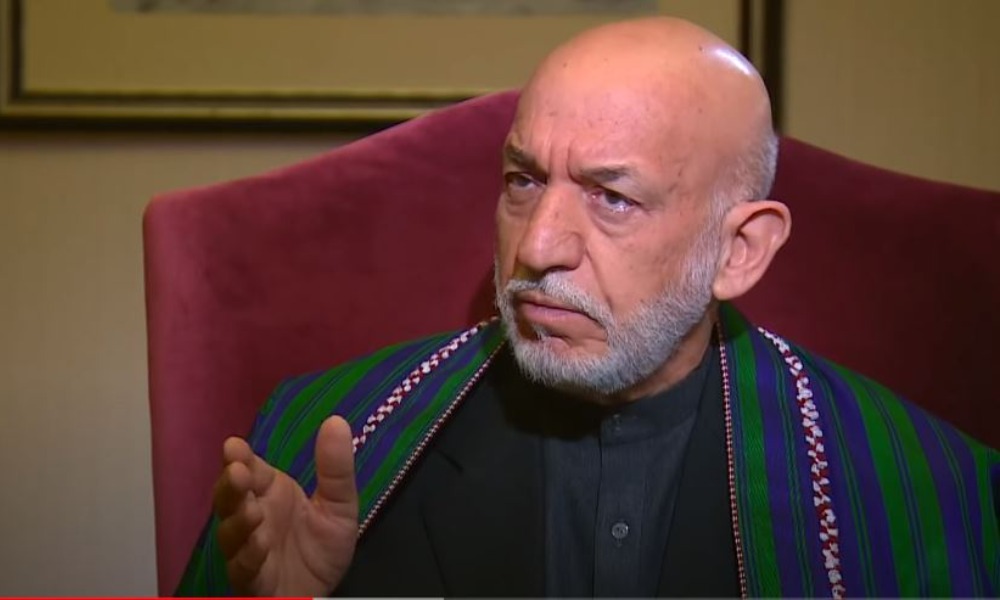
Former Afghan President Hamid Karzai offered insights into the secret and sudden departure of Afghan President Ashraf Ghani on August 15 and said he “invited” the Islamic Emirate of Afghanistan (IEA) to enter Kabul.
In an interview with the Associated Press, Karzai said he issued the invitation in order “to protect the population so that the country, the city doesn’t fall into chaos and the unwanted elements who would probably loot the country, loot shops.”
Karzai said that when Ghani left, his security officials also left. The then defense minister Bismillah Khan even asked Karzai if he wanted to leave Kabul when Karzai contacted him to know what remnants of the government still remained. It turned out there were none. Not even the Kabul police chief had remained, AP reported.
Karzai, who was the country’s president for 13 years after the IEA was first ousted in the wake of the 9/11 attacks, refused to leave.
Karzai said Ghani’s flight scuttled a last-minute push by himself, the government’s chief negotiator Abdullah Abdullah and the IEA leadership in Doha that would have seen the IEA enter the capital as part of a negotiated agreement.
The countdown to a possible deal began August 14, the day before the IEA came to power, AP reported.
Karzai and Abdullah met Ghani, and they agreed that they would leave for Doha the next day with a list of 15 others to negotiate a power-sharing agreement. The IEA were already on the outskirts of Kabul, but Karzai said the leadership in Qatar promised IE forces would remain outside the city until the deal was struck.
Early on the morning of August 15, Karzai said, he waited to draw up the list. The capital was fidgety, on edge. Rumors were swirling about an IEA takeover. Karzai called Doha. He was told the IEA would not enter the city.
At noon, the IEA called to say that “the government should stay in its positions and should not move that they have no intention to (go) into the city,” Karzai said. “I and others spoke to various officials and assurances were given to us that, yes, that was the case, that the Americans and the government forces were holding firm to the places (and) that Kabul would not fall.”
However, by about 2:45 pm it became apparent Ghani had fled the city. Karzai called the defense minister, called the interior minister, searched for the Kabul police chief. Everyone was gone. “There was no official present at all in the capital, no police chief, no corps commander, no other units. They had all left.”
Ghani’s own protection unit’s deputy chief called Karzai to come to the palace and take over the presidency. He declined, saying legally he had no right to the job, AP reported. Instead, the former president decided to make a public, televised message, with his children at his side “so that the Afghan people know that we are all here.”
Karzai was adamant that there would have been an agreement for a peaceful transition had Ghani remained in Kabul.
“Absolutely. Absolutely. That is what we were preparing for, what we were hoping (along) with the chairman of the peace council to go to Doha that evening, or the next morning, and to finalize the agreement,” he said. “And I believe the Taliban (IEA) leaders were also waiting for us in Doha for the same … objective, for the same purpose.”
Today, Karzai meets regularly with the IEA leadership and says the world must engage with them. Equally important, he said, is that Afghans have to come together. War has dominated Afghanistan for more than 40 years, and in the last 20 years “Afghans have suffered on all sides,” he said.
The former president has a plan. In his talks with the IEA, he is advocating the temporary resurrection of the constitution that governed when Afghanistan was a monarchy. The idea was also floated during earlier Doha talks, AP reported.
At the same time, a traditional Loya Jirga — a grand council of all Afghans, including women — would be convened. It would decide the country’s future, including a representative government, a constitution, a national flag, he told AP.
There’s no indication the IEA will accept his formula, though he says they have not rejected it in discussions.
Karzai said the world has to engage with the IEA. Afghanistan needs to operate. Government servants have to be paid. Health care facilities need to function, he told AP.
“Right now, they need to cooperate with the government in any form they can,” said Karzai who also bemoaned the unchallenged and sometimes wrong international perceptions of the IEA.
He cited claims that women and girls are not allowed outside their homes or require a male companion. “That’s not true. There are girls on the streets — women by themselves.” The situation on the ground in Kabul bears this out.
Asked to describe the IEA, Karzai said: “I would describe them as Afghans, but Afghans who have gone through a very difficult period in their lives as all other Afghans have done for the past 40 years.”
We “have been through an extremely difficult period of our history in which we, the Afghans, have made mistakes on all sides, in which the international community and those who interacted with us have made tremendous mistakes,” Karzai said. “It’s time for all of us to realize that, and to look back at the mistakes that we have all made and to make it better.”












Kazakhstan’s Foreign Minister Mukhtar Tileuberdi has called for pragmatic and coordinated international engagement with Afghanistan, saying the country’s long-term stability is closely linked to the security and sustainable development of Central Asia.
Speaking during the general debate of the 81st session of the United Nations General Assembly in New York on Friday, Tileuberdi said humanitarian assistance to Afghanistan remains essential but alone cannot break the cycle of poverty, displacement and dependency.
He said Kazakhstan supports a “pragmatic, coordinated and step-by-step” approach to international engagement with Afghanistan, with the United Nations playing a central role.
Tileuberdi also said Kazakhstan is working with the UN to operationalize the United Nations Regional Centre for the Sustainable Development Goals for Central Asia and Afghanistan in Almaty.
He said the success of the centre should be measured by the results and assistance it delivers to the region.


Abu Muslim Farah defeat Khurasan Faryab 2-0 in ACL season six

Saar: Concerns over Pakistan’s political crisis discussed

Afghanistan Champions League: Omar Zawak Herat beat Toofan Herat 1-0

Blast in Pakistan’s Dera Ismail Khan kills 11, injures 30

Ariana Afghan Airlines increases Kabul-Delhi cargo flights

Saudi energy group signs major Afghanistan deals covering gas exploration and pipeline plans

Trump floats idea of renaming Atlantic or Pacific Ocean

US hits Egyptian bank branches with Iran sanctions as war marks six months

Nepal flood rescue mission enters critical phase as thousands remain missing

Iranian clubs to face Gulf opponents at neutral venues in Asian Champions League Elite
Saar: Concerns over Pakistan’s political crisis discussed

Exclusive interview with Abdul Latif Mansoor, Minister of MRRD

Tawsia: Overview of Afghanistan’s iron mines

Tahawol: Discussion on fresh Pakistani airstrikes on Afghanistan

Saar: Calls for international support for Afghanistan discussed
-

 World5 days ago
CNN, MS NOW and Politico sue Trump, challenging White House ban
-

 Latest News3 days ago
Ariana Afghan Airlines ranks seventh among 45 Central Asian airlines
-

 Latest News5 days ago
UN reiterates call for respect for international law after Kunar airstrikes
-

 Regional4 days ago
US and Iran hold first talks since June after Trump’s ‘annihilation’ threat
-

 Latest News3 days ago
Silk Road highway in Wakhan corridor now reaches the China border
-

 Latest News5 days ago
Afghan Official: Pakistan’s airstrikes will not go unanswered
-

 Regional3 days ago
Iran airlines cancel flights as US sanctions hit
-

 Sport5 days ago
Afghan boxing referee heads to China for international festival