
Latest News
OIC chief says he will ‘pursue dialogue’ with IEA and int’l community


The head of the Organization of Islamic Cooperation said on Tuesday that the 48th Session of the OIC Council of Foreign Ministers meeting will tackle a number of issues and that the organization will address the situation in Afghanistan.
Speaking during the opening session of the meeting, in Islamabad, the Secretary-General of the OIC, Hissein Brahim Taha, also said that foreign ministers would discuss the political and security situation in Afghanistan with the Islamic Emirate of Afghanistan (IEA).
In his address to delegates, Taha said: “I will pursue dialogue for peace, security and development in Afghanistan with de facto authorities and international partners.”
Saudi Arabia’s Foreign Minister Prince Faisal bin Farhan also commented on Afghanistan during the opening session and said: “We call for more efforts to help the brotherly Afghan people and we call on Afghans to help themselves by ensuring that Afghan lands are not used as a haven for extremist groups and respect for human rights, including Women’s right to education.”
Pakistan’s Prime Minister Imran Khan meanwhile gave the opening speech at the two-day meeting and said the OIC needs to encourage the Afghan people and include them in the international community.
He said he believed the “people of Afghanistan are strong enough to evolve and go in the right direction.”
Imran Khan also said no other people had suffered as much as Afghans but noted that for the first time in over 40 years, there was no conflict in the country.
“The only danger now is through the sanctions [imposed on Afghanistan] and non-recognition”, which could cause a humanitarian crisis, he said.
Imran Khan stated that it was “extremely important” to stabilize Afghanistan because it was the “only way we are going to be able to stop international terrorism from Afghan soil”.
“Let’s not be delusional that some other country can come in and fight terrorism through drones. The only way is a stable Afghanistan government that can take care of terrorism.
“Anyone who knows the Afghan character should be cautioned, please do not push the people of Afghanistan where they feel their sovereignty is being threatened.”
The meeting, however, is taking place in the midst of Imran Khan’s toughest political phase as he is facing a no-confidence motion.
Nearly two dozen lawmakers of his own Pakistan Tehreek-e-Insaf party have turned against him in the past week. The session for a vote on the motion has been called on 25 March.
Afghanistan has sent a delegation to Islamabad for the meeting but Pakistan’s Dawn News reported that Afghan Foreign Minister Amir Khan Muttaqi was not present.
According to Dawn News, another IEA official, Muhammad Akbar Azeemi, is leading the Afghan delegation.






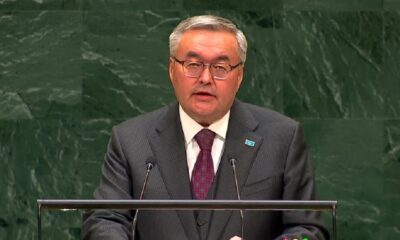




Kazakhstan’s Foreign Minister Mukhtar Tileuberdi has called for pragmatic and coordinated international engagement with Afghanistan, saying the country’s long-term stability is closely linked to the security and sustainable development of Central Asia.
Speaking during the general debate of the 81st session of the United Nations General Assembly in New York on Friday, Tileuberdi said humanitarian assistance to Afghanistan remains essential but alone cannot break the cycle of poverty, displacement and dependency.
He said Kazakhstan supports a “pragmatic, coordinated and step-by-step” approach to international engagement with Afghanistan, with the United Nations playing a central role.
Tileuberdi also said Kazakhstan is working with the UN to operationalize the United Nations Regional Centre for the Sustainable Development Goals for Central Asia and Afghanistan in Almaty.
He said the success of the centre should be measured by the results and assistance it delivers to the region.


Afghanistan Champions League: Omar Zawak Herat beat Toofan Herat 1-0

Blast in Pakistan’s Dera Ismail Khan kills 11, injures 30

Ariana Afghan Airlines increases Kabul-Delhi cargo flights

Khalilzad questions Pakistan’s commitment to Afghan welfare

India, UN envoy discuss Afghanistan’s humanitarian needs

Saudi energy group signs major Afghanistan deals covering gas exploration and pipeline plans

Trump floats idea of renaming Atlantic or Pacific Ocean

US hits Egyptian bank branches with Iran sanctions as war marks six months

Nepal flood rescue mission enters critical phase as thousands remain missing

Iranian clubs to face Gulf opponents at neutral venues in Asian Champions League Elite

Exclusive interview with Abdul Latif Mansoor, Minister of MRRD

Tawsia: Overview of Afghanistan’s iron mines

Tahawol: Discussion on fresh Pakistani airstrikes on Afghanistan

Saar: Calls for international support for Afghanistan discussed

Tahawol: Opening of the 81st UN General Assembly Session
-

 World4 days ago
CNN, MS NOW and Politico sue Trump, challenging White House ban
-

 Latest News3 days ago
Ariana Afghan Airlines ranks seventh among 45 Central Asian airlines
-

 Latest News4 days ago
UN reiterates call for respect for international law after Kunar airstrikes
-
 Latest News5 days ago
Khalilzad condemns Pakistan airstrikes, says current strategy is not working
-

 Regional3 days ago
US and Iran hold first talks since June after Trump’s ‘annihilation’ threat
-

 Latest News3 days ago
Silk Road highway in Wakhan corridor now reaches the China border
-

 Latest News4 days ago
Afghan Official: Pakistan’s airstrikes will not go unanswered
-

 Regional4 days ago
G7 foreign ministers call on Iran to stop arming Houthis