
Latest News
It’s too early to consider recognition of IEA: US

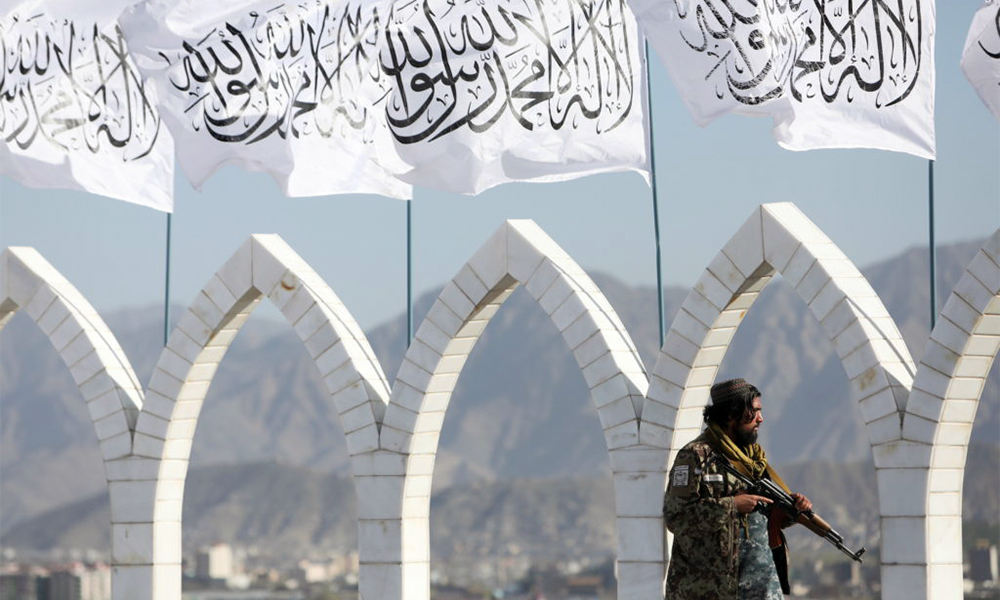
The United States said Wednesday no foreign government is contemplating legitimacy for the new government in Afghanistan.
“I think there’s actually a global consensus to include Moscow and Beijing and Iran, that it’s too early to look at recognition,” Donald Lu, U.S. assistant secretary of state for South and Central Asia, told VOA in an interview.
“Yes, some countries are beginning a very slow process of normalization of relations. No one is talking about formal recognition,” Lu said.
The U.S. diplomat noted that international discussions instead were focused on seeking an engagement with the IEA that can help improve the situation on the ground in Afghanistan in terms of the rights of women and girls, and security.
“We, as partner countries, should also be working with authorities in Afghanistan to create a better world for Afghan people to try to influence what is happening in Afghanistan for the betterment of the people of Afghanistan, but also a stable region.”
The IEA seized power last August when U.S. and NATO partners withdrew their final troops, ending almost two decades of foreign military intervention in the country.
The US urges the IEA to remove sanctions on women, reopen girls’ schools above the sixth grade and allow them to have access to work if it wants to be recognized.
“It’s critical that all of us work together to try to encourage the Taliban (IEA) onto a constructive path,” Lu said. He emphasized the IEA “now has to get to the business of governance.”
Washington has made it clear repeatedly that no legitimacy is possible unless and until the IEA reverse their restrictions on women and induct representatives of other ethnic Afghan groups into the government.
Lu cautioned the IEA rulers that the investment made by the global community over the past 20 years “will shape the future” of the country, and they “cannot merely impose their own will” on millions of Afghans.
Lu said that the IEA supreme leader renewed his resolve Wednesday in a message he issued in connection with this week’s Muslim festival of Eid-ul-Adha.
“The Islamic Emirate is committed to upholding all the rights of its citizens, as Islam commands us to grant and protect the rights of all people. And within the framework of the Sharia law, the rights of women will be ensured,” IEA’s supreme leader said.
“Within the framework of mutual interaction and commitment, we want good, diplomatic, economic and political relations with the world, including the United States, and we consider this in the interest of all sides,” Mullah Haibatullah Akhunzada further added.
Neighboring and regional countries, including China and Pakistan — which shares a long border with Afghanistan — have kept their diplomatic and trade contacts open with the IEA, citing dire humanitarian and economic emergencies facing the country’s estimated 40 million population.
But these nations also are pressing the IEA to rule the country through a politically inclusive administration, ease curbs on women and desist from cracking down on dissent before they decide to consider the IEA’s call for a formal recognition of their government.
“We hope Afghanistan to be stable, peaceful, pursues a moderate policy and to meet the expectations,” said Wang Yu, China’s ambassador to Kabul, while addressing a rare news conference Tuesday in the Afghan capital.
Lu told VOA that Central Asian countries also are worried about security threats coming from Afghanistan. The U.S. is talking with them about how it can help with cross-border security and “facilitate conversation with this very unusual IEA’s government,” he added.
Meanwhile, Akhundzada reassured Afghanistan’s neighbors and the world at large Wednesday that the IEA would not allow anyone to use their territory to threaten the security of other countries.
In his Eid message, the leader of the Islamic Emirate called for diplomatic relations with all countries, including the United States.
Russia, China, Iran, Pakistan, Qatar, UAE, Turkey, India, and even Saudi Arabia, which are important regional countries, have asked the Islamic Emirate to create an inclusive government, but the IEA considers the current system to be inclusive.







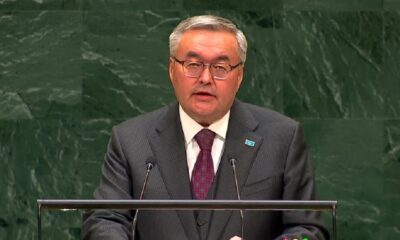




Kazakhstan’s Foreign Minister Mukhtar Tileuberdi has called for pragmatic and coordinated international engagement with Afghanistan, saying the country’s long-term stability is closely linked to the security and sustainable development of Central Asia.
Speaking during the general debate of the 81st session of the United Nations General Assembly in New York on Friday, Tileuberdi said humanitarian assistance to Afghanistan remains essential but alone cannot break the cycle of poverty, displacement and dependency.
He said Kazakhstan supports a “pragmatic, coordinated and step-by-step” approach to international engagement with Afghanistan, with the United Nations playing a central role.
Tileuberdi also said Kazakhstan is working with the UN to operationalize the United Nations Regional Centre for the Sustainable Development Goals for Central Asia and Afghanistan in Almaty.
He said the success of the centre should be measured by the results and assistance it delivers to the region.


Saar: Concerns over Pakistan’s political crisis discussed

Afghanistan Champions League: Omar Zawak Herat beat Toofan Herat 1-0

Blast in Pakistan’s Dera Ismail Khan kills 11, injures 30

Ariana Afghan Airlines increases Kabul-Delhi cargo flights

Khalilzad questions Pakistan’s commitment to Afghan welfare

Saudi energy group signs major Afghanistan deals covering gas exploration and pipeline plans

Trump floats idea of renaming Atlantic or Pacific Ocean

US hits Egyptian bank branches with Iran sanctions as war marks six months

Nepal flood rescue mission enters critical phase as thousands remain missing

Iranian clubs to face Gulf opponents at neutral venues in Asian Champions League Elite
Saar: Concerns over Pakistan’s political crisis discussed

Exclusive interview with Abdul Latif Mansoor, Minister of MRRD

Tawsia: Overview of Afghanistan’s iron mines

Tahawol: Discussion on fresh Pakistani airstrikes on Afghanistan

Saar: Calls for international support for Afghanistan discussed
-

 World5 days ago
CNN, MS NOW and Politico sue Trump, challenging White House ban
-

 Latest News3 days ago
Ariana Afghan Airlines ranks seventh among 45 Central Asian airlines
-

 Latest News4 days ago
UN reiterates call for respect for international law after Kunar airstrikes
-
 Latest News5 days ago
Khalilzad condemns Pakistan airstrikes, says current strategy is not working
-

 Regional3 days ago
US and Iran hold first talks since June after Trump’s ‘annihilation’ threat
-

 Latest News3 days ago
Silk Road highway in Wakhan corridor now reaches the China border
-

 Latest News4 days ago
Afghan Official: Pakistan’s airstrikes will not go unanswered
-

 Sport4 days ago
Afghan boxing referee heads to China for international festival