
World
S.Korea, US, Japan hold drills as N.Korea slams US ‘nuclear blackmail’

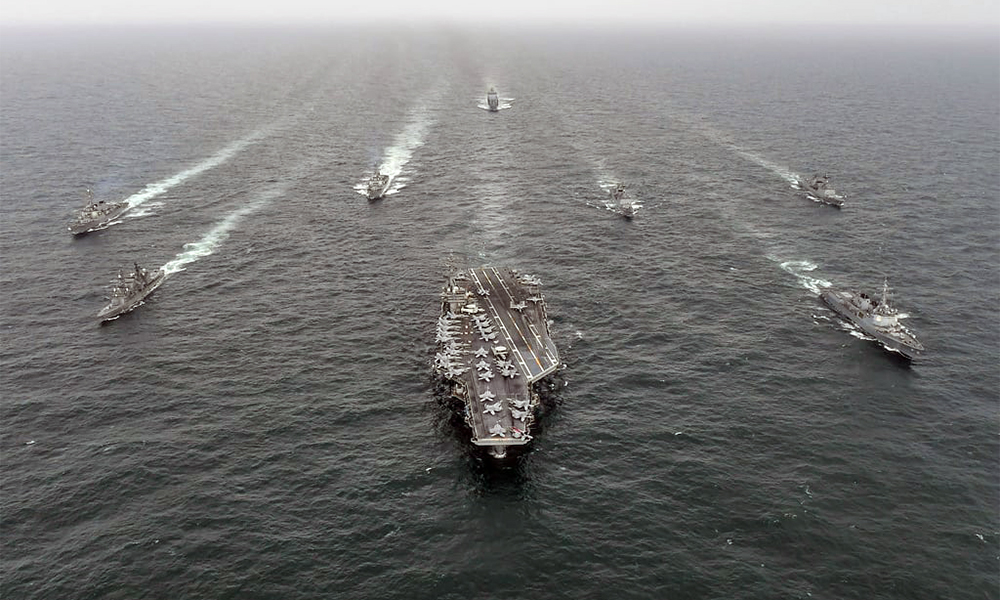
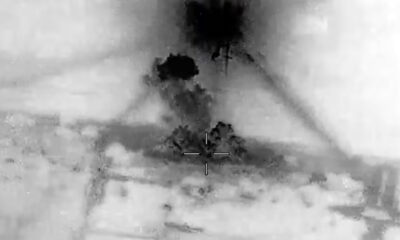
South Korea, the United States and Japan staged joint naval missile defence exercises on Monday to improve responses to North Korean threats, as Pyongyang accused Washington of ramping up “nuclear blackmail” with military drills, Reuters reported.
The three nations agreed at talks in Washington on Friday to hold regular missile defence and anti-submarine exercises in their efforts to boost diplomatic and military cooperation.
North Korea tested a new solid-fuel intercontinental ballistic missile (ICBM) on Friday that experts say would ease the way for missile launches with little warning, part of an increase in its military activities in recent weeks, read the report.
Hours after the trilateral exercises, Ri Pyong Chol, vice president of the North Korean ruling party’s Central Military Commission, issued a statement criticising the U.S. for calling a U.N. Security Council meeting over its ICBM test.
The North’s weapons development was a self-defensive measure of defence against the U.S., Ri said. He accused Washington of raising regional tensions “to the brink of explosion” with military drills simulating a “pre-emptive nuclear strike and an all-out war” against the North.
The recent deployment of U.S. strategic bombers was “clear evidence that the U.S. nuclear threat and blackmail against us has reached a level that cannot be overlooked”, Ri said.
“If the U.S. ignores our repeated warnings and continues actions that endanger the security environment of the Korean peninsula, we will take necessary action so that it feels a clearer security crisis and insurmountable threat,” he added.
U.S. Ambassador to the U.N. Linda Thomas-Greenfield told the U.N. Security Council at Monday’s meeting: “Let me be clear, our lawful efforts to defend against the DPRK’s repeated escalatory actions do not in any way justify the DPRK’s unlawful behaviour.”
North Korea – formally known at the Democratic People’s Republic of Korea (DPRK) – has been under U.N. sanctions for its missile and nuclear programs since 2006, Reuters reported.
After years of unity, the 15-member U.N. Security Council is now deadlocked on how to deal with Pyongyang. The United States and several other members want the council to toughen sanctions on Pyongyang, but veto-powers Russia and China are opposed.
Russia’s U.N. Ambassador Vassily Nebenzia described the meeting on Monday as “unnecessary,” adding that it would “simply make the situation worse.” China’s U.N. Ambassador Zhang Jun said the situation on the Korean Peninsula was at a crossroads, Reuters reported.
“The United States and its allies should stop provocative military exercises,” Zhang told Reuters. “The other thing, which is also very much urgent, is the resumption of dialogue.”
Monday’s drills in international waters between Korea and Japan bring together South Korea’s 7,600-tonne Aegis destroyer Yulgok Yi I, the U.S. guided-missile destroyer Benfold, and Japan’s Atago destroyer, also equipped with Aegis radar systems.
The effort focuses on mastering response procedures, from detection and tracking to information-sharing, by creating a virtual target in a scenario featuring a North Korean ballistic missile provocation, the South’s navy said.
Pyongyang has threatened “more practical and offensive” action as South Korean and U.S. forces have performed annual springtime exercises since March, some involving Japan, which the North has described as a rehearsal for nuclear war.
Separately, the air forces of South Korea and the United States are set to begin drills on Monday for a 12-day run, Reuters reported.
Also on Monday, South Korea and Japan resumed “two-plus-two” talks of senior diplomatic and security officials in Seoul after a five-year halt, as their ties thaw after a years-long feud over issues of wartime history.
President Yoon Suk Yeol, who has pledged to move ties with Japan beyond the past, visited Tokyo in March for the first time in 12 years as South Korea’s leader.




World
Israel, Lebanon sign initial agreement after US-mediated talks
Israeli Prime Minister Benjamin Netanyahu said the agreement allows Israeli forces to continue to occupy southern Lebanon if Hezbollah does not disarm.
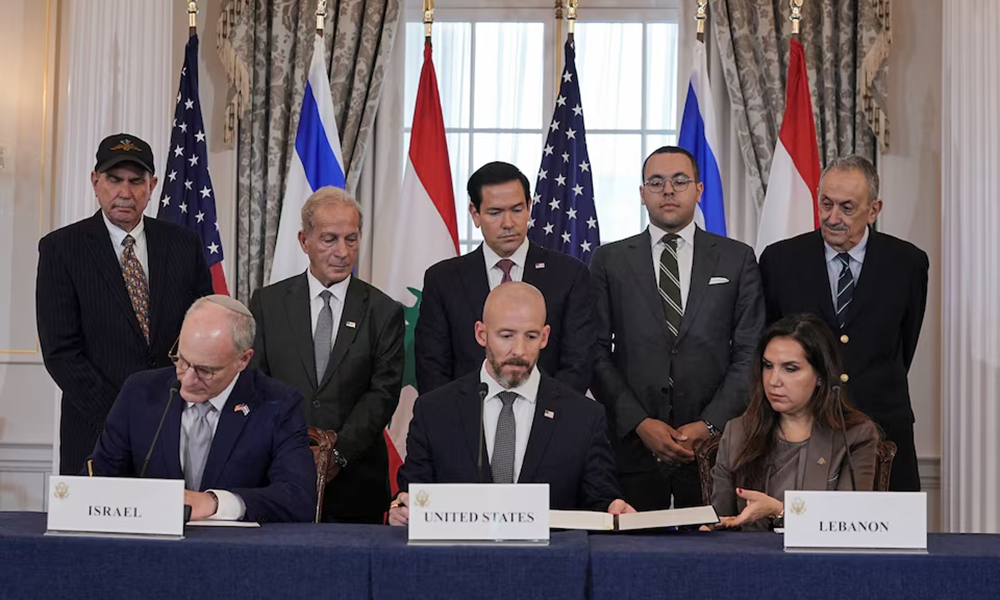
Israel and Lebanon signed a framework agreement in Washington on Friday following several days of talks to secure an end to fighting between Israel and Iran-backed Hezbollahmilitants, though both sides framed the deal as an initial step, Reuters reported.
Lebanese Ambassador Nada Moawad and her Israeli counterpart Yechiel Leiter signed the trilateral document with the U.S. at the State Department in Washington, providing few details.
Israeli Prime Minister Benjamin Netanyahu said the agreement allows Israeli forces to continue to occupy southern Lebanon if Hezbollah does not disarm.
“Today we’ve taken the first step in what will be a difficult journey, without a doubt, but an important and an essential and a necessary one,” U.S. Secretary of State Marco Rubio said before the agreement was inked.
In a later statement he said that the U.S. would facilitate the implementation of the deal through a trilateral “Military Coordination Group for Lebanon” and that Washington would commit significant resources, including an immediate $100 million in humanitarian assistance in coordination with the U.N.
Rubio added that the U.S. reaffirmed its intent to improve the capabilities of the Lebanese Armed Forces “to more effectively establish sovereignty throughout Lebanese territory” with more than $30 million in funds under existing U.S. authorities and appropriations.
The conflict between Israel and Hezbollah broke out when the armed group fired at Israel on March 2, days after the U.S. and Israel attacked Iran. The Hezbollah attacks triggered Israeli air and ground attacks that have killed more than 4,000 people in Lebanon and displaced more than a million.
Lebanon’s Moawad also called it a “first step” on the road to restoring Lebanese sovereignty.
“Iran is out, Hezbollah is out, and the road to peace between Israel and Lebanon is in,” Leiter said.
Netanyahu said in a statement that the deal would also allow the Lebanese army “to begin organizing to take control of territory,” starting with what he described as two “pilot zones” from which Israeli troops would withdraw from land they occupied during the war.
Israel describes that territory as a “security zone” or “buffer zone” where its troops can thwart Hezbollah attacks on northern Israel.
Lebanese President Joseph Aoun said the agreement should allow Lebanese to return to “fully liberated” land and rebuilt homes with “no partner” in its sovereignty.
Israel’s death toll from this round of hostilities with Hezbollah includes at least 32 soldiers and four Israeli civilians. Hezbollah does not release figures on its war dead. Reuters reported on May 4 that several thousand Hezbollah fighters had been killed in the war.
A State Department official told Reuters on Thursday that Israel had agreed to pull back from some of the territory it has occupied, something Israeli and Lebanese officials denied.
Before the talks resumed this week, Israel and Hezbollah agreed to halt fire even as Israel kept troops in southern Lebanon.
Violence has persisted since the ceasefire, with Israel saying on Friday its troops had struck and killed what the military described as seven Hezbollah members who were operating near the territory it is occupying. Reuters could not confirm this.
“To the degree that the Lebanese army performs in dismantling and disarming Hezbollah, we will proceed with additional pilot zones and the ultimate determination of an internationally recognized, secure, and agreed upon border,” Leiter told reporters after the signing.
Hezbollah lawmaker Hassan Fadlallah said Lebanese authorities would not be able to enforce the agreement unless, with U.S. support, “they go to civil war,” pro-Iranian broadcaster Al Mayadeen reported, read the report.
Hezbollah would confront any measure taken by Lebanese authorities and would hold on to its weapons even more, adding that the group’s opposition was “serious” and would not allow authorities to implement their commitments on the ground, Fadlallah said.
Israeli forces dropped leaflets over the southern Lebanese town of Mansouri on Friday ordering residents to leave, Lebanese state media reported, the first such order issued since the latest ceasefire between Israel and Hezbollah took effect.
A senior Lebanese military official said Israel had recently added Mansouri to its occupation zone. The official said Lebanese farmers had continued to enter and leave the town, but had not been living there.
An Israeli military spokesperson said the military issued what it described as a “reminder” to the civilian population that “the area is within the security zone in which (Israeli) soldiers operate. It’s a reminder not to be in the area so they won’t be harmed.”
World
Venezuela earthquake death toll rises to 188 as rescue efforts continue
According to officials, 138 aftershocks have been recorded since the twin 7.2- and 7.5-magnitude earthquakes struck late Wednesday, causing widespread destruction.
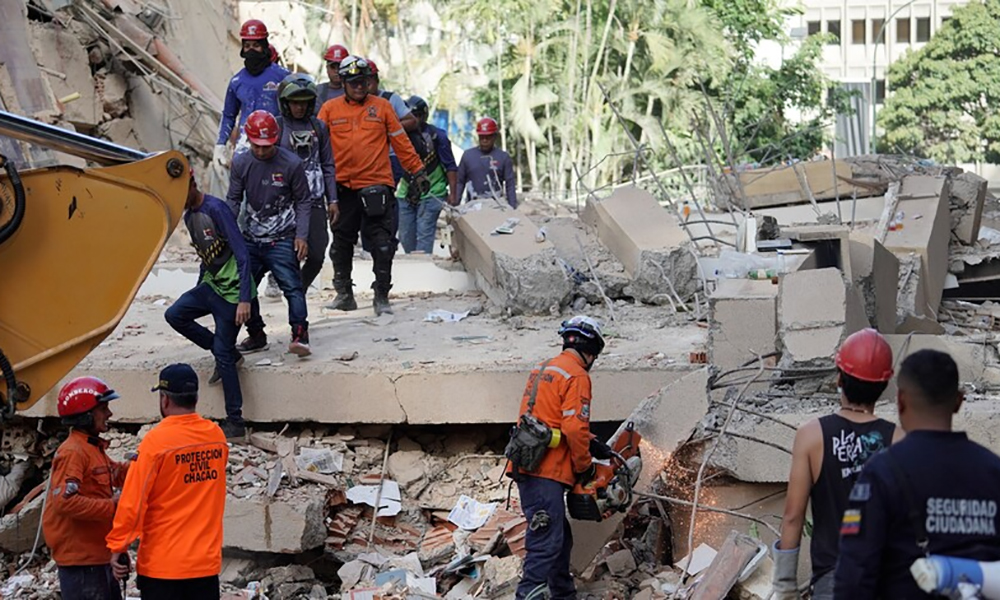
The death toll from the powerful earthquakes that struck Venezuela’s northern Caribbean coast has risen to 188, authorities confirmed on Thursday, as emergency crews continue search and rescue operations.
Jorge Rodriguez, President of Venezuela’s National Assembly, said 1,520 people have been hospitalized with injuries, while 157 people remain missing. Rescue teams are still searching for more than 200 people believed to be trapped beneath collapsed buildings.
According to officials, 138 aftershocks have been recorded since the twin 7.2- and 7.5-magnitude earthquakes struck late Wednesday, causing widespread destruction.
Rodriguez said 346 infrastructure sites sustained damage, including 250 buildings, 20 shopping centers, and eight hospitals, forcing authorities to transfer patients to other medical facilities.
The Venezuelan government has announced the establishment of a $200 million emergency reconstruction fund to support the rebuilding of damaged homes, hospitals, and other critical infrastructure.
Following the disaster, Acting President Delcy Rodriguez declared a national state of emergency, while tsunami warnings were issued across parts of the Caribbean region after the powerful earthquakes.
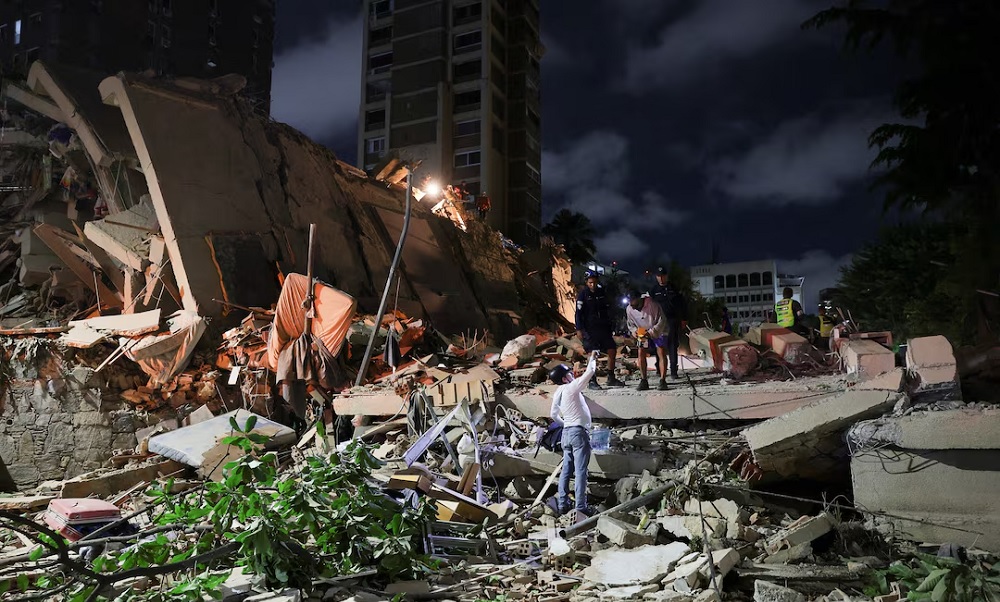
Strong earthquakes struck west of Venezuela’s capital on Wednesday afternoon, toppling buildings in Caracas, trapping people in the rubble and prompting scientists to warn of potentially heavy casualties and widespread destruction across the South American country.
A magnitude 7.2 earthquake hit about 160 km (100 miles) west of Caracas, followed less than a minute later by a magnitude 7.5 tremor, according to the U.S. Geological Survey (USGS), Reuters reported.
“High casualties and extensive damage are probable and the disaster is likely widespread,” the USGS said, initially estimating the death toll would most likely range from 10,000 to 100,000.
Interim President Delcy Rodriguez said she would declare a state of emergency and request funds from multilateral organizations to back the recovery effort.
“We extend our condolences to those who have unfortunately suffered the loss of a family member,” she said in a national address, without giving a national count for deaths or injuries.
Local officials and witnesses reported collapsed buildings, rescues and a growing number of injured.
“We have buildings, homes and houses which have collapsed and we are taking care of things with everything we have available in terms of security, civil assistance,” Interior Minister Diosdado Cabello said earlier on state television.
Video footage showed emergency workers climbing through the ruins of a collapsed building in the capital as night fell, while distraught relatives sought help for loved ones believed to be trapped.
Gustavo Duque, the mayor of the Chacao municipality in Caracas, said several buildings collapsed, and 18 survivors were extracted from one building alone. He urged onlookers to seek shelter and aid at public plazas because there could be aftershocks.
“We’re going to do everything we can to rescue the most people possible,” he said.
Twenty-two people were injured in the coastal state of Falcon, Governor Victor Clark said on state television. Fifteen missing people, all adults, were still being searched for.
RESIDENTS RUSH INTO THE STREETS
Many Venezuelans were at home when the quakes struck during a public holiday marking an 1821 military victory that helped secure the country’s independence from Spain.
“As soon as it started, we began hearing people screaming,” said Astrid Ramirez, a 41-year-old publicist in western Caracas. “Everyone was running down the stairs.”
Residents across Caracas, which was also hit by a deadly magnitude 6.3 earthquake in 1967, rushed to evacuate as buildings shook.
“There was a very loud crash. Things fell in the house, jugs inside the refrigerator. I’ve never experienced anything like it,” said Coro Martinez, 56, who lives in eastern Caracas.
Item 1 of 10 Emergency services work at the site of a collapsed building after an earthquake, in Caracas, Venezuela, June 24. REUTERS/Gaby Oraa
Maria Romero, an 80-year-old pensioner in southern Caracas, said police helped her get out of her home. “This earthquake was horrible, even worse than the one in 1967,” she said.
Another resident, a 41-year-old office worker who declined to be named, said she received an earthquake alert on her phone just before the shaking intensified.
“As I picked it up and started listening to what it was saying, I first felt light shaking. Then, in less than two seconds, everything started moving.”
Rodriguez has been running the country since the U.S. ouster of President Nicolas Maduro in January. She has hailed a new era of cooperation with the U.S. and other countries, especially on oil, mining and other industries.
The U.S. embassy in Caracas said it was closely monitoring the aftermath of the quake and urged citizens in the country to seek secure shelter and avoid damaged areas.
HOSPITALS BRACE FOR THE INJURED
Fire trucks were seen on the streets of Caracas, where some buildings suffered significant facade damage.
At Caracas’ Hospital de Clinicas, staff were asked to double up on the night shift to help treat the injured, a worker there said.
Venezuela’s largest airport, in Maiquetia on the coast north of Caracas, was closed due to damages, Rodriguez said.
Classes were cancelled for the rest of the week as authorities began to take stock of the damage.
Venezuela’s oil infrastructure did not immediately appear to be affected by the tremors, as almost none of the cities with official reports of severe damage include critical oil infrastructure. Civil protection authorities in Maracaibo, near the large oil hub of Lake Maracaibo, said there were no injuries reported.
Many energy companies with operations in the country were accounting for staff before making initial assessments on the condition of oilfields, plants and refineries.
One source noted that extended loss of power could hit crude output levels until the service is restored. Venezuela’s oil ministry, state-run oil company PDVSA (PDVSA.UL) and its main foreign partner, Chevron did not immediately reply to requests for comment.
TSUNAMI ALERT WITHDRAWN
The U.S. Tsunami Warning System issued a tsunami threat for Puerto Rico and the U.S. and British Virgin Islands after the earthquake, and said hazardous waves could also affect Aruba, Curacao and Bonaire. The warning was withdrawn about an hour later.
Venezuela lies in a seismically active zone where the Caribbean Plate meets the South American Plate.
An estimated 30,000 people were killed when a powerful quake caused widespread destruction in the cities of Merida and Caracas in 1812, according to the USGS.


Afghan minister says ‘outsiders’ should not claim to support Afghanistan’s independence

FIFA World Cup group stage wraps up; moves into high-stakes knock out round

Afghanistan, Kyrgyzstan establish trade council to boost economic cooperation

Afghanistan remains central to SCO–UN talks in New York Consultations

Afghanistan committed to continued cooperation with UN on humanitarian and development projects: FM Muttaqi

Norway’s Viking-inspired World Cup team photo goes viral

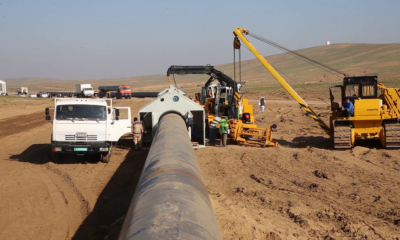
TAPI project advances in Afghanistan as 84kms of pipeline laid

Afghanistan’s trade with Central Asia records sharp growth

Afghanistan to play in Diamond Jubilee Tournament opener against Maldives

Gaikwad set to replace injured Kohli for Afghanistan ODI Series

Saar: Concerns over Afghan deportations from Europe discussed

Exclusive interview with Polleak Ok Serei, UNODC Representative for Afghanistan

Tahawol: Germany’s defense of engagement with IEA discussed

Saar: Rejection of security threats from Afghan soil discussed

Tahawol: Efforts to eliminate drugs across Afghanistan discussed
-
 Latest News2 days ago
TAPI project sees rapid progress in Afghanistan
-

 International Sports4 days ago
Knockout picture begins to take shape at FIFA World Cup 2026
-

 International Sports1 day ago
FIFA World Cup: Iran held by Egypt after controversial late goal Is disallowed
-
 Latest News4 days ago
Afghanistan’s SCO participation blocked over one member’s objection, Kabulov says
-

 International Sports3 days ago
FIFA World Cup: Messi turns 39, shows no signs of stopping
-
 Latest News4 days ago
EU allocates 20 million euros to support returnees in Afghanistan
-
 Regional4 days ago
Iran’s Pezeshkian says without missiles his country would be ‘just like Gaza’
-

 Business4 days ago
Afghanistan chamber, India’s ASSOCHAM sign MoU to enhance trade and investment cooperation