
Regional
Mazar inhabitant’s plan to vote in large numbers during upcoming elections

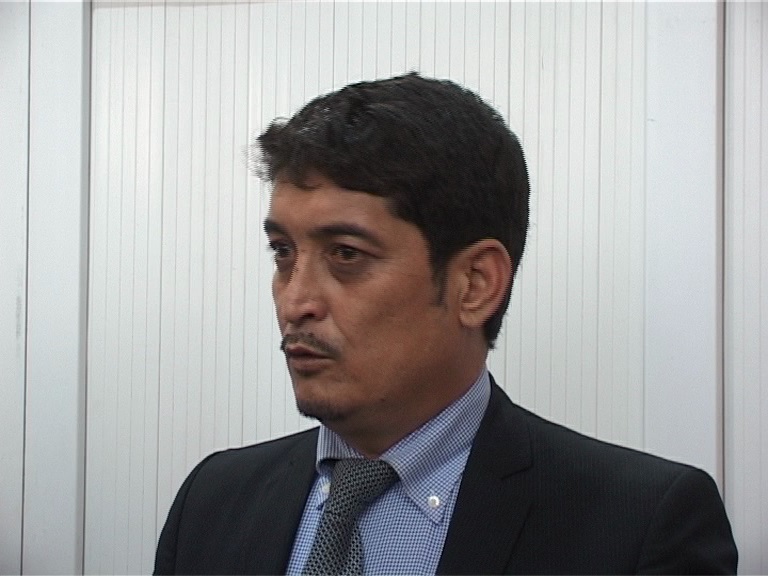

Dozens of northern Balkh inhabitants complained that their representatives in the Parliament have failed in the past decade to work for the province.
At a gathering to discuss the provincial council, people complained that lawyers wrongly used their power and money to enter Parliament and hadn’t done a good job representing the people. He said, “The votes of the people are not considered and lawyers with power and money become Members of Parliament.”
Ibrahim Zada, a representative of Balkh, said in the House of Representatives, lawyers considered people’s problems and have represented the people to the government, but people have ignored their work and chosen to complain instead.
“The main problem is that the laws that are approved in parliament are does not implemented correctly. The law is not properly applied to the powerful and the law works only against the poor people,” he added. More than eight months remain before the presidential election and provincial councils and Balkh residents insist the people will be involved and will be ready to vote in the upcoming elections.

Regional
Iran’s strongest card in nuclear talks: its highly enriched uranium
Uranium is highly enriched when it has reached 20% purity, and weapons-grade as of around 90%.
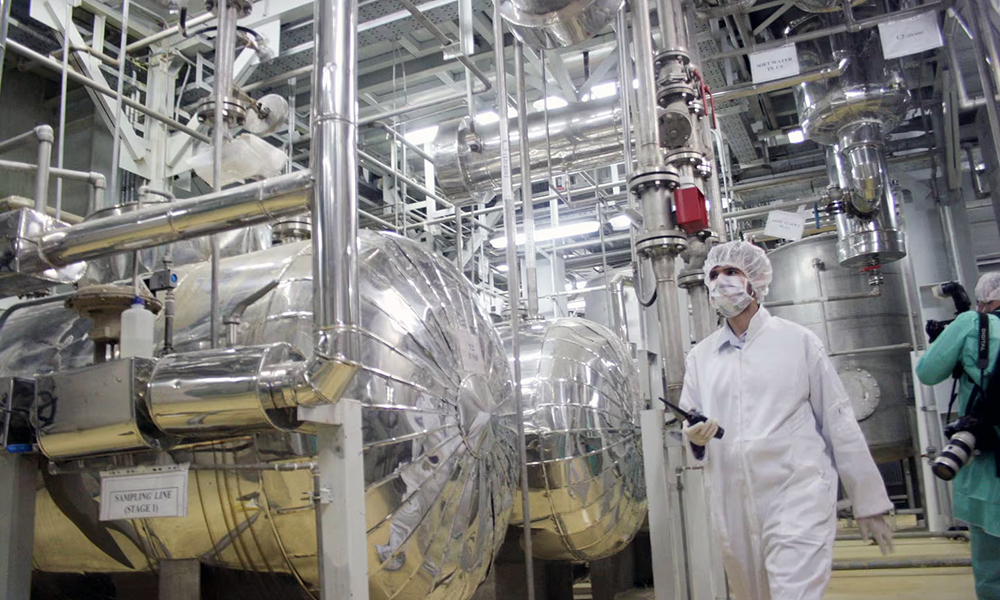
Iran and the United States are in discussions to extend their ceasefire so as to start negotiations on issues including Tehran’s nuclear program, where Washington insists Iran must not be able to make a nuclear weapon, Reuters reported.
While much of Iran’s uranium enrichment infrastructure was destroyed or badly damaged when Israel and the U.S. bombed it in June, a large part of the highly enriched uranium it amassed is thought to have survived. That is the biggest U.S. concern ahead of nuclear talks.
On Friday Trump said in a social media post that Iran must agree that the enriched uranium buried underground after earlier U.S. strikes be “unearthed” and destroyed in coordination with Iran and the U.N. nuclear watchdog.
WHAT IS HIGHLY ENRICHED URANIUM?
One of two fissile materials, along with plutonium, with which one can make the core of a nuclear bomb.
While plutonium is usually extracted from the spent fuel of a nuclear reactor, requiring large and highly visible infrastructure, uranium can be enriched using centrifuges that have a much smaller footprint.
Two of Iran’s three enrichment sites that are known to have been operating when Israel and the U.S. attacked in June were underground. The above-ground one was clearly destroyed.
Uranium is highly enriched when it has reached 20% purity, and weapons-grade as of around 90%.
Modern reactors generally use fuel enriched to up to 5%, but some use fuel enriched to higher levels. The ones that power U.S. nuclear submarines reportedly use fuel enriched beyond 90%.
HOW MUCH DOES IRAN HAVE?
Iran has not informed the U.N. nuclear watchdog of the fate of its enriched uranium since the June attacks or let its inspectors return to the sites where it was stored.
The International Atomic Energy Agency estimates Iran had these amounts when the first Israeli bombs fell on June 13:
– 440.9 kg enriched to up to 60%
– 184.1 kg enriched to up to 20%
– 6,024.4 kg enriched to up to 5%
– 2,391.1 kg enriched to up to 2%
According to an IAEA yardstick, the amount at 60% is enough, if enriched further, for 10 nuclear weapons. The 20% stock would be enough for one and the 5% could produce 12, read the report.
How much has survived is unclear. IAEA chief Rafael Grossi has said his agency believes “a bit more than 200 kg” of the 60% stock is stored at a tunnel complex in Isfahan that appears to have been largely unharmed by the June attacks. Some was also at the Natanz nuclear site, he said.
WHY THE CONCERN?
U.S. concern has been focused on the 60% material because that would be easiest and thus quickest to make a bomb with. Washington wants it gone. Iran denies seeking nuclear weapons.
As the enrichment level of uranium increases, it becomes exponentially easier to enrich further. Getting from 60% to 90% is easier than getting from unenriched to 5%.
President Donald Trump pulled the United States out of a nuclear deal between Iran and major powers that kept Tehran at a far greater distance from being able to produce an atom bomb than it is at now. The U.S. withdrawal in 2018 caused the deal to unravel, and Iran quickly expanded its atomic program.
Under that 2015 deal, Iran did not enrich beyond 3.67%.
Even at 90%, however, it takes more steps to produce the core of a bomb. When it is enriched, the uranium is in gas form. It must then be turned into metal for use in a weapon.
CAN YOU MOVE IT?
Yes. Iran moved enriched material between sites under IAEA monitoring before the June attacks.
Under the 2015 deal and a precursor to it, Iran’s stocks of uranium enriched to up to 20% were diluted or turned into reactor fuel plates and shipped out of the country.
Moving nuclear material like highly enriched uranium internationally is a sensitive but relatively routine procedure.
“It requires some precaution but it can be moved,” Grossi told PBS in March when asked about the 60% material.
WILL IRAN GIVE IT UP?
Iran’s supreme leader has issued a directive that the 60% material should not be sent abroad, two senior Iranian sources said last week.
Iranian sources say Tehran might agree to send half of it to a third country, receiving uranium enriched to 5% in return, and dilute the other half inside Iran, Reuters reported.
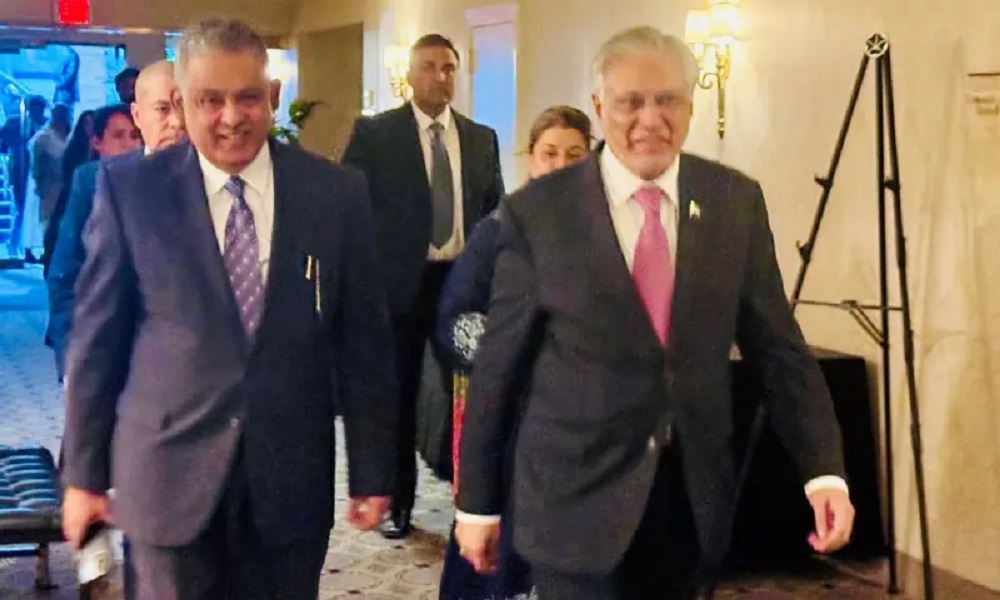
Mohammad Ishaq Dar, Pakistan’s Deputy Prime Minister and Foreign Minister, has arrived in Washington on an official visit.
During the trip, Ishaq Dar is expected to meet and hold talks with U.S. Secretary of State and National Security Adviser Marco Rubio on bilateral and regional issues.
Pakistan’s Foreign Ministry said that after concluding his meetings and official engagements, Dar will return to Islamabad later the same day.
Pakistan is playing a mediating role in the negotiations between Iran and the United States.
Regional
Iran and US trade air strikes after Trump dismisses report of Hormuz deal
Trump said no single country would have control over the waterway, and appeared to threaten Oman, a country with which the U.S. has decades-long military and economic ties.

Iran’s Revolutionary Guard said on Thursday it targeted a U.S. airbase after the U.S. military carried out what a Washington official said were strikes targeting an Iranian drone operation near the Strait of Hormuz, hours after President Donald Trump rejected a report he was close to a compromise deal with Tehran, Reuters reported.
The escalation in hostilities highlighted threats to the tenuous ceasefire between the U.S. and Iran that took effect in early April, dampening hopes for a peace deal and sending oil prices surging again.
The U.S. official, who requested anonymity to speak candidly about military operations, told Reuters the military shot down four Iranian attack drones and struck a ground control station in the port city of Bandar Abbas that was about to launch a fifth drone.
“These actions were measured, purely defensive and intended to maintain the ceasefire,” the official said.
The Islamic Revolutionary Guard Corps said it targeted a U.S. base in response to what it described as an early morning U.S. attack near Bandar Abbas airport, Tasnim news agency reported. The IRGC said they targeted the U.S. airbase from which the attack on the control station near Bandar Abbas was launched.
Kuwait – which hosts a large U.S. base – said it was responding to missile and drone attacks without saying where the attacks were coming from, read the report.
Israel, which has been fighting Iran-backed Hezbollah militants in southern Lebanon, also reported sounding sirens regarding hostile aircraft activity in northern Israel.
Oil prices, having fallen more than 5% on Wednesday, rebounded after reports of the escalation in hostilities. U.S. crude futures gained more than 3%, while stocks fell and the dollar rose.
The war has killed thousands and sent global energy prices sharply higher since it began on February 28 with U.S. and Israeli strikes. Trump has repeatedly said that a deal is close at hand.
At a cabinet meeting attended by media on Wednesday, Trump dismissed an Iranian state TV report that it had obtained an unofficial draft of an agreement to restore commercial shipping through the strait to prewar levels within a month, with Iran and Oman jointly managing traffic.
Trump said no single country would have control over the waterway, and appeared to threaten Oman, a country with which the U.S. has decades-long military and economic ties.
“Nobody’s going to control (the strait),” Trump said. “It’s international waters and Oman will behave just like everybody else or we’ll have to blow them up. They understand that, they’ll be fine.”
Trump added that he was not yet satisfied on a deal with Iran and the U.S. was not discussing easing sanctions on the country.
The White House and Oman’s embassy in Washington did not immediately respond to a request for comment.
Iran’s permanent mission to the United Nations was not immediately available for comment.
The Iranian TV report of a framework deal said the United States would also lift its blockade of Iranian ports and withdraw military forces from Iran’s vicinity.
Ebrahim Azizi, head of the Iranian parliament’s national security committee, said Trump’s “rhetoric” would not force Iran to back away from its demands to enrich uranium, wield authority over the strait and see sanctions against it lifted.
“It is obvious Trump, seeking a way out of this strategic deadlock, alternates between issuing threats and appealing for an agreement,” Azizi said in a post on X.
The strait, which handled a fifth of the world’s oil and liquefied natural gas traffic before the war, the dismantling of Iran’s nuclear capacity and ongoing sanctions are the sticking points in talks seeking to end the three-month conflict.
The waterway is covered by international law that guarantees foreign vessels the right to pass through.
The U.S. Treasury Department added the Persian Gulf Strait Authority, the Iranian body set up to manage passage through the strait, to a list of sanctioned people and entities seen as posing threats to U.S. national security, Reuters reported.
Iranian state TV said the draft deal would also have the U.S. withdraw military forces from the immediate vicinity, though it said the issue of U.S. troops in the region needed further discussion. The White House dismissed the report as a “complete fabrication.” Tehran did not comment.
The Iranian TV report on the draft agreement did not mention Iran’s nuclear program, which the U.S. wants disbanded.
Iranian sources have said talks on the nuclear issue will come in a second round of negotiations – something that may not be acceptable to some of Trump’s closest supporters. Iran says its nuclear program is for peaceful purposes only.
“The bottom line is Iran’s never going to have a nuclear weapon,” U.S. Secretary of State Marco Rubio said at the cabinet meeting.


Defense minister: Russia military-technical cooperation deal aims to strengthen Afghanistan’s defense capabilities

Afghanistan war crimes claims review dismissed, UK inquiry hears

Deadly highway crash in Laghman kills 18, injures 29

Hajj minister attends closing ceremony of hajj season in Mecca

Pentagon chief sounds ‘alarm’ over China’s buildup, urges allies to boost defence spend

New Afghanistan-China transport corridor launched via Turkmenistan

Afghanistan signs $46 million deal to develop standard laboratory complexes

Germany to launch online visa system for Afghan study and work applicants in Pakistan

Large blast near Beit Shemesh part of pre-planned test: Israeli defense firm

Trump returns from China with stability but little progress

Tawsia: Afghanistan’s weekly economic roundup reviewed

Tahawol: Kabul Pursuing Constructive Regional Diplomacy

Saar: Afghanistan, Russia sign military cooperation agreement

Saar: IEA seeking Sharia-based global engagement

Tahawol: Islamic Emirate defense minister’s visit to Russia
-

 Sport3 days ago
Afghanistan announce squad for India series
-
 Latest News2 days ago
Afghanistan, Russia sign military cooperation agreement
-
 Latest News3 days ago
‘We will never bow our heads before infidels,’ says IEA Supreme Leader
-
 Business2 days ago
Afghanistan expands oil production as investment in Amu Darya fields grows
-
 Latest News2 days ago
Mujahid calls for stronger Afghanistan-Russia relations during Moscow meeting
-
 Latest News4 days ago
China and Pakistan deepen Afghanistan cooperation after Beijing talks
-

 Sport3 days ago
ATN secures exclusive rights to broadcast Afghanistan Tour of India
-
 Latest News1 day ago
Work on TAPI project in Afghanistan ongoing and accelerating: Mujahid