
Latest News
Aid starts arriving after entire villages destroyed in deadly quake

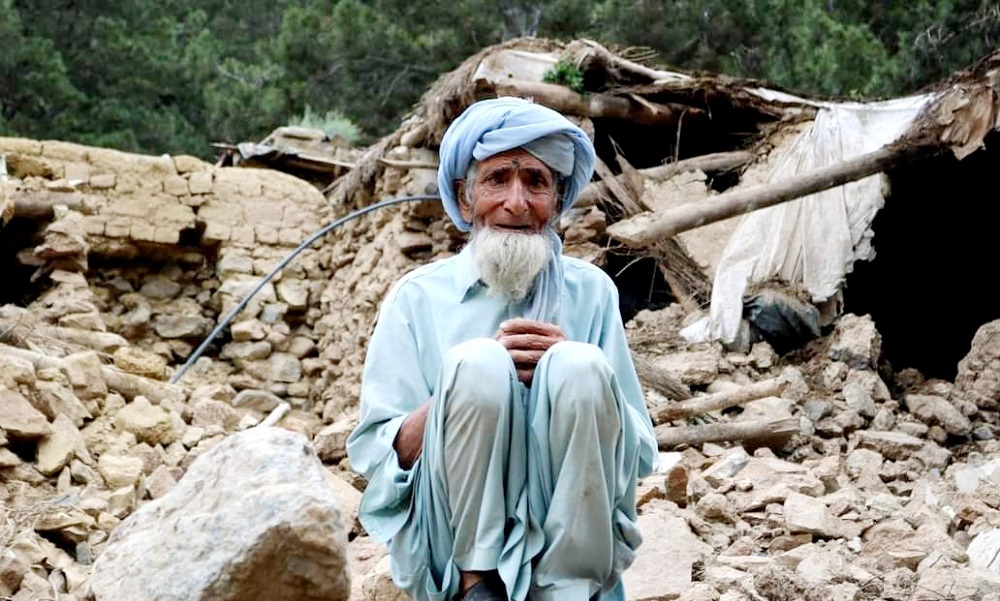
Villagers rushed to bury the dead on Thursday and dug through rubble by hand in search of survivors following Wednesday’s deadly 6.1 magnitude earthquake that has killed over 1,000 people and injured hundreds more.
The quake, which struck just before 2am on Wednesday morning, while most people were asleep, has completely destroyed hundreds of houses and in some cases entire villages.
AP reported that in a village in Paktika, the men dug a row of graves as they tried to lay the dead to rest quickly in line with Muslim tradition.
In one courtyard, bodies lay wrapped in plastic to protect them from the rain that is hampering relief efforts for survivors.
The quake was Afghanistan’s deadliest in 20 years and officials have warned the casualty toll could rise.
NGOs have heeded the Islamic Emirate’s desperate appeal for help and aid is starting to make its way into the affected areas.
Among those who stepped in to help was the Bayat Foundation, which sent in an ambulance, medical supplies and a team of doctors, who will operate a mobile clinic in the worst hit areas to help the injured.
The World Food Program, Pakistan, Qatar, Iran and the United Nations have also dispatched assistance and aid along with other UN agencies.
Paktika residents meanwhile came together on Thursday and in conjunction with a charity association and local businesses established a collection of cash, food and water for those in need.
By mid-day these residents had already collected over 200,000 Afghanis for quake victims.
Afghanistan’s national cricket hero Rashid Khan also reached out to his fans and launched an appeal for donations on his social media pages.
In a rare move, the IEA’s supreme leader, Haibatullah Akhundzadah, pleaded for help from the world on Wednesday. In a statement he called on the international community to send in help as soon as possible.
However, the full extent of the devastation among villages in remote mountainous regions was slow in coming to light.
The head of the Paktika provincial health department Dr Hekmatullah Esmat told Ariana News early Thursday that in Paktika alone, “hundreds of families have been killed”.
One survivor, who spoke to Ariana News, said he lost 18 members from his 24-member family in the quake.
The official death toll has however been put at almost 1,000 but officials have said this tally is expected to rise.
The earthquake struck just before 2am on Wednesday morning, when most people were asleep. Thousands of village houses collapsed, resulting in the high casualty toll.










Kazakhstan’s Foreign Minister Mukhtar Tileuberdi has called for pragmatic and coordinated international engagement with Afghanistan, saying the country’s long-term stability is closely linked to the security and sustainable development of Central Asia.
Speaking during the general debate of the 81st session of the United Nations General Assembly in New York on Friday, Tileuberdi said humanitarian assistance to Afghanistan remains essential but alone cannot break the cycle of poverty, displacement and dependency.
He said Kazakhstan supports a “pragmatic, coordinated and step-by-step” approach to international engagement with Afghanistan, with the United Nations playing a central role.
Tileuberdi also said Kazakhstan is working with the UN to operationalize the United Nations Regional Centre for the Sustainable Development Goals for Central Asia and Afghanistan in Almaty.
He said the success of the centre should be measured by the results and assistance it delivers to the region.


Trump rejects Iranian proposal to open Hormuz and end fighting

Abu Muslim Farah defeat Khurasan Faryab 2-0 in ACL season six

Saar: Concerns over Pakistan’s political crisis discussed

Afghanistan Champions League: Omar Zawak Herat beat Toofan Herat 1-0

Blast in Pakistan’s Dera Ismail Khan kills 11, injures 30

Saudi energy group signs major Afghanistan deals covering gas exploration and pipeline plans

Trump floats idea of renaming Atlantic or Pacific Ocean

US hits Egyptian bank branches with Iran sanctions as war marks six months

Nepal flood rescue mission enters critical phase as thousands remain missing

Iranian clubs to face Gulf opponents at neutral venues in Asian Champions League Elite
Saar: Concerns over Pakistan’s political crisis discussed

Exclusive interview with Abdul Latif Mansoor, Minister of MRRD

Tawsia: Overview of Afghanistan’s iron mines

Tahawol: Discussion on fresh Pakistani airstrikes on Afghanistan

Saar: Calls for international support for Afghanistan discussed
-

 Latest News4 days ago
Ariana Afghan Airlines ranks seventh among 45 Central Asian airlines
-

 Latest News5 days ago
UN reiterates call for respect for international law after Kunar airstrikes
-

 Regional4 days ago
US and Iran hold first talks since June after Trump’s ‘annihilation’ threat
-

 Latest News4 days ago
Silk Road highway in Wakhan corridor now reaches the China border
-

 Regional3 days ago
Iran airlines cancel flights as US sanctions hit
-

 Latest News5 days ago
Afghan Official: Pakistan’s airstrikes will not go unanswered
-

 Regional5 days ago
G7 foreign ministers call on Iran to stop arming Houthis
-

 Sport5 days ago
Afghan boxing referee heads to China for international festival