
World
Biden hits Russia with new sanctions for ‘premeditated’ Ukraine attack

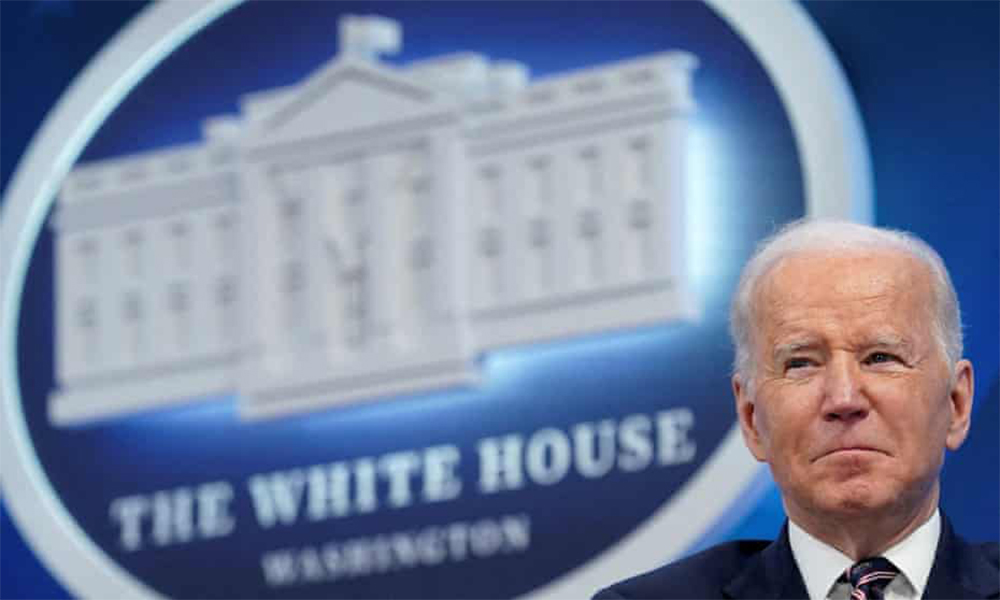
President Joe Biden hit Russia with a wave of sanctions on Thursday after Moscow invaded Ukraine, measures that impede Russia’s ability to do business in major currencies along with sanctions against banks and state-owned enterprises, Reuters reported.
Biden described Russian President Vladimir Putin as an aggressor with a “sinister vision of the world” and a misguided dream of recreating the Soviet Union.
But he held back from imposing sanctions on Putin himself and from disconnecting Russia from the SWIFT international banking system, amid differences with Western allies over how far to go at this juncture and criticism from Republicans that he should have done more.
According to Reuters Ukrainian forces battled Russian invaders on three sides on Thursday, prompting tens of thousands of people to flee their homes.
“This is a premeditated attack,” Biden told reporters at the White House. “Putin is the aggressor. Putin chose this war. And now he and his country will bear the consequences.”
Biden said the sanctions were designed to have a long-term impact on Russia and to minimize the impact on the United States and its allies. And he said Washington was prepared to do more.
The sanctions are aimed at limiting Russia’s ability to do business in dollars, euros, pounds and yen. Among the targets were five major banks, including state-backed Sberbank and VTB, as well as members of the Russian elite and their families. Sberbank, Russia’s largest lender, will no longer be able to transfer money with the assistance of U.S. banks.
The White House also announced export restrictions aimed at curbing Russia’s access to everything from commercial electronics and computers to semiconductors and aircraft parts, read the report.
‘DANGEROUS MOMENT’
Biden said NATO would meet on Friday to map out further measures and reiterated that the United States would not engage in war with Russia. But he said the United States would meet its Article 5 commitments, in which NATO members agree an armed attack against one of them in Europe or North America will be considered an attack against them all. Since Ukraine is not a NATO member, those protections do not apply.
Biden said this was “a dangerous moment for all of Europe,” and that he had authorized troops that had been placed on standby to deploy to Germany. He declined to comment on whether he would urge China to join the West’s drive to isolate Russia.
U.S. Senate Republican leader Mitch McConnell said the world was watching how Washington responds, Reuters reported.
He said Congress would support “truly devastating sanctions” against the Kremlin, but he said Biden should have imposed tough sanctions early enough to deter an invasion and weaken Russia.
“Sadly, deterrence after the fact is not deterrence at all,” McConnell said in a statement.
Biden met with his counterparts from the Group of Seven allies and his National Security Council on Thursday, after speaking with Ukrainian President Volodymyr Zelenskiy late on Wednesday.
His announcement represented the second major tranche of sanctions against Russia since Putin earlier this week declared two breakaway regions of Ukraine independent and sent troops there.
The United States had warned it would initiate waves of sanctions against Moscow if it further invaded Ukraine, and Russia’s full-on military assault launched on Thursday led to the latest round of Western penalties, read the report.
White House press secretary Jen Psaki later told reporters the Biden administration believes Putin has “grander ambitions than Ukraine” without offering further details.
On Wednesday Washington imposed sanctions on the company in charge of building Russia’s Nord Stream 2 gas pipeline, and on Tuesday it sanctioned two large Russian financial institutions and Russian sovereign debt along with some members of the Russian elite and their family members.
The moves are aimed at pushing up inflation and interest rates in Russia, lowering purchasing power, investment, growth and living standards, White House economic adviser Daleep Singh told reporters on Thursday.
Biden has become the face of the Western response to Russian aggression at a time when he is battling low poll numbers at home, rising inflation that could be exacerbated by the Ukraine conflict, and looming midterm elections that could hand control of the Senate and House of Representatives from his fellow Democrats to Republicans, Reuters reported.
Officials said he briefed leaders in the U.S. Congress about the Ukraine crisis during a secure call on Thursday.
The White House has warned Americans that the conflict could lead to higher fuel prices in the United States, though it is taking measures to help soften that blow. U.S. officials have been working with counterparts in other countries on a combined release of additional oil from global strategic crude reserves, two sources said on Thursday.
Biden warned oil and gas companies not to “exploit” this moment to raise prices.






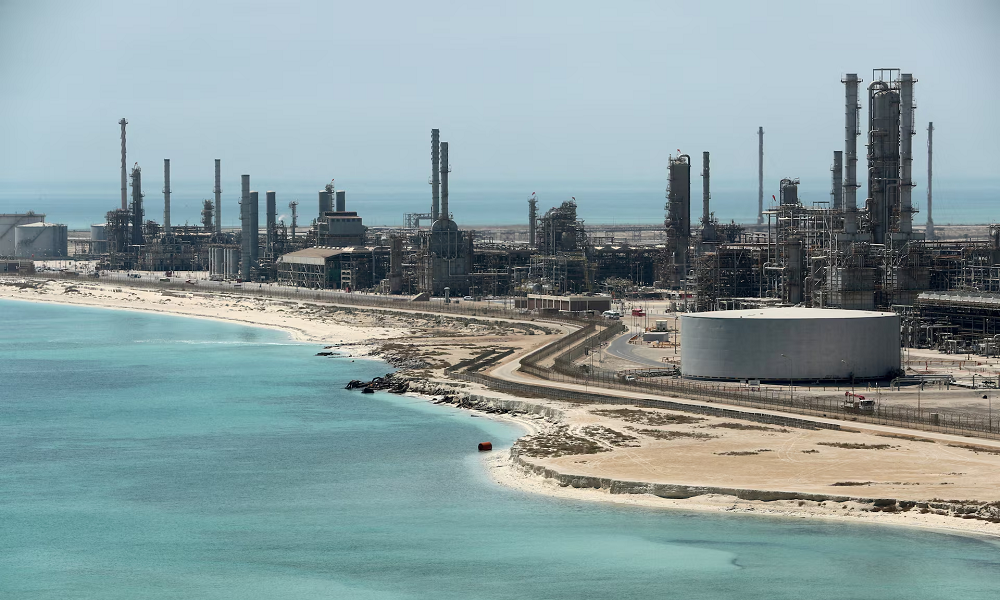
A helicopter belonging to Saudi oil giant Aramco crashed on Sunday in Ras Tanura on Saudi Arabia’s eastern coast on the Gulf, west of the Strait of Hormuz, killing 14 nationals, the state news agency reported, adding that the cause was unknown.
Aramco had resumed crude oil loadings on Friday at its Ras Tanura terminal in the Gulf after they were halted for nearly four months, Reuters reported.
“The relevant authorities have launched a full investigation to determine the cause of the crash,” the state news agency added.
Aramco did not respond immediately to an emailed request for comment.
The incident took place at 6 a.m. local time (0300 GMT), the state agency said, without providing further details.
Saudi Arabia, the world’s biggest oil exporter, has joined a rush to move cargoes after Middle East producers ramped up oil and gas output and exports ahead of an interim deal to halt the war between the United States and Iran.
World
Israel, Lebanon sign initial agreement after US-mediated talks
Israeli Prime Minister Benjamin Netanyahu said the agreement allows Israeli forces to continue to occupy southern Lebanon if Hezbollah does not disarm.
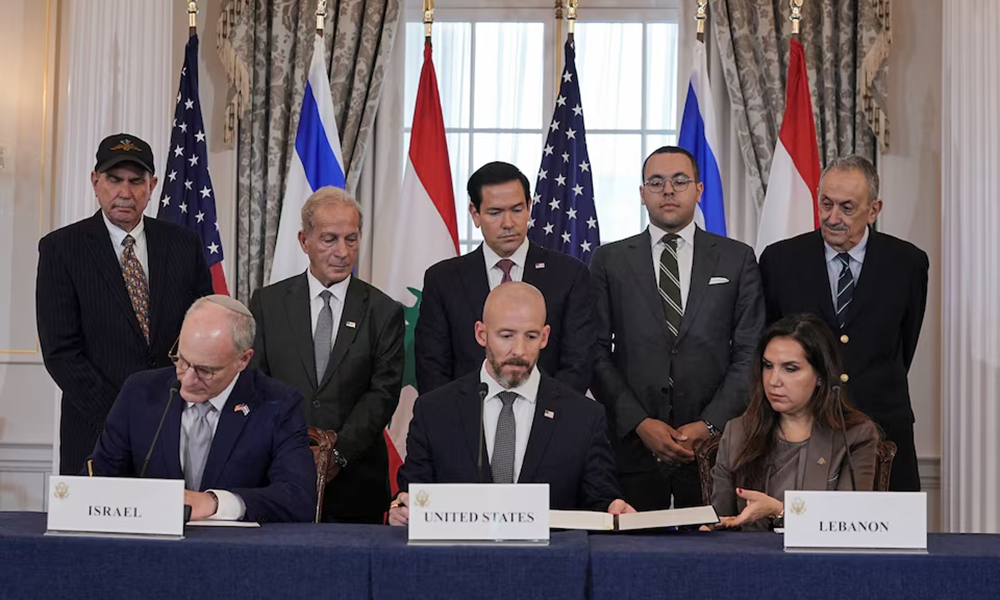
Israel and Lebanon signed a framework agreement in Washington on Friday following several days of talks to secure an end to fighting between Israel and Iran-backed Hezbollahmilitants, though both sides framed the deal as an initial step, Reuters reported.
Lebanese Ambassador Nada Moawad and her Israeli counterpart Yechiel Leiter signed the trilateral document with the U.S. at the State Department in Washington, providing few details.
Israeli Prime Minister Benjamin Netanyahu said the agreement allows Israeli forces to continue to occupy southern Lebanon if Hezbollah does not disarm.
“Today we’ve taken the first step in what will be a difficult journey, without a doubt, but an important and an essential and a necessary one,” U.S. Secretary of State Marco Rubio said before the agreement was inked.
In a later statement he said that the U.S. would facilitate the implementation of the deal through a trilateral “Military Coordination Group for Lebanon” and that Washington would commit significant resources, including an immediate $100 million in humanitarian assistance in coordination with the U.N.
Rubio added that the U.S. reaffirmed its intent to improve the capabilities of the Lebanese Armed Forces “to more effectively establish sovereignty throughout Lebanese territory” with more than $30 million in funds under existing U.S. authorities and appropriations.
The conflict between Israel and Hezbollah broke out when the armed group fired at Israel on March 2, days after the U.S. and Israel attacked Iran. The Hezbollah attacks triggered Israeli air and ground attacks that have killed more than 4,000 people in Lebanon and displaced more than a million.
Lebanon’s Moawad also called it a “first step” on the road to restoring Lebanese sovereignty.
“Iran is out, Hezbollah is out, and the road to peace between Israel and Lebanon is in,” Leiter said.
Netanyahu said in a statement that the deal would also allow the Lebanese army “to begin organizing to take control of territory,” starting with what he described as two “pilot zones” from which Israeli troops would withdraw from land they occupied during the war.
Israel describes that territory as a “security zone” or “buffer zone” where its troops can thwart Hezbollah attacks on northern Israel.
Lebanese President Joseph Aoun said the agreement should allow Lebanese to return to “fully liberated” land and rebuilt homes with “no partner” in its sovereignty.
Israel’s death toll from this round of hostilities with Hezbollah includes at least 32 soldiers and four Israeli civilians. Hezbollah does not release figures on its war dead. Reuters reported on May 4 that several thousand Hezbollah fighters had been killed in the war.
A State Department official told Reuters on Thursday that Israel had agreed to pull back from some of the territory it has occupied, something Israeli and Lebanese officials denied.
Before the talks resumed this week, Israel and Hezbollah agreed to halt fire even as Israel kept troops in southern Lebanon.
Violence has persisted since the ceasefire, with Israel saying on Friday its troops had struck and killed what the military described as seven Hezbollah members who were operating near the territory it is occupying. Reuters could not confirm this.
“To the degree that the Lebanese army performs in dismantling and disarming Hezbollah, we will proceed with additional pilot zones and the ultimate determination of an internationally recognized, secure, and agreed upon border,” Leiter told reporters after the signing.
Hezbollah lawmaker Hassan Fadlallah said Lebanese authorities would not be able to enforce the agreement unless, with U.S. support, “they go to civil war,” pro-Iranian broadcaster Al Mayadeen reported, read the report.
Hezbollah would confront any measure taken by Lebanese authorities and would hold on to its weapons even more, adding that the group’s opposition was “serious” and would not allow authorities to implement their commitments on the ground, Fadlallah said.
Israeli forces dropped leaflets over the southern Lebanese town of Mansouri on Friday ordering residents to leave, Lebanese state media reported, the first such order issued since the latest ceasefire between Israel and Hezbollah took effect.
A senior Lebanese military official said Israel had recently added Mansouri to its occupation zone. The official said Lebanese farmers had continued to enter and leave the town, but had not been living there.
An Israeli military spokesperson said the military issued what it described as a “reminder” to the civilian population that “the area is within the security zone in which (Israeli) soldiers operate. It’s a reminder not to be in the area so they won’t be harmed.”
World
Venezuela earthquake death toll rises to 188 as rescue efforts continue
According to officials, 138 aftershocks have been recorded since the twin 7.2- and 7.5-magnitude earthquakes struck late Wednesday, causing widespread destruction.
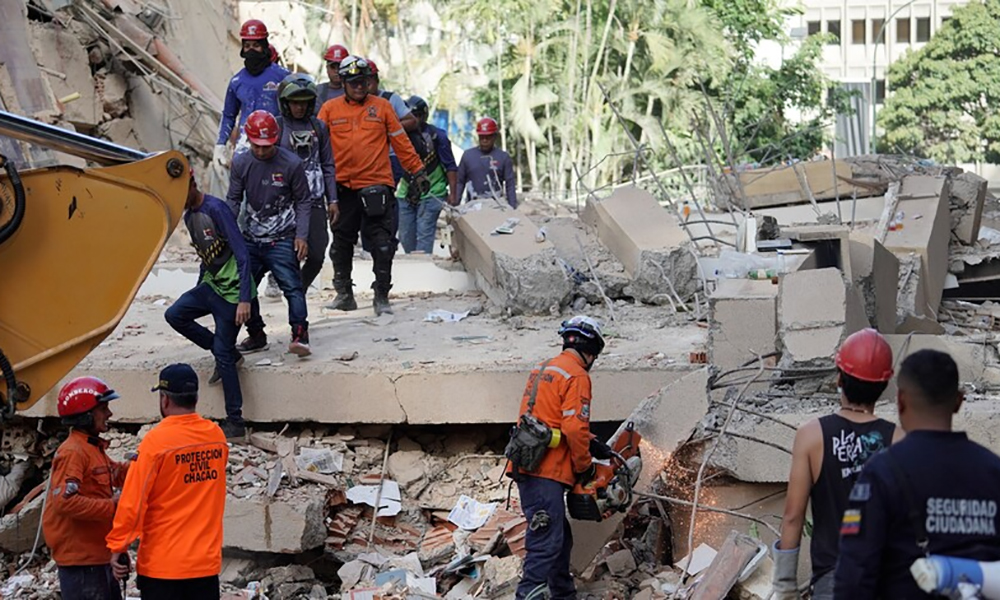
The death toll from the powerful earthquakes that struck Venezuela’s northern Caribbean coast has risen to 188, authorities confirmed on Thursday, as emergency crews continue search and rescue operations.
Jorge Rodriguez, President of Venezuela’s National Assembly, said 1,520 people have been hospitalized with injuries, while 157 people remain missing. Rescue teams are still searching for more than 200 people believed to be trapped beneath collapsed buildings.
According to officials, 138 aftershocks have been recorded since the twin 7.2- and 7.5-magnitude earthquakes struck late Wednesday, causing widespread destruction.
Rodriguez said 346 infrastructure sites sustained damage, including 250 buildings, 20 shopping centers, and eight hospitals, forcing authorities to transfer patients to other medical facilities.
The Venezuelan government has announced the establishment of a $200 million emergency reconstruction fund to support the rebuilding of damaged homes, hospitals, and other critical infrastructure.
Following the disaster, Acting President Delcy Rodriguez declared a national state of emergency, while tsunami warnings were issued across parts of the Caribbean region after the powerful earthquakes.


Tahawol: Calls for diplomacy between Kabul, Islamabad

Saar: US and Iran exchanging attacks

Saudi Aramco helicopter crash kills 14 nationals, state news agency says

Afghanistan eyes direct Basmati rice imports from India amid tensions with Pakistan

Afghan minister says ‘outsiders’ should not claim to support Afghanistan’s independence

Norway’s Viking-inspired World Cup team photo goes viral

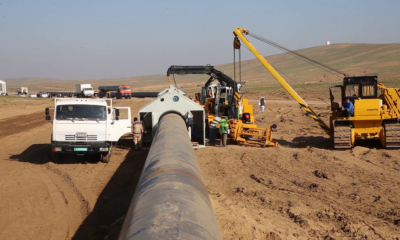
TAPI project advances in Afghanistan as 84kms of pipeline laid

Afghanistan’s trade with Central Asia records sharp growth

Afghanistan to play in Diamond Jubilee Tournament opener against Maldives

Gaikwad set to replace injured Kohli for Afghanistan ODI Series
Tahawol: Calls for diplomacy between Kabul, Islamabad
Saar: US and Iran exchanging attacks

Saar: Concerns over Afghan deportations from Europe discussed

Exclusive interview with Polleak Ok Serei, UNODC Representative for Afghanistan

Tahawol: Germany’s defense of engagement with IEA discussed
-
 Latest News2 days ago
TAPI project sees rapid progress in Afghanistan
-

 International Sports5 days ago
Knockout picture begins to take shape at FIFA World Cup 2026
-

 International Sports2 days ago
FIFA World Cup: Iran held by Egypt after controversial late goal Is disallowed
-
 Latest News5 days ago
Afghanistan’s SCO participation blocked over one member’s objection, Kabulov says
-

 International Sports4 days ago
FIFA World Cup: Messi turns 39, shows no signs of stopping
-
 Latest News5 days ago
EU allocates 20 million euros to support returnees in Afghanistan
-
 Regional5 days ago
Iran’s Pezeshkian says without missiles his country would be ‘just like Gaza’
-
 Latest News1 day ago
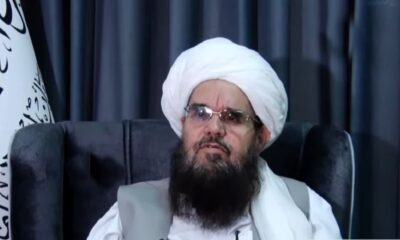
Delawar says Afghanistan has achieved security and unity after 47 years