
Business
Committee for Ground Transportation Established:Masoud

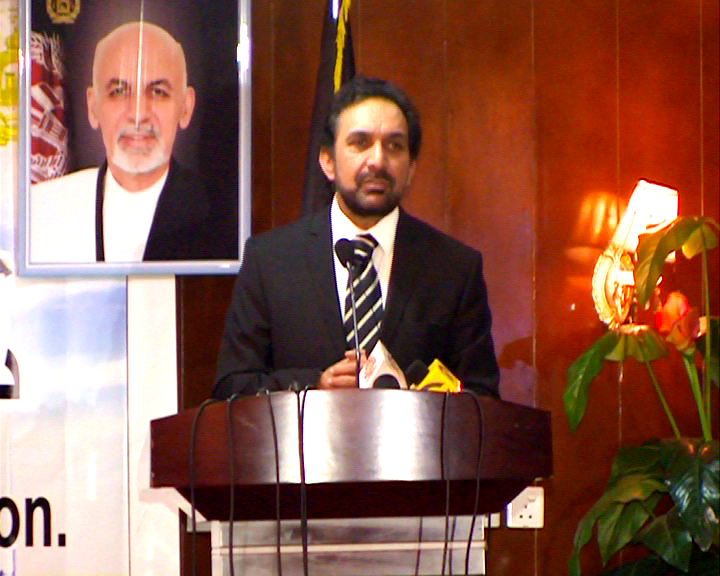

A committee for ground transportation has been established to accelerate activities within the grounds in Afghanistan.
The National Unity Government special envoy on reformation and Good Governance Ahmad Zai Masoud will chair the following committee to combat corruptions and bring reformation within the related departments.
Meanwhile Minister of Transportation Mohammadullah Batash has confirmed the presence of corruption within collecting the taxations which raise deep concerns.
NUG special envoy in good Governance and reformation Ahmad Zai Masoud said,” by establishing of the such committee the ground transportation ties will be strengthened with neighboring countries,saying there is poor management within the system, Minister of public interests is responsible to adopt necessary measurements on the aspect.”
Minister of public interests Mahmood Balegh said,” big plans should be adopted in order to save the asphalted roads,ports responsible don’t have to allow high tonnage inside the cities.”
This comes after that the earliest destruction of roads in Afghanistan has raised Afghans concerns, and the main reasons entitled poor quality of asphalted roads.

Business
Afghanistan, Uzbekistan sign $400 million trade deals in push to deepen ties
The agreements span multiple sectors, including textiles, raw materials, pharmaceuticals and other key industries.
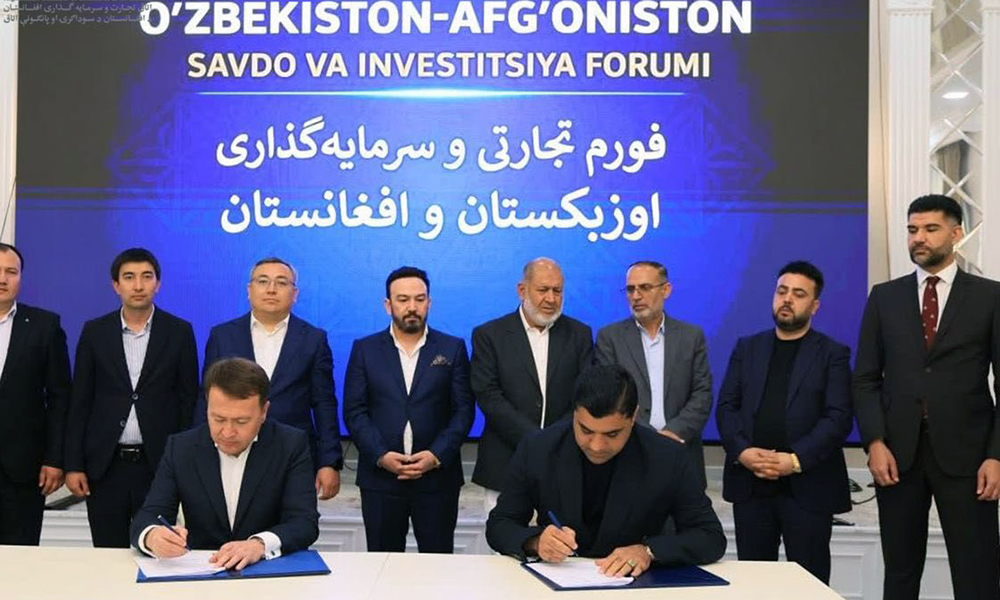
Afghanistan and Uzbekistan have signed 20 commercial agreements worth more than $400 million, marking a significant step toward expanding economic cooperation between the two neighboring countries.
The deals were finalized during a high-level business meeting in Uzbekistan’s Fergana Province, where Afghan and Uzbek private sector representatives gathered as part of an official Afghan trade delegation visit.
The agreements span multiple sectors, including textiles, raw materials, pharmaceuticals and other key industries.
The Afghan delegation was led by Zalgai Azimi, deputy for investment at the Afghan Chamber of Commerce, and included senior business figures such as Abdullah Rahimi, Syed Ahmad Noorzad, Ubaidullah Hotak, and Deputy Chief Executive Mirzaman Popal. Participants from both sides highlighted the importance of strengthening cross-border trade and building long-term commercial partnerships.
As part of the visit, Afghan delegates toured major industrial facilities in Fergana Valley to assess Uzbekistan’s manufacturing capacity and explore opportunities for future collaboration.
The agreements come as Afghanistan seeks to boost regional connectivity and revive its economy following years of conflict, isolation and economic disruption.
Trade with Central Asian neighbors—particularly Uzbekistan—has become increasingly important, with both sides investing in transport links, energy cooperation and cross-border markets.
Uzbekistan has positioned itself as a key economic partner for Afghanistan in recent years, supporting infrastructure projects and promoting trade corridors that connect South and Central Asia.
Analysts say deals of this scale could help generate jobs, increase exports and gradually integrate Afghanistan more deeply into regional supply chains.
The latest agreements signal growing momentum in bilateral relations, as both countries look to translate geographic proximity into stronger economic interdependence.
Business
Afghanistan, Kyrgyzstan aim to boost trade to $1 billion
Both sides welcomed the steady growth in trade between the two countries in recent years and agreed on the strategic goal of increasing bilateral trade to reach $1 billion.
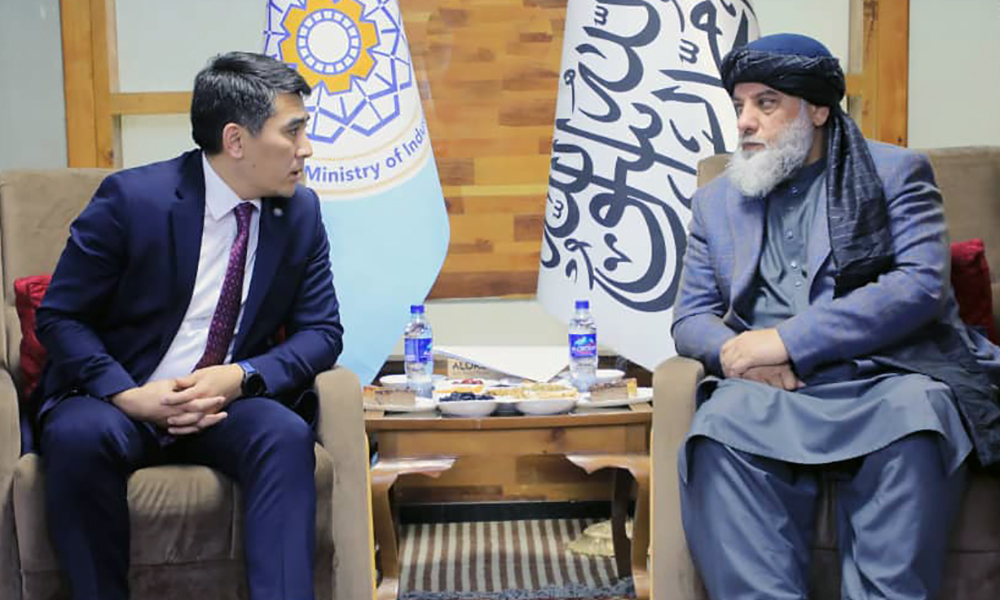
Afghanistan’s Minister of Industry and Commerce, Nooruddin Azizi, met with Kairat Tursunkulov, Deputy Foreign Minister of Kyrgyzstan, in Kabul this week to discuss ways to strengthen economic and trade ties between the two countries.
The meeting was also attended by Turdakun Sadykov, Kyrgyzstan’s ambassador to Afghanistan.
Azizi expressed appreciation for Kyrgyzstan’s participation in the recent Afghanistan–Central Asia consultative meeting and underlined the importance of expanding bilateral trade and economic cooperation.
Tursunkulov described Afghanistan and Kyrgyzstan as “brotherly nations” with strong cultural connections. He extended an invitation for Azizi to visit Kyrgyzstan to further enhance collaboration.
Both sides welcomed the steady growth in trade between the two countries in recent years and agreed on the strategic goal of increasing bilateral trade to reach $1 billion.
In addition, Azizi highlighted ongoing construction projects in Kyrgyzstan and suggested that Afghan construction companies and skilled workers could contribute their expertise to support development efforts in the country.
Business
Kazakhstan eyes rare metals mining projects in Afghanistan and Rwanda
As Kazakhstan looks to expand its global mining footprint, the exploration of rare metals in Afghanistan and Rwanda marks a significant step towards diversifying its mining interests.

Kazakhstan is actively exploring mining opportunities in Afghanistan and Rwanda, focusing on rare metals, as part of a broader strategy to expand its resource development portfolio. According to a report by Kazinform, Tau-Ken Samruk, Kazakhstan’s national mining company, is conducting laboratory studies on mineral samples obtained from both countries.
The announcement was made by Iran Sharkhan, Kazakhstan’s Vice Minister of Industry and Construction, during the Geoscience & Exploration Central Asia 2026 event. Sharkhan emphasized the substantial resource potential in Afghanistan and Rwanda, noting that current efforts are directed towards evaluating the legal and regulatory frameworks in these countries, as well as verifying the geological prospects before proceeding with potential mining operations.
The laboratory testing, which is taking place at Tau-Ken Samruk’s facilities and additional labs in Kazakhstan’s Karaganda region, involves comprehensive analysis of base metals, rare metals, and rare earth elements from the two countries. These tests will determine the viability of large-scale mining operations in the future.
Sharkhan further indicated that if the laboratory results confirm promising geological findings, more detailed plans for mining projects will be disclosed in the coming months.
The report also highlighted that Kazakhstan’s major mining companies have already invested nearly 150 billion tenge into scientific research in the country’s mining sector, reinforcing the nation’s commitment to advancing its mining industry on both the local and international stages.
As Kazakhstan looks to expand its global mining footprint, the exploration of rare metals in Afghanistan and Rwanda marks a significant step towards diversifying its mining interests.


Tahawol: Two‑week truce agreement between Iran-US reviewed

Afghanistan, Pakistan hold ‘constructive’ China-mediated talks

Saar: US–Iran two-week ceasefire agreement discussed

Snooker fever grows as Kabul prepares for Ariana Championship

Aid distributed to flood-affected families as severe weather causes widespread damage

IEA Supreme Leader issues Eid-ul-Fitr message urging unity and support for Islamic system

14 Pakistani soldiers killed after military post falls along Durand line: MoD

IEA supreme leader orders replacement of foreign terminology in official documents

Afghan airstrikes target Pakistani military sites in retaliation for air attacks

Turkmenistan, Afghanistan discuss steps to speed up land acquisition for TAPI pipeline
Tahawol: Two‑week truce agreement between Iran-US reviewed
Saar: US–Iran two-week ceasefire agreement discussed

Tahawol: Ongoing negotiations between Kabul-Islamabad discussed

Saar: Afghanistan in spotlight of SCO discussed

Tahawol: Continuation of Middle East crisis discussed
-
 Latest News3 days ago
IEA supreme leader orders replacement of foreign terminology in official documents
-
 Latest News3 days ago
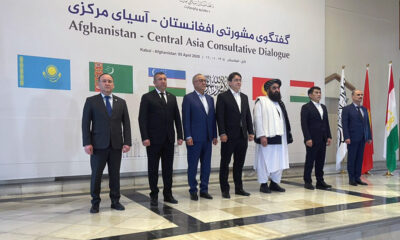
Afghanistan hosts inaugural Afghanistan–Central Asia Consultative Dialogue to strengthen regional cooperation
-

 Business4 days ago
Kazakhstan eyes rare metals mining projects in Afghanistan and Rwanda
-
 Latest News4 days ago
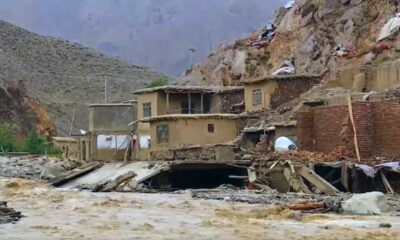
Severe rainfall and natural disasters cause heavy casualties across Afghanistan
-
 Latest News5 days ago
Afghan citizens reported among casualties in US, Israeli attacks, Iran says
-
 Latest News4 days ago
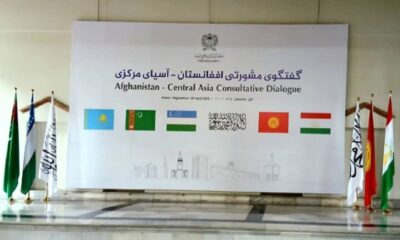
Kabul to host ‘Afghanistan–Central Asia Consultative Dialogue’ tomorrow
-
 Latest News4 days ago
IEA accuses Pakistan of war crimes amid heavy civilian losses
-
 Saar4 days ago
Saar: Ongoing Kabul-Islamabad talks in China discussed