
Latest News
‘Desperate situation’ for Ghani as his power is undermined: NYT

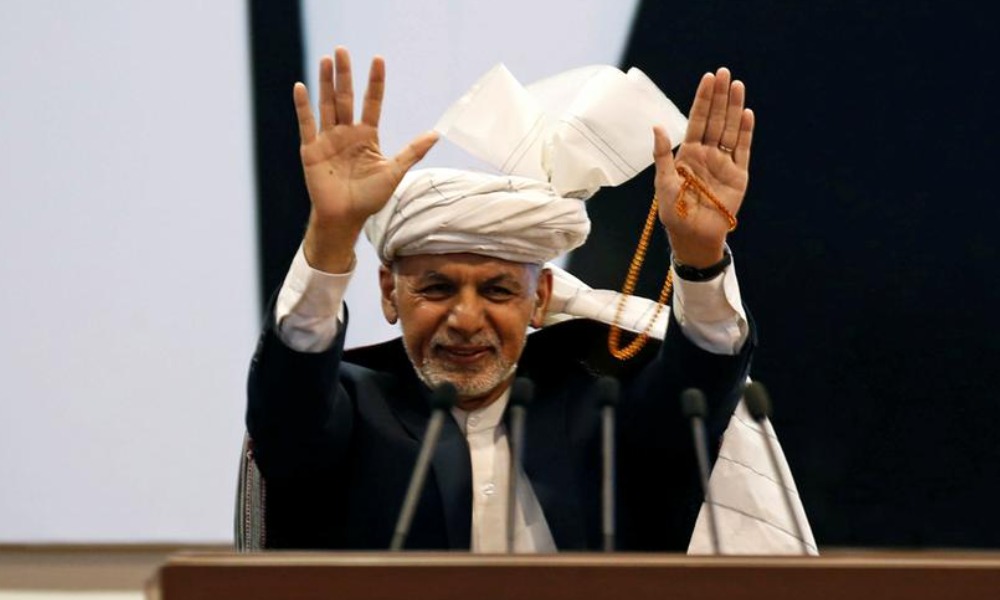
A senior Afghan military official said this week that if the US pulls out without a political settlement having been reached between government and the Taliban, the country will be in “deep trouble”.
Speaking to the New York Times this week, the security official said: “If the US pulls out, and there is no political agreement, then we are in deep trouble.”
“Militarily, we don’t have much hope,” he said. “If we don’t get something, the Taliban are going to march. It’s going to be a severe battle.”
One Western diplomat in Kabul said the country’s military position is deteriorating. Each day brings news of security force members blown up or gunned down.
“They can’t keep doing that,” said the diplomat, commenting on the steady loss of military strength. “The toll on the government, and the credibility and legitimacy it has, it’s not sustainable.”
The New York Times reported that this comes at a time where President Ashraf Ghani has few remaining allies, the Taliban are gaining militarily and his international supporters are impatient with him and the stumbling peace process.
The article questions how much control Ghani actually has over his country’s future and his own – questions that have, according to the NYT, been largely resolved by politicians, analysts and citizen: Not much!
NYT reports Ghani is dependent on the counsel of a handful of people and is unwilling to even watch television news – also that he is losing allies fast.
This, the NYT reports, spells trouble for a country where a hard-line insurgency has the upper hand militarily, where nearly half the population faces hunger at crisis levels, where the majority of government money comes from donors and where weak governance and widespread corruption are endemic.
This, meanwhile, is all taking place as Washington is preparing to pull out its last remaining troops, “a prospect expected to lead to the medium-term collapse of the Afghan forces they now support,” the report read.
Former National Directorate of Security chief Rahmatullah Nabil told the NYT: “He (Ghani) is in a desperate situation.”
“We’re getting weaker. Security is weak, everything is getting weaker, and the Taliban are taking advantage.”
The NYT reported that many are fed up with what they see as Ghani’s obstinacy in refusing to make concessions to adversaries, or his condescending style and that a recent letter to him from US Secretary of State Antony Blinken was so harsh that even Afghans critical of Ghani found it insulting.
The letter used the phrase “I urge you” three times while Blinken also said “I must also make clear to you, Mr. President … that as our policy process continues in Washington, the United States has not ruled out any option.”
The NYT stated that the unspoken subtext was clear: Your influence is minimal.
Hekmat Khalil Karzai, the head of an Afghan think tank reacted to this and said: “As an Afghan, a sense of humiliation comes over you.”
“But I also feel Ghani deserves it,” Karzai said. “He’s dealing with the kiss of death from his own closest partner.”
This comes as US President Joe Biden continues to “review” the agreement signed with the Taliban in February last year – which stipulates Washington pulls out all its troops by May 1 – a deadline that is just three weeks away.
It also comes amid a flurry of meetings between leaders of countries in the region, of US officials and Afghan politicians.
The key issue currently is the US proposal of an interim government followed by elections – an interim government that would include Taliban participation.
As pointed out by the NYT, such a move could require Ghani to step down – something he has until now repeatedly refused to consider.
Ghani has his own plan, which includes early elections but the NYT states, both Washington’s plan and Ghani’s could fall flat as the Taliban have never said they would agree to elections, nor have they indicated that they would go along with any sort of government plan or be content with power-sharing.
“From what we’re seeing, they want absolute power, and they are waiting to take power by force,” Ghani’s national security adviser, Hamdullah Mohib, said in an interview.
Visions of September 1996, when the Taliban rolled into Kabul virtually unopposed and proceeded to establish their harsh regime, haunt the capital, the NYT stated.
Meanwhile some former officials criticized Ghani as being compelled to micromanage all ministries and departments, including that of military matters.
Karzai said: “He likes that, because he feels he’s the only one [competent to make serious decisions].”
But Mohib called the micromanagement accusation “a huge exaggeration,” saying that the president had not attended a security meeting “in weeks,” adding that “he is aware of the strategic picture.”
When contacted by the NYT for an interview, Ghani’s communications office refused, while a senior aide did not respond to an interview request.
A Western diplomat meanwhile told the NYT that the consequences of Ghani’s isolation is not good for Afghan unity and that these divisions spread from Kabul into the country’s fractious regions, where independent militias and other longstanding power-brokers have either rearmed themselves or are preparing to do so.
One example cited by the NYT is the low-intensity fight between government forces and the militia of a minority militia commander, Alipour, which has been smoldering for months.
The fight was recently fueled by the downing of an Afghan forces helicopter in March by Alipour’s men.
The NYT reported that Ghani and his aides have taken an active role in managing the conflict, to the dismay of the Afghan military.
“This is what we wanted to avoid. We are already stretched,” said a senior Afghan security official. “And here, you want to start another war?”
In conclusion, the NYT article noted that the upcoming talks in Turkey, the Istanbul Summit, could well end up like the recent ones in Moscow and Dushanbe, Tajikistan — with bland communiqués deploring violence and hoping for peace.
The American idea — to substitute new talks in a new locale for the old talks in Qatar that have gone nowhere — is not necessarily a winning bet and that early signs are not promising, with Ghani once again rejecting preliminary American proposals, and the Taliban aggressively noncommittal about the ideas currently on the table, the NYT reported.







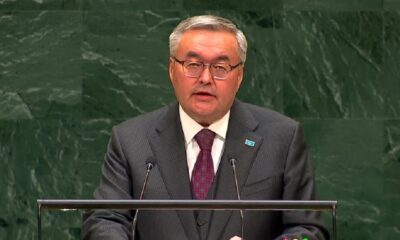




Kazakhstan’s Foreign Minister Mukhtar Tileuberdi has called for pragmatic and coordinated international engagement with Afghanistan, saying the country’s long-term stability is closely linked to the security and sustainable development of Central Asia.
Speaking during the general debate of the 81st session of the United Nations General Assembly in New York on Friday, Tileuberdi said humanitarian assistance to Afghanistan remains essential but alone cannot break the cycle of poverty, displacement and dependency.
He said Kazakhstan supports a “pragmatic, coordinated and step-by-step” approach to international engagement with Afghanistan, with the United Nations playing a central role.
Tileuberdi also said Kazakhstan is working with the UN to operationalize the United Nations Regional Centre for the Sustainable Development Goals for Central Asia and Afghanistan in Almaty.
He said the success of the centre should be measured by the results and assistance it delivers to the region.


Saar: Concerns over Pakistan’s political crisis discussed

Afghanistan Champions League: Omar Zawak Herat beat Toofan Herat 1-0

Blast in Pakistan’s Dera Ismail Khan kills 11, injures 30

Ariana Afghan Airlines increases Kabul-Delhi cargo flights

Khalilzad questions Pakistan’s commitment to Afghan welfare

Saudi energy group signs major Afghanistan deals covering gas exploration and pipeline plans

Trump floats idea of renaming Atlantic or Pacific Ocean

US hits Egyptian bank branches with Iran sanctions as war marks six months

Nepal flood rescue mission enters critical phase as thousands remain missing

Iranian clubs to face Gulf opponents at neutral venues in Asian Champions League Elite
Saar: Concerns over Pakistan’s political crisis discussed

Exclusive interview with Abdul Latif Mansoor, Minister of MRRD

Tawsia: Overview of Afghanistan’s iron mines

Tahawol: Discussion on fresh Pakistani airstrikes on Afghanistan

Saar: Calls for international support for Afghanistan discussed
-

 World5 days ago
CNN, MS NOW and Politico sue Trump, challenging White House ban
-

 Latest News3 days ago
Ariana Afghan Airlines ranks seventh among 45 Central Asian airlines
-

 Latest News4 days ago
UN reiterates call for respect for international law after Kunar airstrikes
-

 Regional3 days ago
US and Iran hold first talks since June after Trump’s ‘annihilation’ threat
-

 Latest News3 days ago
Silk Road highway in Wakhan corridor now reaches the China border
-

 Latest News4 days ago
Afghan Official: Pakistan’s airstrikes will not go unanswered
-

 Sport4 days ago
Afghan boxing referee heads to China for international festival
-
 Regional4 days ago
G7 foreign ministers call on Iran to stop arming Houthis