
Latest News
Erdogan visits Azerbaijan for Karabakh victory parade

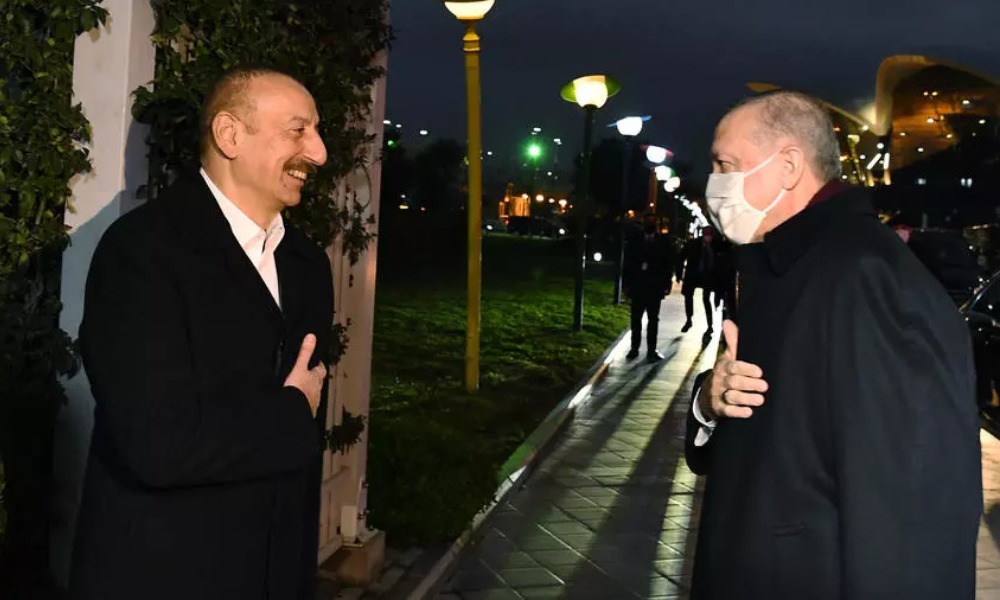
Turkish President Recep Tayyip Erdogan was in Azerbaijan Thursday to join in celebrations to mark the anniversary of the nation’s victory against Armenia following their six-week war over control of the disputed Nagorno-Karabakh territory.
Azerbaijan’s army paraded military hardware and weapons seized from Armenia through the capital Baku ahead of Erdogan’s arrival to rehearse for a large-scale victory parade on Thursday.
France24 reported the Turkish leader’s visit to Azerbaijan was an opportunity to celebrate together the “glorious victory” against Armenia for control of the mountainous Nagorno-Karabakh region, Erdogan’s office said.
Erdogan was scheduled to hold talks with Azerbaijani counterpart Ilham Aliyev and preside over the military showcasing that is the culmination of nationwide festivities for the victory, France24 reported.
The Turkish president’s visit came weeks after Armenia and Azerbaijan agreed on a deal with Russia to end clashes over Nagorno-Karabakh after a string of Azerbaijani victories in its fight to retake the disputed region.
Azerbaijan’s historic win was an important geopolitical coup for Erdogan who has cemented Turkey’s leading role as a powerbroker in the ex-Soviet Caucasus region.
Turkey backed Azerbaijan during the six weeks of fighting that erupted in late September and left more than 5,000 people dead and Ankara was accused of sending mercenaries from Syria to bolster Baku’s army, but denied the charge.
Meanwhile, Amnesty International on Thursday said in a statement that both Azerbaijani and Armenian forces committed war crimes during the recent fighting.
According to Amnesty International videos showing the decapitation of captives and the desecration of corpses had been analyzed and verified.
Amnesty International analysed 22 videos that depict extrajudicial executions, the mistreatment of prisoners of war and other captives, and desecration of the dead bodies of enemy soldiers.
Two videos show extrajudicial executions by decapitation by Azerbaijani military members, while another video shows the cutting of an Azerbaijani border guard’s throat that led to his death, the statement read.
“During the recent Nagorno-Karabakh fighting, members of the military on both sides have behaved horrendously, displaying a complete disregard for the rules of war,” said Denis Krivosheev, Amnesty International’s Research Director for Eastern Europe and Central Asia
“The depravity and lack of humanity captured in these videos shows the deliberate intention to cause ultimate harm and humiliation to victims, in clear violation of international humanitarian law.
“Both Azerbaijani and Armenian authorities must immediately conduct independent, impartial investigations and identify all those responsible. The perpetrators – as well as any commanding officers who ordered, allowed or condoned these crimes – must be brought to justice,” he said.











Kazakhstan’s Foreign Minister Mukhtar Tileuberdi has called for pragmatic and coordinated international engagement with Afghanistan, saying the country’s long-term stability is closely linked to the security and sustainable development of Central Asia.
Speaking during the general debate of the 81st session of the United Nations General Assembly in New York on Friday, Tileuberdi said humanitarian assistance to Afghanistan remains essential but alone cannot break the cycle of poverty, displacement and dependency.
He said Kazakhstan supports a “pragmatic, coordinated and step-by-step” approach to international engagement with Afghanistan, with the United Nations playing a central role.
Tileuberdi also said Kazakhstan is working with the UN to operationalize the United Nations Regional Centre for the Sustainable Development Goals for Central Asia and Afghanistan in Almaty.
He said the success of the centre should be measured by the results and assistance it delivers to the region.


Abu Muslim Farah defeat Khurasan Faryab 2-0 in ACL season six

Saar: Concerns over Pakistan’s political crisis discussed

Afghanistan Champions League: Omar Zawak Herat beat Toofan Herat 1-0

Blast in Pakistan’s Dera Ismail Khan kills 11, injures 30

Ariana Afghan Airlines increases Kabul-Delhi cargo flights

Saudi energy group signs major Afghanistan deals covering gas exploration and pipeline plans

Trump floats idea of renaming Atlantic or Pacific Ocean

US hits Egyptian bank branches with Iran sanctions as war marks six months

Nepal flood rescue mission enters critical phase as thousands remain missing

Iranian clubs to face Gulf opponents at neutral venues in Asian Champions League Elite
Saar: Concerns over Pakistan’s political crisis discussed

Exclusive interview with Abdul Latif Mansoor, Minister of MRRD

Tawsia: Overview of Afghanistan’s iron mines

Tahawol: Discussion on fresh Pakistani airstrikes on Afghanistan

Saar: Calls for international support for Afghanistan discussed
-

 World5 days ago
CNN, MS NOW and Politico sue Trump, challenging White House ban
-

 Latest News3 days ago
Ariana Afghan Airlines ranks seventh among 45 Central Asian airlines
-

 Latest News5 days ago
UN reiterates call for respect for international law after Kunar airstrikes
-

 Regional4 days ago
US and Iran hold first talks since June after Trump’s ‘annihilation’ threat
-

 Latest News3 days ago
Silk Road highway in Wakhan corridor now reaches the China border
-

 Regional3 days ago
Iran airlines cancel flights as US sanctions hit
-

 Latest News5 days ago
Afghan Official: Pakistan’s airstrikes will not go unanswered
-

 Sport5 days ago
Afghan boxing referee heads to China for international festival