
Latest News
Almost half a million Afghans return home from Iran in past 100 days
Afghan authorities in Herat and Nimroz have reported growing pressure on local services and have appealed for greater international support to assist returnees.


Nearly 490,000 undocumented Afghan nationals have voluntarily left Iran through the Dogharoun/Islam Qala border crossing in the past 100 days, according to Amirollah Shamghadari, deputy governor of Khorasan Razavi Province, which borders western Afghanistan.
In a statement this weekend, Shamghadari emphasized that the process has been conducted “with full respect and human dignity,” in line with Iran’s official policy of supporting voluntary, humane, and lawful departures.
“Sixty-seven percent of all Afghan exits have taken place via Dogharoun,” he noted, highlighting the crossing as the busiest point of return for Afghan nationals.
According to Iranian authorities, 26,000 Afghans crossed the border on Friday alone, many bypassing refugee camps entirely and proceeding directly into Afghanistan. Shamghadari said priority was being given to families who had voluntarily introduced themselves to authorities, rather than those apprehended during routine checks.
The official also underscored Iran’s rejection of xenophobia and anti-Afghan sentiment, pointing to the historic and cultural ties between the two neighboring countries. He said Afghan returnees had expressed satisfaction with services at the Safid Sang and Hasanabad camps, which are providing short-term humanitarian assistance.
Allegations of espionage dismissed
Responding to recent speculation that the exodus may be tied to espionage or infiltration concerns—including unverified claims of Afghan involvement in Israeli intelligence activities—Shamghadari dismissed such assertions as part of a “psychological operation” orchestrated by hostile actors.
“These are baseless rumors spread by the enemies of Iran. Our goal is to organize the current situation, not to politicize it,” he stated.
He added that Iran is exploring legal pathways for future re-entry by Afghan nationals under a regulated framework once identity, security, and documentation processes are streamlined.
The large-scale return of Afghan nationals, many of whom had been living in Iran without legal status for years, presents significant humanitarian and logistical challenges on both sides of the border.
Afghan authorities in Herat and Nimroz have reported growing pressure on local services and have appealed for greater international support to assist returnees.
According to the International Federation of Red Cross and Red Crescent Societies (IFRC), hundreds of thousands of Afghans have returned from Iran this year, with June alone seeing more than 137,000 arrivals via Islam Qala and Dogharoun.
Iran, long a host to millions of Afghan migrants and refugees, maintains that it will continue to coordinate with Afghan authorities and humanitarian agencies to ensure an orderly and respectful process.







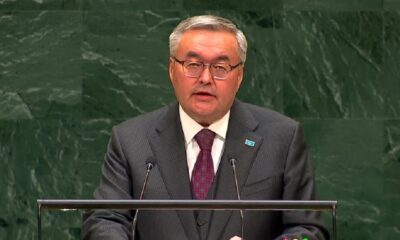




Kazakhstan’s Foreign Minister Mukhtar Tileuberdi has called for pragmatic and coordinated international engagement with Afghanistan, saying the country’s long-term stability is closely linked to the security and sustainable development of Central Asia.
Speaking during the general debate of the 81st session of the United Nations General Assembly in New York on Friday, Tileuberdi said humanitarian assistance to Afghanistan remains essential but alone cannot break the cycle of poverty, displacement and dependency.
He said Kazakhstan supports a “pragmatic, coordinated and step-by-step” approach to international engagement with Afghanistan, with the United Nations playing a central role.
Tileuberdi also said Kazakhstan is working with the UN to operationalize the United Nations Regional Centre for the Sustainable Development Goals for Central Asia and Afghanistan in Almaty.
He said the success of the centre should be measured by the results and assistance it delivers to the region.


Saar: Concerns over Pakistan’s political crisis discussed

Afghanistan Champions League: Omar Zawak Herat beat Toofan Herat 1-0

Blast in Pakistan’s Dera Ismail Khan kills 11, injures 30

Ariana Afghan Airlines increases Kabul-Delhi cargo flights

Khalilzad questions Pakistan’s commitment to Afghan welfare

Saudi energy group signs major Afghanistan deals covering gas exploration and pipeline plans

Trump floats idea of renaming Atlantic or Pacific Ocean

US hits Egyptian bank branches with Iran sanctions as war marks six months

Nepal flood rescue mission enters critical phase as thousands remain missing

Iranian clubs to face Gulf opponents at neutral venues in Asian Champions League Elite
Saar: Concerns over Pakistan’s political crisis discussed

Exclusive interview with Abdul Latif Mansoor, Minister of MRRD

Tawsia: Overview of Afghanistan’s iron mines

Tahawol: Discussion on fresh Pakistani airstrikes on Afghanistan

Saar: Calls for international support for Afghanistan discussed
-

 World5 days ago
CNN, MS NOW and Politico sue Trump, challenging White House ban
-

 Latest News3 days ago
Ariana Afghan Airlines ranks seventh among 45 Central Asian airlines
-

 Latest News4 days ago
UN reiterates call for respect for international law after Kunar airstrikes
-
 Latest News5 days ago
Khalilzad condemns Pakistan airstrikes, says current strategy is not working
-

 Regional3 days ago
US and Iran hold first talks since June after Trump’s ‘annihilation’ threat
-

 Latest News3 days ago
Silk Road highway in Wakhan corridor now reaches the China border
-

 Latest News4 days ago
Afghan Official: Pakistan’s airstrikes will not go unanswered
-

 Sport4 days ago
Afghan boxing referee heads to China for international festival