
Latest News
A battlefield decision might be needed if Taliban shun peace: Ghani

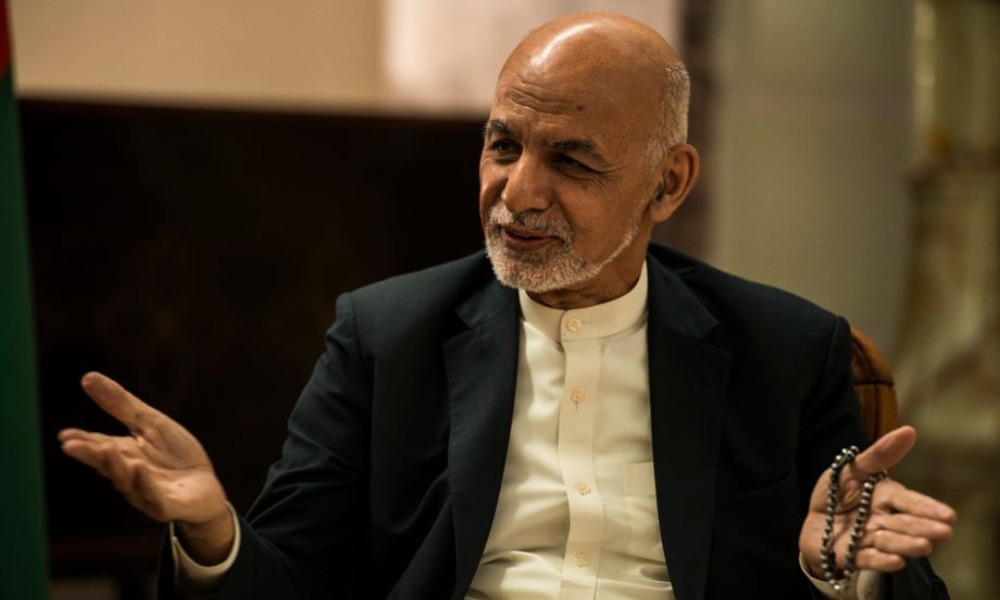
Afghan President Ashraf Ghani said on Monday if the Taliban wants peace, then it has to be peace that respects the gains of the citizens of Afghanistan and among them, first and foremost, women.
In an interview with PBS News Hour, Ghani also said if the Taliban does not want peace and wants to gain power through violence and impose a “dictatorial regime” then “all the patriotic forces of Afghanistan would have to rally and make a decision. And that issue, unfortunately, would have to be decided on the field of battle.”
In terms of foreign troops withdrawing and the possibility of increased violence, Ghani said the Afghan security forces are ready for battle. “We have been ready for months.”
He noted that the U.S. withdrawal is a strategic decision “that clarifies a lot of things.
“The war will become simpler, because their — all their allegations of international conspiracy or international desire to stay permanently, et cetera, has now come to an end. We need to work together,” he said.
He also stated that countries in the region are glad the U.S. has no intentions of staying longer.
“Consequently, we need to get together to arrive at a collective security strategy.
Despite a push by the Taliban to gain territory in provinces, Ghani said: “The Taliban are not holding.”
He said the Taliban are carrying out “sporadic attacks” that are a “destructive force”.
“Arghandab was the only district in Kandahar where they tried to hold. And now the people hate them with passion,” he said.
On peace talks, Ghani said that key to a political dialogue is that the Taliban accept that the future political system of Afghanistan is based on elections.
“That is the fundamental bottom line. Other things are discussible, negotiable. But if that fundamental issue is not granted, then the question of rights and the question of gains that have occurred in the last 20 years, particularly vis-a-vis women, youth, minorities, all walks of life, will be put into question.”
Asked whether he would step down Ghani said No. Sticking to what he has repeatedly said about only handing over power to an elected leader, he said: If there is war — no.
“If there is war, I am the commander in chief. I will not abandon my people. I will not abandon my forces. I am willing to die for my country. I have no interest in power. I’m committed to the principle of ensuring order. Afghan society wants order.”
However, he said the threat of terrorism has changed. It has not disappeared.
The terrorist networks are not just from the region, he said, adding that there are Daesh women and children from 16 different countries that Afghanistan is trying “to return”.












Kazakhstan’s Foreign Minister Mukhtar Tileuberdi has called for pragmatic and coordinated international engagement with Afghanistan, saying the country’s long-term stability is closely linked to the security and sustainable development of Central Asia.
Speaking during the general debate of the 81st session of the United Nations General Assembly in New York on Friday, Tileuberdi said humanitarian assistance to Afghanistan remains essential but alone cannot break the cycle of poverty, displacement and dependency.
He said Kazakhstan supports a “pragmatic, coordinated and step-by-step” approach to international engagement with Afghanistan, with the United Nations playing a central role.
Tileuberdi also said Kazakhstan is working with the UN to operationalize the United Nations Regional Centre for the Sustainable Development Goals for Central Asia and Afghanistan in Almaty.
He said the success of the centre should be measured by the results and assistance it delivers to the region.


Abu Muslim Farah defeat Khurasan Faryab 2-0 in ACL season six

Saar: Concerns over Pakistan’s political crisis discussed

Afghanistan Champions League: Omar Zawak Herat beat Toofan Herat 1-0

Blast in Pakistan’s Dera Ismail Khan kills 11, injures 30

Ariana Afghan Airlines increases Kabul-Delhi cargo flights

Saudi energy group signs major Afghanistan deals covering gas exploration and pipeline plans

Trump floats idea of renaming Atlantic or Pacific Ocean

US hits Egyptian bank branches with Iran sanctions as war marks six months

Nepal flood rescue mission enters critical phase as thousands remain missing

Iranian clubs to face Gulf opponents at neutral venues in Asian Champions League Elite
Saar: Concerns over Pakistan’s political crisis discussed

Exclusive interview with Abdul Latif Mansoor, Minister of MRRD

Tawsia: Overview of Afghanistan’s iron mines

Tahawol: Discussion on fresh Pakistani airstrikes on Afghanistan

Saar: Calls for international support for Afghanistan discussed
-

 World5 days ago
CNN, MS NOW and Politico sue Trump, challenging White House ban
-

 Latest News3 days ago
Ariana Afghan Airlines ranks seventh among 45 Central Asian airlines
-

 Latest News4 days ago
UN reiterates call for respect for international law after Kunar airstrikes
-

 Regional3 days ago
US and Iran hold first talks since June after Trump’s ‘annihilation’ threat
-

 Latest News3 days ago
Silk Road highway in Wakhan corridor now reaches the China border
-

 Latest News5 days ago
Afghan Official: Pakistan’s airstrikes will not go unanswered
-

 Sport4 days ago
Afghan boxing referee heads to China for international festival
-

 Regional5 days ago
G7 foreign ministers call on Iran to stop arming Houthis