
World
Iran’s Zarif blames Israel for Natanz incident, vows revenge


Iran blames its regional arch-foe Israel for Sunday’s incident at the Natanz nuclear site and will take its revenge, state TV quoted Foreign Minister Mohammad Javad Zarif as saying on Monday.
Iranian authorities described the incident – an apparent cyber-attack – a day earlier as an act of “nuclear terrorism” and said Tehran reserves the right to take action against the perpetrators, Reuters reported.
“The Zionists want to take revenge because of our progress in the way to lift sanctions … they have publicly said that they will not allow this. But we will take our revenge from the Zionists,” Zarif was quoted as saying.
Multiple Israeli media outlets have quoted unnamed intelligence sources as saying that the country’s Mossad spy service carried out a successful sabotage operation at the Natanz site, potentially setting back enrichment work there by months. Israel has not formally commented on the incident, Reuters reported.
The Natanz uranium-enrichment site, much of which is underground, is one of several Iranian facilities monitored by inspectors of the International Atomic Energy Agency (IAEA), the U.N. nuclear watchdog.
Israel’s army chief has appeared to hint at possible Israeli involvement in an incident at the Natanz nuclear site in Iran — an event labeled a “terrorist action” by the head of Iran’s atomic energy agency.
CNN meanwhile reported that a spokesman for Iran’s Atomic Energy Organization, Behrouz Kamalvand said: “Fortunately, the incident did not cause any human injuries or leaks.”
“The causes of the accident are under investigation and further information will be announced later.”
AEOI condemned the incident, calling it a “terrorist action,” according to the Iranian telegram channel of the Revolution Guard Corps, or IRGC, a branch of the Iranian Armed Forces.
CNN reported that just hours after Iranian officials reported the incident, Israel’s army chief Aviv Kochavi said the country’s “operations throughout the Middle East are not hidden from the eyes of the enemies.”
“They are watching us, seeing the capabilities and carefully considering their steps,” he said.
Israel’s Prime Minister’s office offered no comment on the reports, but Prime Minister Benjamin Netanyahu addressed Iran Sunday at a toast to mark the anniversary of the founding of the state of Israel.
“The struggle against Iran and its proxies and the Iranian armament efforts is a huge mission,” he said.
“The situation that exists today will not necessarily be the situation that will exist tomorrow.”
Netanyahu is due to meet Monday with US Defense Secretary Lloyd Austin who is on a visit to the country, CNN reported.







The United States will carry out aggressive strikes on Iran over the next two to three weeks and is nearing completion of its main strategic objectives in the war, President Donald Trump said in a prime-time address to the nation on Wednesday.
Addressing a war-weary U.S. public, Trump said his military had delivered “swift, decisive, overwhelming victories on the battlefield,” during 32 days of military strikes and that Iran was no longer a security threat, Reuters reported.
“I can say tonight that we are on track to complete all of America’s military objectives shortly, very shortly,” Trump said in a nationally televised address.
“We’re going to hit them extremely hard over the next two to three weeks. We’re going to bring them back to the Stone Ages where they belong.”
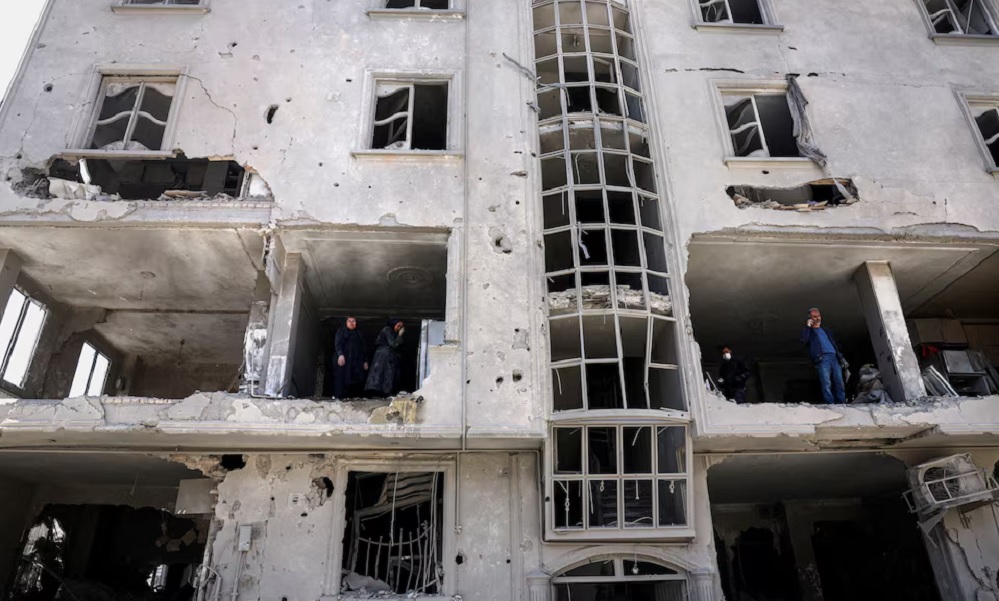
Thousands of people have been killed across the Middle East since February 28, when the U.S. and Israel struck Iran, triggering Iranian attacks on Israel, U.S. bases and the Gulf states, while opening a new front in Lebanon.
The conflict, which prompted Iran to shut the Strait of Hormuz — a key waterway carrying about a fifth of global oil supplies — has rattled financial markets and weighed on Trump’s sagging approval ratings months ahead of pivotal midterm congressional elections.
Stocks fell and oil prices rose sharply after Trump’s speech, with investors disappointed that a clearer path to swiftly ending the conflict was not spelled out.
Trump said the United States does not need the Strait of Hormuz and he challenged U.S. allies who rely on oil in the region to work toward reopening it.
“Many Americans have been concerned to see the recent rise in gasoline prices here at home,” Trump said. “This short-term increase has been entirely the result of the Iranian regime launching deranged terror attacks against commercial oil tankers of neighboring countries that have nothing to do with the conflict.”
The International Monetary Fund, World Bank and International Energy Agency on Wednesday warned the war was having “substantial, global and highly asymmetric” effects and said they would coordinate their response, including through potential financial support to those countries hit hardest.
NUCLEAR THREAT
In an interview with Reuters earlier on Wednesday, Trump said U.S.-Israeli strikes had ensured Iran would not obtain nuclear weapons, adding that U.S. forces could return with “spot hits” if the threat resurfaces.
“They were right at the doorstep (of a nuclear weapon),” Trump said in his TV address, without providing evidence.
“In these past four weeks, our armed forces have delivered swift, decisive, overwhelming victories on the battlefield,” he said. “We are systematically dismantling the regime’s ability to threaten America or project power outside of their borders.”
Prior to Trump’s address, Iranian President Masoud Pezeshkian said in a letter addressed to the American people that his country harbors no enmity towards ordinary Americans.
Yet prospects for a near-term end to the fighting remained elusive. A senior Iranian source told Reuters on Wednesday that Tehran is demanding a guaranteed ceasefire to halt its attacks and said no talks have taken place through intermediaries on a temporary truce. The New York Times reported separately that U.S. intelligence agencies assess Iran is currently unwilling to engage in substantial negotiations to end the war.
Trump said that discussions were ongoing with Iranian leaders he considered less radical than previous leaders.
“Yet if during this period of time, no deal is made we have our eyes on key targets,” Trump said. “If there’s no deal, we are going to hit each and every one of their electric generating plants, very hard and probably simultaneously.”
TRUMP CONSIDERS QUITTING NATO
Trump said on social media earlier on Wednesday that Iran had asked for a ceasefire but that he would not consider it until Tehran ceased blocking the Strait of Hormuz, which carries a fifth of global oil and liquefied natural gas.
Iran denied making any such request.
Two security sources from Pakistan, which is mediating in the conflict, told Reuters that Islamabad had proposed a temporary ceasefire but had not heard back from either side.
U.S. Vice President JD Vance communicated with intermediaries from Pakistan about the Iran conflict as recently as Tuesday, according to a source briefed on the matter, making clear that Trump was open to a ceasefire if certain demands were met, including reopening the Strait of Hormuz, the source said.
Trump had suggested on Tuesday he could wind down the war in two to three weeks even without a deal, while scaling up threats to pull the U.S. out of the NATO defence alliance if European states did not help stop Iran from blocking the waterway.
In his remarks to Reuters on Wednesday, Trump said he had planned to express his disgust with NATO for what he considers the alliance’s lack of support for U.S. objectives in Iran.
Trump did not explicitly mention NATO in his address, but appeared to be sending a message to European allies, urging countries in need of oil to buy it from the United States or to “build up some delayed courage” and use the Strait of Hormuz.
“Go to the Strait and just take it,” Trump said. “Iran has been essentially decimated. The hard part is done, so it should be easy.”
European states have taken pains to appear unruffled, and France’s junior army minister Alice Rufo said operations by NATO in the Strait of Hormuz would be a breach of international law.
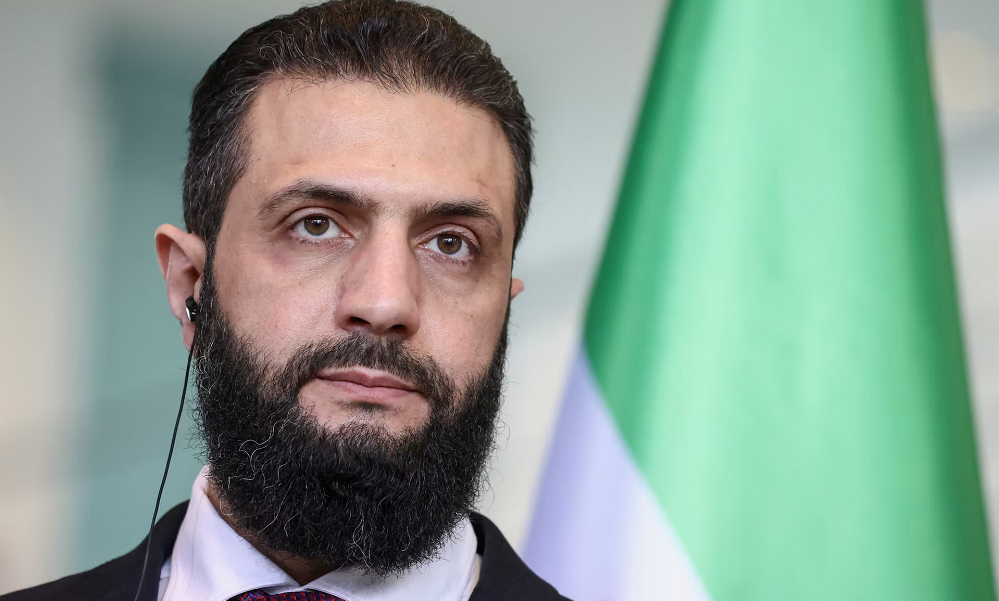
Syrian President Ahmed al-Sharaa said on Tuesday that his country will stay out of the U.S.-Israeli war against Iran unless Syria is subject to aggression and has no diplomatic solutions.
“Unless Syria is targeted by any party, Syria will remain outside any conflict,” the Syrian president said at an event hosted by think tank Chatham House in London, Reuters reported.
“We do not want Syria to be an arena of war. But unfortunately, today, things are not governed by wise minds. The situation is volatile and random,” the president said.
The month-long conflict has spread across the region, killing thousands, disrupting energy supplies, and threatening to send the global economy into a tailspin.
“We want Syria to have ideal relationships with the entire region, with Lebanon, Iraq, Turkey, Saudi Arabia, and world powers like the UK, France, Germany and the U.S. I think that Syria is qualified to start a strategic relationship network,” he said, responding to a question on whether Syria would stay neutral while the conflict goes on.
Syria has been keen to stay on the sidelines of the regional conflict that has pulled in neighbouring countries, including Lebanon, where armed group Hezbollah is locked in fighting with Israeli ground troops, and Iraq, where Iran-aligned factions have launched drone and rocket attacks.
Syria sent thousands of troops to its western border with Lebanon and its eastern border with Iraq earlier this month. Syria’s defense ministry said the deployment was part of efforts to “protect and control the borders amid the escalating regional conflict”.
“We had enough war. We paid a large bill. We are not ready for another war experience,” Syria’s president said.
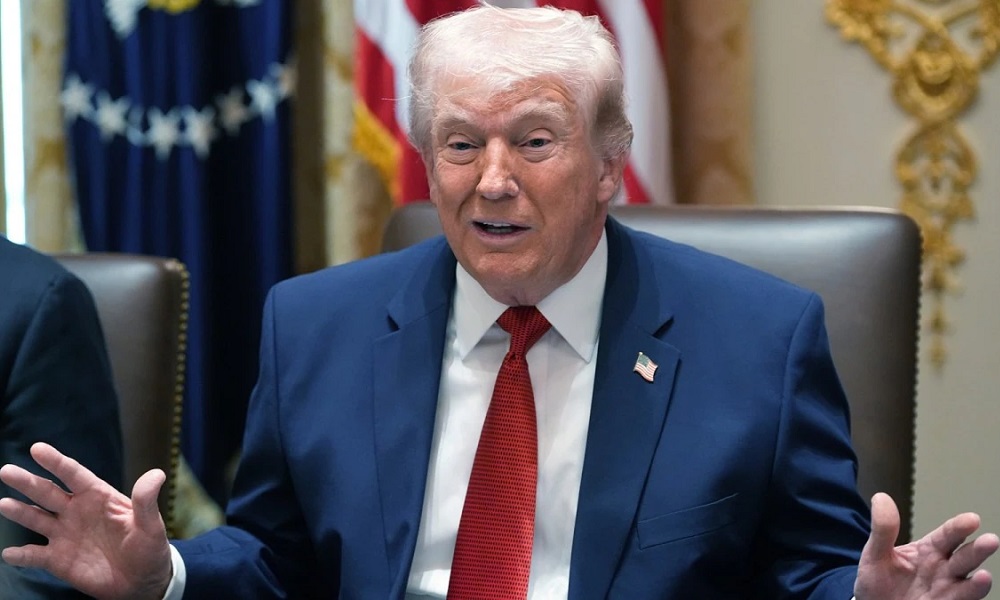
US President Donald Trump again on Tuesday lashed out at allies urging those affected by fuel shortages to secure their own supplies or buy from the United States.
In a post on Truth Social early in the day, Trump criticised allies stating: “All of those countries that can’t get jet fuel because of the Strait of Hormuz, like the United Kingdom… I have a suggestion for you: Number 1, buy from the U.S., we have plenty, and Number 2, build up some delayed courage, go to the Strait, and just TAKE IT,” he wrote.
He added: “You’ll have to start learning how to fight for yourself, the U.S.A. won’t be there to help you anymore… Go get your own oil!”
The remarks come amid heightened tensions in the Gulf, where shipping traffic has been severely disrupted, contributing to rising oil prices and concerns over global supply chains.
Pentagon briefing
At a press briefing on Tuesday, the Pentagon sought to clarify the US position, stopping short of endorsing Trump’s remarks.
Officials said the United States continues to prioritise freedom of navigation in the Strait of Hormuz and is working with regional partners to maintain stability. They emphasised that while all options remain under consideration, there has been no formal shift toward encouraging unilateral action by allied countries.
Pentagon spokespersons also noted that contingency planning is ongoing in response to escalating threats in the region, including missile and drone attacks, but reiterated that diplomatic efforts remain a key component of US strategy.
Key shipping route
The Strait of Hormuz, located between Iran and Oman, handles a significant share of the world’s oil and liquefied natural gas shipments. Any disruption to traffic through the waterway has immediate global repercussions, particularly for energy markets.
Recent weeks have seen escalating tensions involving Iran, with reports of restricted maritime movement and increased military activity in the region. Shipping slowdowns have already pushed oil prices higher and raised fears of prolonged economic fallout.
Trump’s comments also reflect a broader shift in tone toward allies, suggesting a reduced willingness by the United States to intervene militarily on behalf of partner nations.
Despite the controversy, US officials have not formally clarified whether the remarks signal a change in policy or were intended as rhetorical pressure on allies to strengthen their own energy security and defence capabilities.
Ongoing conflict
Trump’s remarks came against the backdrop of another night of intense fighting across the region, underscoring the growing volatility of the conflict.
Iranian forces reportedly struck a large Kuwaiti oil tanker off the coast of Dubai overnight, setting it ablaze and initially raising fears of a major oil spill. However, officials said on Tuesday that the fire had been contained, confirming that no oil leak occurred and no injuries were reported.
Earlier in the day, the United Arab Emirates Ministry of Defense said it had intercepted and responded to missiles and drones launched by Iran targeting the country.
As tensions ripple across the Gulf, Saudi Arabia also reported drone attacks overnight, highlighting the widening regional impact of the conflict. Iran’s foreign minister, however, insisted that the strikes were directed at US-linked targets and not at what he described as “brotherly” nations in the region.
Elsewhere, central Israel came under attack, with multiple strikes reported. The Israel Defense Forces said emergency responders had been dispatched to impact sites, while local media reported casualties.
In response, the IDF said it had carried out a series of strikes targeting government infrastructure in Tehran.
The Israeli military also confirmed it was continuing operations against the Iran-backed militant group Hezbollah in southern Lebanon, stating that several weapons depots, command centres, underground facilities and a rocket launcher had been destroyed.
However, Israel has also reported further losses, announcing that three additional soldiers had been killed in ongoing operations.


Tahawol: Start of talks between Kabul-Islamabad in China discussed

Saar: Ongoing US and Israeli attacks on Iran discussed

IEA confirms sending delegation to China for talks with Pakistan

Afghanistan–Pakistan talks begin in China amid hopes for easing tensions

Late drama as Lucknow edge Delhi Capitals in IPL thriller

Prominent Muslim scholar issues fatwa calling for Afghanistan-Pakistan ceasefire

IEA Supreme Leader issues Eid-ul-Fitr message urging unity and support for Islamic system

14 Pakistani soldiers killed after military post falls along Durand line: MoD

Afghanistan steps in to replace Iran in supplying fruits and vegetables to Russia

Afghan airstrikes target Pakistani military sites in retaliation for air attacks
Tahawol: Start of talks between Kabul-Islamabad in China discussed
Saar: Ongoing US and Israeli attacks on Iran discussed

Tahawol: Ongoing US–Israeli war with Iran discussed

Saar: Afghanistan-Pakistan talks in China discussed

Tahawol: Escalation of conflict in Middle East discussed
-
 Latest News3 days ago
TAPI gas pipeline advances 25 km in Afghanistan
-

 International Sports5 days ago
Injury concerns mount ahead of FIFA World Cup 2026 as stars sidelined
-
 Business5 days ago
Afghanistan, Uzbekistan ink $514.8 million deals to deepen trade ties
-
 Latest News5 days ago
Peshawar to host key Pakistan-Afghanistan peace jirga amid ongoing tensions
-
 Latest News5 days ago
US report flags continued presence of anti-India militant groups in Pakistan
-

 Business3 days ago
Afghanistan opens doors to agribusiness investments amid rising opportunities
-
 Regional5 days ago
Pakistan to host talks with Saudi Arabia, Turkey, Egypt amid Iran war diplomacy
-

 International Sports5 days ago
Kohli shines as RCB open IPL title defence with dominant win