
Regional
Israel-Iran air war enters second week as Europe pushes diplomacy

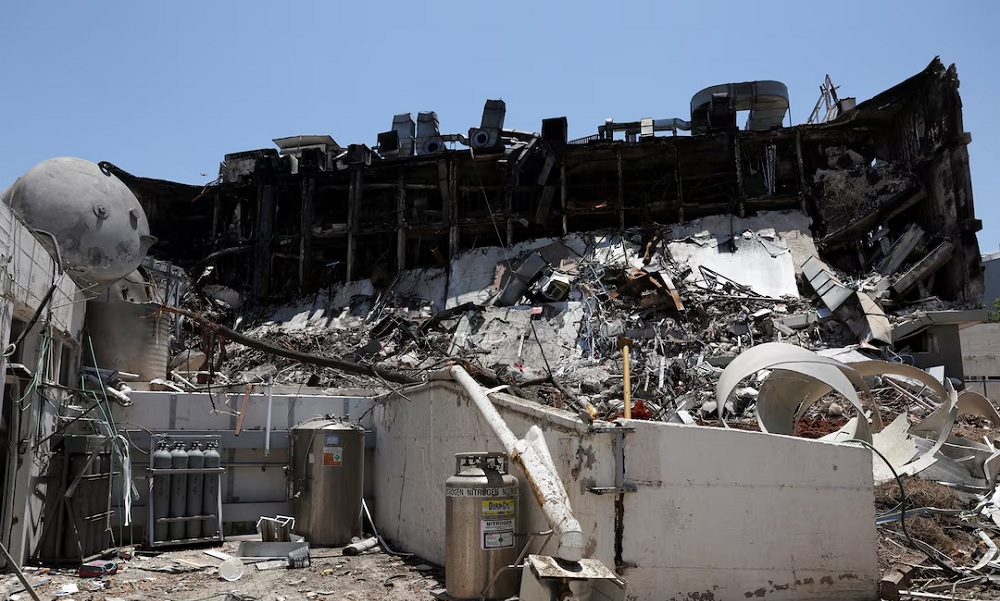
Israel and Iran’s air war entered a second week on Friday and European officials sought to draw Tehran back to the negotiating table after President Donald Trump said any decision on potential U.S. involvement would be made within two weeks.
Israel began attacking Iran last Friday, saying it aimed to prevent its longtime enemy from developing nuclear weapons. Iran retaliated with missile and drone strikes on Israel. It says its nuclear programme is peaceful, Reuters reported.
Israeli air attacks have killed 639 people in Iran, said the Human Rights Activists News Agency. Those killed include the military’s top echelon and nuclear scientists. Israel has said at least two dozen Israeli civilians have died in Iranian missile attacks. Reuters could not independently verify the death toll from either side.
Israel has targeted nuclear sites and missile capabilities, and sought to shatter the government of Supreme Leader Ayatollah Ali Khamenei, according to Western and regional officials.
“Are we targeting the downfall of the regime? That may be a result, but it’s up to the Iranian people to rise for their freedom,” Israeli Prime Minister Benjamin Netanyahu said on Thursday.
Iran has said it is targeting military and defence-related sites in Israel, although it has also hit a hospital and other civilian sites.
Israel accused Iran on Thursday of deliberately targeting civilians through the use of cluster munitions, which disperse small bombs over a wide area. Iran’s mission to the United Nations did not immediately respond to a request for comment.
With neither country backing down, the foreign ministers of Britain, France and Germany along with the European Union foreign policy chief were due to meet in Geneva with Iran’s foreign minister to try to de-escalate the conflict on Friday.
“Now is the time to put a stop to the grave scenes in the Middle East and prevent a regional escalation that would benefit no one,” said British Foreign Minister David Lammy ahead of their joint meeting with Abbas Araqchi, Iran’s foreign minister.
U.S. Secretary of State Marco Rubio also met Lammy on Thursday and held separate calls with his counterparts from Australia, France and Italy to discuss the conflict.
The U.S. State Department said that Rubio and the foreign ministers agreed that “Iran can never develop or acquire a nuclear weapon.”
Lammy said the same on X while adding that the situation in the Middle East “remained perilous” and a “window now exists within the next two weeks to achieve a diplomatic solution.”
Russian President Vladimir Putin and Chinese President Xi Jinping both condemned Israel and agreed that de-escalation is needed, the Kremlin said on Thursday.
The role of the United States remained uncertain. Lammy also met Trump’s special envoy to the region, Steve Witkoff, on Thursday in Washington, and said they had discussed a possible deal.
Witkoff has spoken with Araqchi several times since last week, sources say.
The White House said Trump will take part in a national security meeting on Friday morning. The president has alternated between threatening Tehran and urging it to resume nuclear talks that were suspended over the conflict.
Trump has mused about striking Iran, possibly with a “bunker buster” bomb that could destroy nuclear sites built deep underground. The White House said Trump would decide in the next two weeks whether to get involved in the war.
That may not be a firm deadline. Trump has commonly used “two weeks” as a time frame for making decisions and has allowed other economic and diplomatic deadlines to slide.
With the Islamic Republic facing one of its greatest external threats since the 1979 revolution, any direct challenge to its 46-year-long rule would likely require some form of popular uprising.
But activists involved in previous bouts of protest say they are unwilling to unleash mass unrest, even against a system they hate, with their nation under attack.
“How are people supposed to pour into the streets? In such horrifying circumstances, people are solely focused on saving themselves, their families, their compatriots, and even their pets,” said Atena Daemi, a prominent activist who spent six years in prison before leaving Iran.






Regional
Twelve US troops wounded in Iran strike on base in Saudi Arabia, US official says
Earlier on Friday, the U.S. military said 273 of them had already returned to duty. Thirteen U.S. troops have been killed in the conflict.

Twelve U.S. troops were wounded, two of them seriously, in an Iranian military strike on Prince Sultan Air Base in Saudi Arabia, a U.S. official told Reuters on Friday.
The latest casualties add to the more than 300 U.S. military service members who have been wounded since the war against Iran started on February 28.
Earlier on Friday, the U.S. military said 273 of them had already returned to duty. Thirteen U.S. troops have been killed in the conflict.
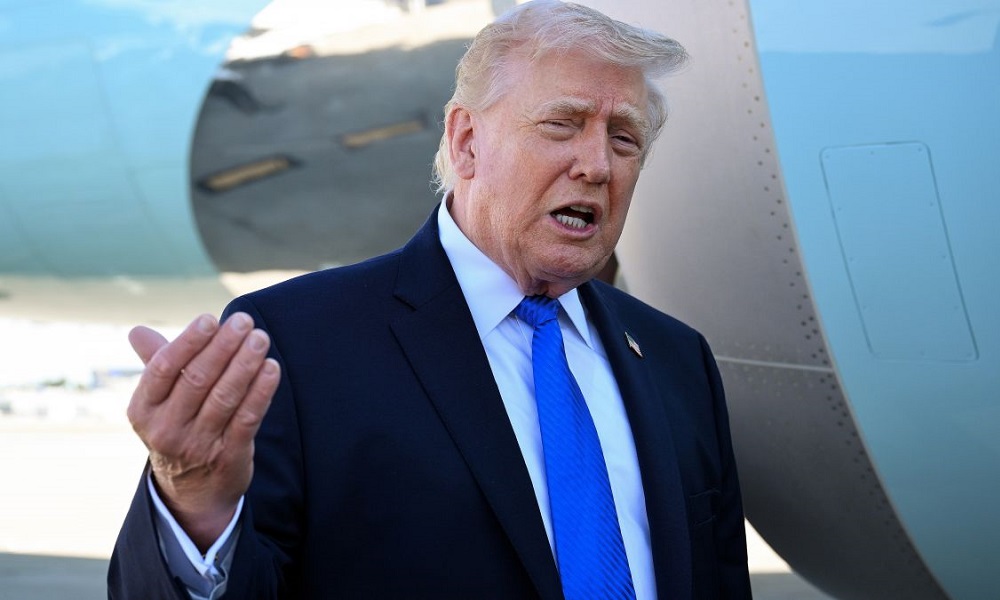
U.S. President Donald Trump announced a new extension of his deadline for Iran to reopen the Strait of Hormuz or face the destruction of its energy plants, after Iran rejected his 15-point proposal to end the war he launched with Israel.
Iran gave no direct indication that it was ready for negotiation or compromise. The Islamic Revolutionary Guard Corps issued a statement reaffirming that all shipping “to and from ports of allies and supporters of the Israeli-American enemies” to any destination was prohibited.
The war has spread across the Middle East, killing thousands of people and causing the biggest disruption in history to energy supplies, hitting the global economy with soaring oil, gas and fertiliser prices that have fuelled inflation fears.
The U.S. and Israel launched strikes on Iran on February 28 during talks with Tehran about its nuclear programme that had not yet yielded a deal. Attacks on Israel by Iran’s Lebanese ally Hezbollah then triggered an Israeli onslaught there that has displaced a fifth of Lebanon’s population.
On Thursday, Trump threatened during a cabinet meeting to increase pressure on Iran if it did not make a deal. He later posted on social media that he would pause threatened attacks on Iranian energy plants for 10 days until April 6 at 8 p.m. Eastern daylight time (0000 GMT on April 7).
“Talks are ongoing and, despite erroneous statements to the contrary by the Fake News Media, and others, they are going very well,” he added in his Truth Social post.
Regional
Russia sought to blackmail US using intelligence to Iran, Zelenskiy says
Zelenskiy, who said on Monday that Ukraine’s military intelligence has “irrefutable” evidence that Russia is continuing to provide intelligence to Iran.
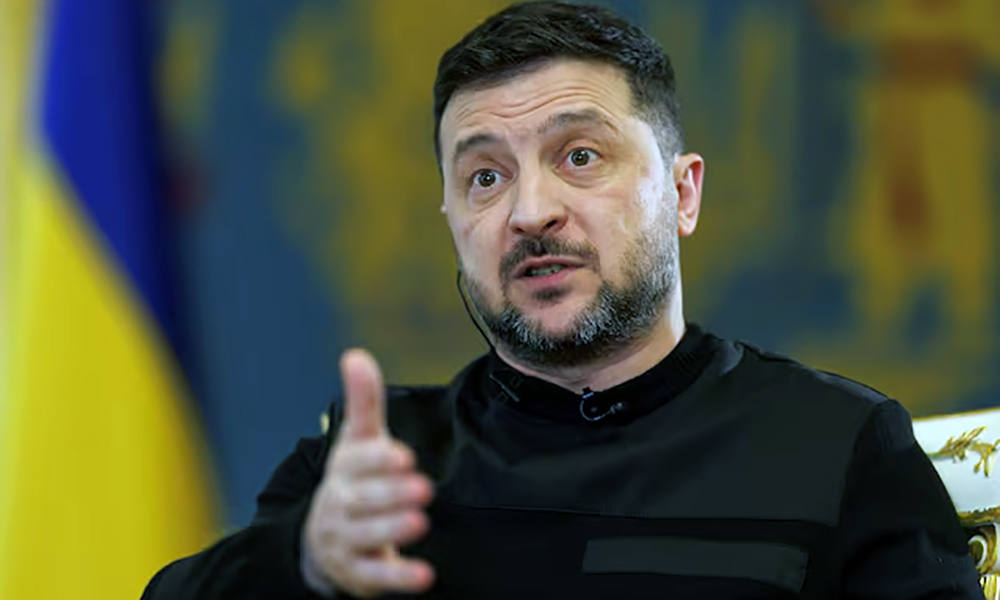
Russia sought to blackmail the United States by offering to stop sharing military intelligence with Iran if, in return, Washington would cut off Ukraine from its intelligence data, President Volodymyr Zelenskiy said on Wednesday.
Zelenskiy, who said on Monday that Ukraine’s military intelligence has “irrefutable” evidence that Russia is continuing to provide intelligence to Iran, told Reuters he had seen the data but provided no further details, Reuters reported.
Speaking in his presidential compound in Kyiv, Zelenskiy said that some Iranian drones, used to attack U.S. military assets and its allies during the war in the Middle East, contained Russian components.
“I have reports from our intelligence services showing that Russia is doing this and saying: ‘I will not pass on intelligence to Iran if America stops passing intelligence to Ukraine.’ Isn’t that blackmail? Absolutely,” Zelenskiy said.
He did not say who, according to the reports, Russia was addressing the comments to. Russia has denied assisting Iran in its month-old conflict with the United States and Israel – a denial that Washington said earlier this month that it had also received directly from Moscow when the issue was discussed.
Ukraine, which has faced sustained attacks by Iranian-designed Shahed drones since Russia launched its invasion in 2022, is helping several Gulf states – including Saudi Arabia, the United Arab Emirates, and Qatar – to counter drone attacks on their territory, the president said.
Zelenskiy said he hoped that Ukraine would be able to reach long-term deals with some Gulf countries that would raise funds for the production of Ukrainian drone interceptors or receiving much-needed air-defence missiles, read the report.


G7 foreign ministers demand an end to attacks on civilians in Iran war

Amnesty International urges IEA to end education ban for girls

Twelve US troops wounded in Iran strike on base in Saudi Arabia, US official says

Exclusive interview with Indrika Ratwatte, Deputy UN Special Representative for Afghanistan

US Vice President Vance emerges as key figure in Iran peace efforts: Report

Pakistani military jet downed in Afghanistan’s Jalalabad, pilot captured alive

Afghan Air Force conducts airstrikes in Islamabad, other cities

Prominent Muslim scholar issues fatwa calling for Afghanistan-Pakistan ceasefire

Afghan air force strikes key Pakistani military installations in retaliatory operation

IEA: Special circle in Pakistan has launched mission to destabilize region
Exclusive interview with Indrika Ratwatte, Deputy UN Special Representative for Afghanistan

Tawsia: Efforts to boost Afghanistan’s domestic production and economic diplomacy

Tahawol: Discussion on day 27 of Iran–US war

Saar: Islamic Emirate confident of Durand Line control

Tahawol: Efforts to release Mohammad Rahim from Guantanamo Bay Detention Camp
-

 Latest News5 days ago
Pakistan seeks Russian mediation to resolve Afghanistan tensions
-
 Latest News2 days ago
Tajikistan shifts stance on Afghanistan amid rising border tensions
-
 Latest News4 days ago
Around 2.3 million tourists visited Afghanistan’s recreational areas during Eid: Ghufran
-

 Sport4 days ago
Afghanistan squad hit by withdrawals ahead of AFC Asian Cup Qualifiers
-
 Latest News4 days ago
Islamic Emirate releases American prisoner Dennis Coyle
-
 Latest News3 days ago
Two civilians killed, eight injured in fresh shelling by Pakistan in Kunar
-
 Regional4 days ago
US allies in Middle East ‘edging closer’ to joining conflict
-
 Latest News5 days ago
Airstrike on Kabul drug rehabilitation centre sparks legal concerns