
Science & Technology
NASA rover finds potential sign of ancient life in Martian rocks


A sample obtained by NASA’s Perseverance rover of reddish rock formed billions of years ago from sediment on the bottom of a lake contains potential signs of ancient microbial life on Mars, according to scientists, though the minerals spotted in the sample also can form through nonbiological processes.
The discovery by the six-wheeled rover in Jezero Crater represents one of the best pieces of evidence to date about the possibility that Earth’s planetary neighbor once harbored life, Reuters reported.
Perseverance scientist Joel Hurowitz of Stony Brook University, lead author of the study published in the journal Nature, said a “potential biosignature” was detected in rock that formed at a time when Jezero Crater was believed to have been a watery environment, between 3.2 and 3.8 billion years ago.
Acting NASA Administrator Sean Duffy told a news conference that the U.S. space agency’s scientists examined the data for a year and concluded that “we can’t find another explanation, so this very well could be the clearest sign of life that we’ve ever found on Mars – which is incredibly exciting.”
NASA released an image of the rock – a very fine-grained, rusty-red mudstone – bearing ring-shaped features resembling leopard spots and dark marks resembling poppy seeds. Those features may have been produced when the rock was forming by chemical reactions involving microbes, according to the researchers.
A potential biosignature is defined as a substance or structure that may have a biological origin but needs more data or further study before a conclusion can be made about the absence or presence of life.
Nicky Fox, associate administrator for NASA’s Science Mission Directorate, noted that the scientists were not announcing the discovery of a living organism.
“It’s not life itself,” Fox told the news conference.
The rover since 2021 has been exploring Jezero Crater, an area in the planet’s northern hemisphere that once was flooded with water and home to an ancient lake basin. Scientists believe river channels spilled over the crater wall and created a lake.
Perseverance has been analyzing rocks and loose material called regolith with its onboard instruments and then collecting samples and sealing them in tubes stored inside the rover.
It collected the sample named Sapphire Canyon in July 2024 from a rock called Cheyava Falls in a locale known as Bright Angel rock formation. The sample came from a set of rocky outcrops on the edges of Neretva Vallis, an ancient river valley about a quarter of a mile (400 meters) wide carved by water rushing into the crater.
TELLTALE MINERALS
Two minerals were detected that appear to have formed as a result of chemical reactions between the mud of the Bright Angel formation and organic matter present in that mud, Hurowitz said. They are: vivianite, a mineral bearing iron and phosphorus, and greigite, a mineral bearing iron and sulfur.
“These reactions appear to have taken place shortly after the mud was deposited on the lake bottom. On Earth, reactions like these, which combine organic matter and chemical compounds in mud to form new minerals like vivianite and greigite, are often driven by the activity of microbes,” Hurowitz told Reuters.
“The microbes are consuming the organic matter in these settings and producing these new minerals as a byproduct of their metabolism,” Hurowitz said.
The rover’s instruments found that the rock was rich in organic carbon, sulfur, phosphorus and iron in its oxidized form, rust. This combination of chemical compounds could have offered a rich source of energy for microbial metabolisms, Hurowitz said.
But Hurowitz offered some words of caution.
“The reason, however, that we cannot claim this is more than a potential biosignature is that there are chemical processes that can cause similar reactions in the absence of biology, and we cannot rule those processes out completely on the basis of rover data alone,” Hurowitz said.
Mars has not always been the inhospitable place it is today, with liquid water on its surface in the distant past.
The sample collected and analyzed by Perseverance provides a new example of a type of potential biosignature that the research community can explore to try to understand whether or not these features were formed by life, Hurowitz said, “or alternatively, whether nature has conspired to present features that mimic the activity of life.”
“We can make a lot of progress on this question with laboratory experiments and fieldwork here on Earth to try to understand the various pathways that might create features like the ones we observe in the Bright Angel formation. But the ultimate tests can only be performed on the Sapphire Canyon core sample if and when it is brought back to Earth for study,” Hurowitz added.
U.S. President Donald Trump’s current budget proposal would cancel NASA’s existing Mars Sample Return mission. Duffy said NASA is examining various ways for potential sample retrieval or even sending equipment to Mars to do further analysis there.
“We’re going to look at our budgets and we’re going to look at our timing, and how we spend money better and what technology do we have to get samples back more quickly,” Duffy said.









Science & Technology
Humanoid robot beats Usain Bolt’s 100m record at Beijing robot games
The record-breaking sprint was one of the highlights of the opening day of the five-day event, which is being held at Beijing’s National Speed Skating Oval, a venue built for the 2022 Winter Olympics.

A Chinese humanoid robot has beaten Usain Bolt’s long-standing 100-metre world record, setting the stage for a spectacular second World Humanoid Robot Games that opened in Beijing on Saturday.
Tiangong Ultra clocked 9.39 seconds in the 100-metre sprint at the games, surpassing Bolt’s human world record of 9.58 seconds, set at the 2009 World Athletics Championships in Berlin. The robot, developed by the Beijing Humanoid Robot Innovation Center, narrowly defeated another humanoid, Honor’s Lightning, which finished in 9.47 seconds.
Lightning had already recorded an even faster 9.32 seconds during a trial run before the games. It reached a peak speed of 14.5 metres per second.
The record-breaking sprint was one of the highlights of the opening day of the five-day event, which is being held at Beijing’s National Speed Skating Oval, a venue built for the 2022 Winter Olympics.
The second edition of the World Humanoid Robot Games brings together 666 teams and 2,056 robots from 16 countries. The competition features 51 events and more than 1,000 matches across sports including running, football and table tennis, as well as other challenges designed to test the capabilities of humanoid machines.
Robots also surpassed another major human athletic benchmark. A humanoid developed by Beijing-based X-Humanoid reached 2.88 metres in the standing high jump, exceeding the human world record of 2.45 metres set by Cuba’s Javier Sotomayor in 1993.
The dramatic improvement in the 100-metre sprint is particularly striking. At last year’s inaugural games, Tiangong Ultra completed the same race in 21.50 seconds.
The rapid progress is part of China’s broader push to develop humanoid robots as a major emerging industry, with companies and policymakers investing heavily in artificial intelligence, robotics and advanced hardware for potential use in manufacturing, logistics and consumer applications.
Despite the impressive performances, the robots still face challenges that human athletes have long mastered. After Saturday’s sprint, Tiangong Ultra stumbled, while Lightning collapsed and had to be removed on a stretcher, highlighting difficulties with balance and braking at high speeds.
The games run through August 26 and are showcasing the rapid evolution of humanoid robots while also testing how far the machines can perform in increasingly demanding real-world sporting environments.

Enayatullah Alokozay, spokesperson for the Ministry of Communications and Information Technology, said Thursday the ministry has signed a contract with Afghan Wireless Communication Company (AWCC) for the construction of 31 telecommunications towers worth more than 269 million AFN under the 11th project of the Telecommunications Development Fund (TDF).
Alokozay said in a post on X that the towers will be built in 13 districts across Kandahar, Paktika, Helmand and Zabul provinces.
He added that the towers will provide services in areas that so far have had no access to any telecommunications services.
Science & Technology
Total darkness, then sunset as full eclipse wows spectators in Spain
Millions of people gathered in Iceland and northern Spain to witness Western Europe’s first total solar eclipse in 27 years.
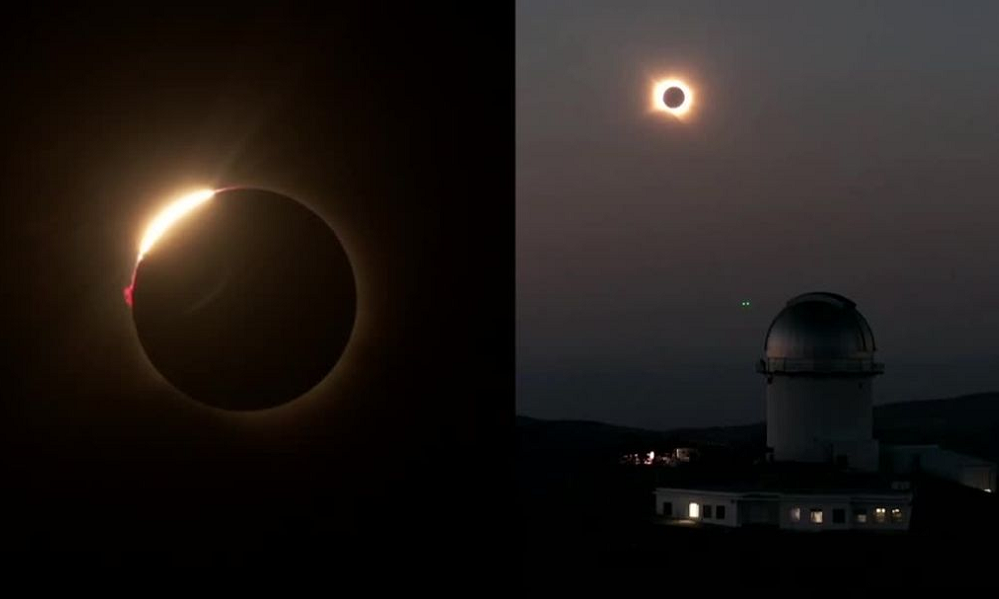
Spectators across Spain watched in wonder, some whipping off their protective glasses and rising to their feet in unison, as a rare total solar eclipse swept across the north of the country on Wednesday evening, plunging it into darkness.
Spain deployed a massive police contingent and set up special viewing spots across rural areas that offered the best views of the spectacle, Reuters reported.
Viewers in Buitrago de Lozoya, a rural district north of Madrid, clapped and cheered as the sky dimmed and Baily’s beads – bright points of sunlight that shine around the edge of the moon during a total eclipse – glistened on the horizon just after 8:30 p.m. (1830 GMT), lasting barely a minute.
“It’s impressive how the colours return little by little after totality – first the reds, then the blues – just like at dawn and sunset, totally deceiving your brain,” said economist Diego Fernandez, 32.
Rafael Jiménez, 50, a resident of Madrid, said the event felt like science fiction. “It was an absurd scene; we even got soaked when the garden sprinklers kicked in,” he said. “And then, just like that, we were watching the sunset again.”
Spain’s turn with the eclipse followed shortly after a less remarkable spectacle over much of overcast Iceland, although a break in the clouds in the far west of the Nordic country allowed holidaymakers and locals a glimpse of the celestial phenomenon. The eclipse was hidden behind clouds in central Reykjavik although the darkness of the totality was still evident.
“It was like a whole day just came at once and I felt goosebumps because it just made us think about … the shortness of life, how time can be different and it depends on your perspective,” lawyer Eduarda Ortiz, 33, told Reuters in the Icelandic capital.
Millions of people gathered in Iceland and northern Spain to witness Western Europe’s first total solar eclipse in 27 years.
Brian May, former guitarist for the rock band Queen, was among them. He travelled to an observatory in Spain’s Teruel province and chronicled the experience on his Instagram page.
“Here we go, the sun is disappearing. It’s amazing,” he said as the eclipse reached its climax and bystanders burst into cheers and applause after a countdown.
In Spain, authorities were expecting up to 6 million visitors in mostly rural areas under the eclipse’s path across the north of Spain and the Balearic Islands.
POLICE, PLANES AND HELICOPTERS ON STANDBY
The Iberian Peninsula last witnessed a total solar eclipse in 1912, but another is due on August 2, 2027, and an annular eclipse will follow in January 2028, completing the so-called “Iberian Eclipse Trio”.
The uncanny sensation when day briefly turns to twilight and some animals fall quiet, while the moon passes directly between Earth and the sun, has often been seen through history as an omen of cosmic struggle or a sign of divine power.
For Spain, the event has been a chance to showcase its less-travelled regions and draw tourists from its overcrowded beach resorts. Some seized the opportunity to get married, according to local press reports.
The eclipse took place in one of the country’s highest-risk periods for wildfires, with emergency crews fighting various fires on Wednesday, including a large one in the southern Andalucia region.
Authorities rolled out a large-scale police operation and public safety campaign to make sure the crowds did not set off wildfires.
A small fire erupted near an eclipse viewing point in the town of Peñíscola, in the Valencia region, local authorities said. The fire began in a vehicle and spread to 33 more before firefighters brought it under control, they said. Emergency crews, including aircraft, were dispatched to the area.
The authorities dispatched 25,000 police officers to guarantee security around the eclipse observation sites and deployed nearly 100 planes and helicopters.
As of late Wednesday, no wildfire incident tied to eclipse chasers was reported.
ECLIPSE FEVER IN THE LAND OF SAGAS
In Reykjavik, glasses that allow spectators to view the phenomenon without damaging their eyes have been sold out for days, as the country of roughly 400,000 people welcomed up to 80,000 visitors.
Totality reached Iceland’s westernmost coast at about 5:44 p.m. (1744 GMT), casting the far west of the island nation into total darkness for up to 2 minutes and 13 seconds.
The event has drawn both casual observers and “eclipse chasers”, enthusiasts who crisscross the globe to be in the path of totality whenever and wherever an eclipse occurs.
In Spain, 43-year old Gema, who did not give her last name, said as she left the Buitrago de Lozoya viewing point: “Everybody tells you about it, but it is more beautiful than you imagine.”


Saar: IEA criticizes US for continuing hostile policies

EU announces 15 million euros to strengthen livelihoods and food security in Afghanistan

IEA says US pressure preventing countries from recognizing Afghan government

Rescuers search for missing after deadly North Cyprus ferry accident

Afghanistan should not be viewed solely through a security lens: Achakzai

AFC confirms clubs for 2026/27 competitions; draw set for August 18

Four mediators struggle to secure lasting Pakistan-Afghanistan ceasefire

Only two days to go before Afghanistan and Ireland begin ODI series

Kabul opens cardiac hospital for children

Heavy monsoon rains claim lives across India as flooding and landslides continue
Saar: IEA criticizes US for continuing hostile policies

Tahawol: Latest on Stalled Kabul-Islamabad Talks

Saar: Afghanistan’s Relations with Regional Countries

Tahawol: Islamic Emirate seeks to normalize US ties

Saar: Discussion on ensuring Afghanistan’s border security
-

 Latest News4 days ago
Pakistan open to state-to-state dialogue with Afghanistan on terrorism
-

 Sport4 days ago
ATN secures exclusive rights to broadcast T20I series in India across Afghanistan
-

 Regional5 days ago
Qatar PM to visit Tehran to pursue mediation efforts
-

 Latest News4 days ago
Standardized orthography for Dari and Pashto languages is essential: official
-

 Latest News4 days ago
Trump says overnight US withdrawal from Bagram left Afghanistan vulnerable to collapse
-

 World3 days ago
US hits Egyptian bank branches with Iran sanctions as war marks six months
-

 Latest News3 days ago
Tajikistan to receive military equipment to strengthen Afghan border
-

 Latest News4 days ago
US Department of War says newly found classified documents could shed light on Abbey gate bombing