
World
U.S. wants Ukraine to hold elections following a ceasefire, says Trump envoy
A senior adviser to Kyiv and a Ukrainian government source said the Trump administration has not yet formally requested Ukraine hold presidential elections by the end of the year.

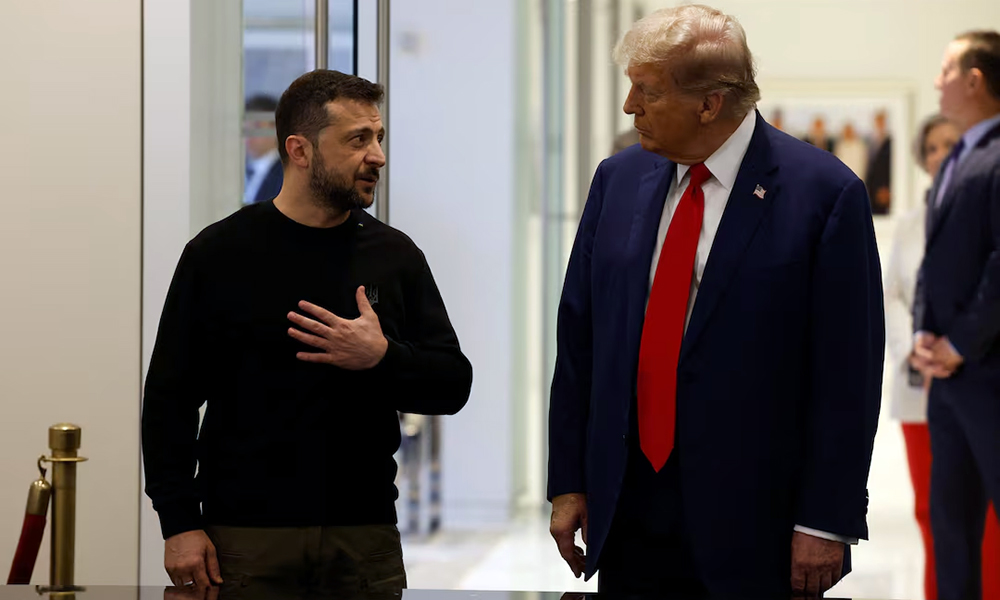
The United States wants Ukraine to hold elections, potentially by the end of the year, especially if Kyiv can agree a truce with Russia in the coming months, President Donald Trump’s top Ukraine official told Reuters.
Keith Kellogg, Trump’s special envoy for Ukraine and Russia, said in an interview that Ukrainian presidential and parliamentary elections, suspended during the war with Russia, “need to be done”.
“Most democratic nations have elections in their time of war. I think it is important they do so,” Kellogg said. “I think it is good for democracy. That’s the beauty of a solid democracy, you have more than one person potentially running.”
Trump and Kellogg have both said they are working on a plan to broker a deal in the first several months of the new administration to end the all-out war that erupted with Russia’s full-scale invasion in February 2022.
They have offered few details about their strategy for ending the deadliest conflict in Europe since World War Two, nor when they might unveil such a plan.
The Trump plan is still evolving and no policy decisions have been made, but Kellogg and other White House officials have discussed in recent days pushing Ukraine to agree to elections as part of an initial truce with Russia, two people with knowledge of those conversations and a former U.S. official briefed about the election proposal said.
Trump officials are also debating whether to push for an initial ceasefire before trying to broker a more permanent deal, the two people familiar with the Trump administration discussions said. If presidential elections were to take place in Ukraine, the winner could be responsible for negotiating a longer-term pact with Moscow, the people said.
The sources declined to be named in order to discuss sensitive policy and security issues.
It is unclear how such a Trump proposal would be greeted in Kyiv. President Volodymyr Zelenskiy has said Ukraine could hold elections this year if the fighting ends and strong security guarantees are in place to deter Russia from renewing hostilities.
A senior adviser to Kyiv and a Ukrainian government source said the Trump administration has not yet formally requested Ukraine hold presidential elections by the end of the year.
Zelenskiy’s five-year term was supposed to end in 2024 but presidential and parliamentary polls cannot be held under martial law, which Ukraine imposed in February 2022, Reuters reported.
Washington raised the issue of elections with senior officials in Zelenskiy’s office in 2023 and 2024 during the Biden administration, two former senior U.S. officials said.
State Department and White House officials told their Ukrainian counterparts that elections were critical to uphold international and democratic norms, the officials said.
Officials in Kyiv have pushed back on elections in conversations with Washington in recent months, telling Biden officials that hosting polls at such a volatile moment in Ukraine’s history would divide Ukrainian leaders and potentially invite Russian influence campaigns, the two former U.S. officials said.
Asked about what the former Western official and two other people familiar with the matter told Reuters, Kremlin spokesman Dmitry Peskov said: “We do not have that information.”
Russian Deputy Foreign Minister Sergei Ryabkov was cited by the Interfax news agency on Jan. 27 as saying that direct contacts between Moscow and the Trump administration were not yet underway. The Russian Foreign Ministry says it is still waiting for the U.S. to approve its new pick as Moscow’s ambassador in Washington, a post currently unoccupied.
Putin has said publicly he does not think Zelenskiy is a legitimate leader in the absence of a renewed electoral mandate and that the Ukrainian president does not have the legal right to sign binding documents related to a potential peace deal.
According to the Russian leader, however, Zelenskiy could take part in negotiations in the meantime but must first revoke a 2022 decree he signed banning talks with Russia for as long as Putin is in charge.
The Ukrainian government source said Putin was using the election issue as a false excuse to disrupt future negotiations, read the report.
“(He) is setting a trap, claiming that if Ukraine doesn’t hold elections, he can later ignore any agreements,” the source said.
Ukrainian legislation explicitly prohibits presidential and parliamentary elections being held under martial law.
The former Western official raised concerns about the U.S. push for elections, saying lifting martial law could allow mobilized soldiers to leave the military, trigger an exodus of hard currency and prompt large numbers of draft-age men to “run for the border”.
It could also ignite political instability, the source said, because it would make Zelenskiy a lame duck, diluting his power and influence and fueling jockeying by potential challengers.
If Trump pressures Zelenskiy to agree to elections, Washington would be playing into Putin’s recent statements questioning the Ukrainian leader’s legitimacy, the former Western official said.
“Trump is reacting, in my view, to … Russian feedback,” the official said. “Russia wants to see an end to Zelenskiy.”
Some former U.S. officials say they are skeptical that a peace deal can be reached in the coming months or that elections would take place in 2025, particularly because both sides appear to be at odds on how to begin formal negotiations.
The Kremlin has said repeatedly that Putin is open to talks without preconditions.
But William Taylor, a former U.S. ambassador to Ukraine, said Putin has shown no readiness for serious negotiations.
Zelenskiy is seeking U.S. and European security guarantees as part of any deal, including the deployment of a foreign military force on the frontlines to ensure Russia abides by any truce.




World
Venezuela earthquake death toll nears 1,500 as race to find survivors intensifies
The powerful magnitude 7.2 and 7.5 earthquakes struck on Wednesday, devastating the coastal state of La Guaira, about 40 kilometres north of Caracas.
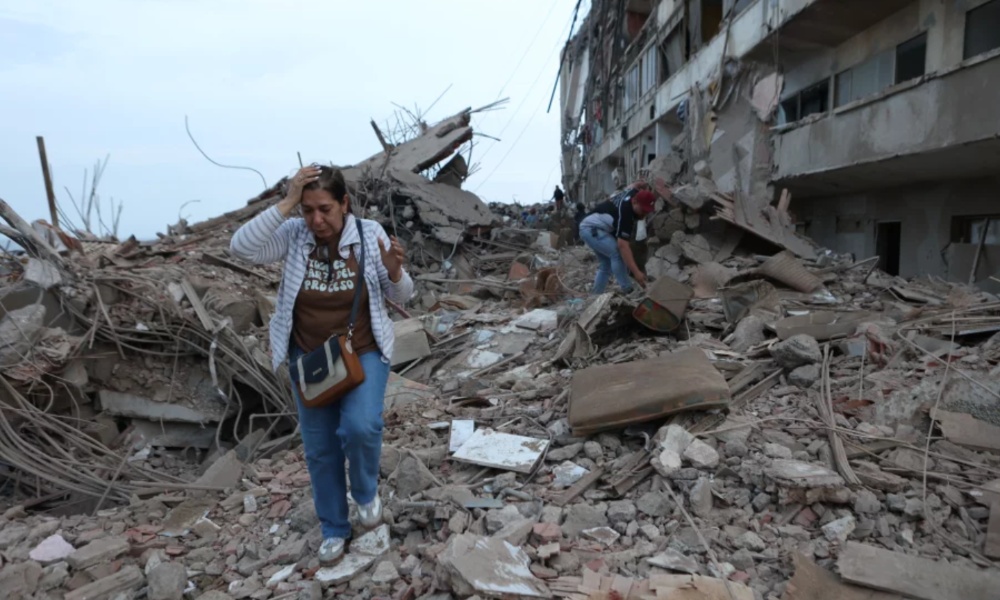
The death toll from Venezuela’s devastating twin earthquakes has climbed to nearly 1,500 as rescue teams continue searching for survivors trapped beneath collapsed buildings, with authorities warning that time is running out.
The powerful magnitude 7.2 and 7.5 earthquakes struck on Wednesday, devastating the coastal state of La Guaira, about 40 kilometres north of Caracas. Officials say the disaster has left more than 3,100 people injured, displaced over 12,700 residents and destroyed at least 774 buildings.
Acting President Delcy Rodríguez said rescue operations would continue after emergency crews recovered additional survivors on Sunday.
“Rescue and recovery efforts are ongoing. Today we have recovered people alive, and therefore operations are not being suspended. We always maintain hope,” she said.
Rodríguez also announced the formation of a presidential commission to assess the structural safety of damaged buildings, extended the suspension of school classes for another week and said electricity had been restored to around 75 percent of La Guaira.
More than 2,600 international rescue workers have joined Venezuelan emergency teams, searching through mountains of rubble with the help of specialised equipment and rescue dogs. Several survivors, including children, have been pulled alive from collapsed buildings in recent days.
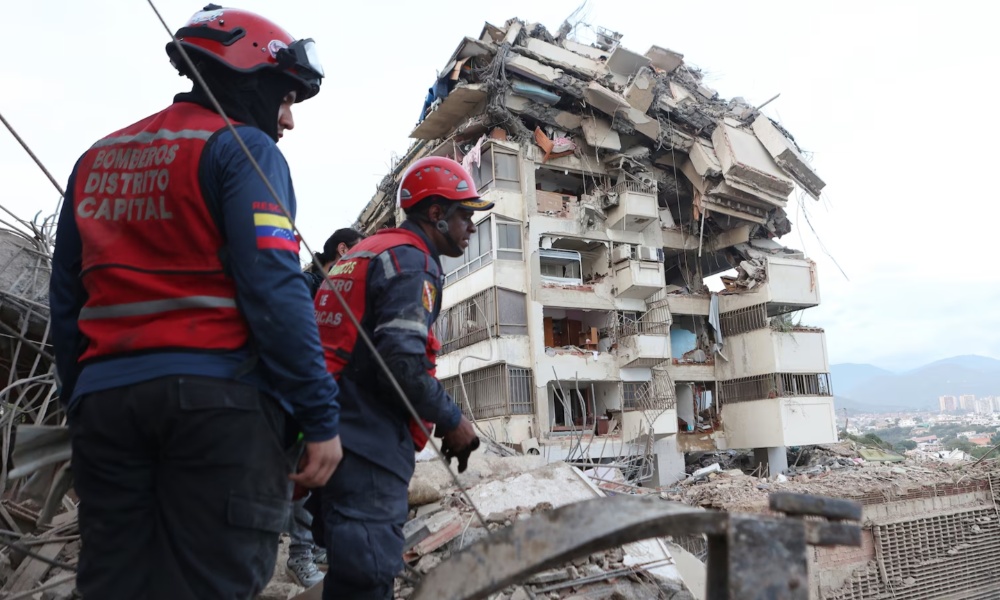
Among the latest rescues were an infant freed by US rescue personnel, an 11-year-old boy rescued by Colombian teams after being trapped three metres beneath rubble, and another 11-year-old saved by Mexican crews. Officials say such rescues are becoming increasingly rare as the critical 72-hour survival window passes.
Swiss rescue team leader Sebastian Eugster said the chances of finding survivors decrease significantly after the first three days.
“There exists a window of roughly 72 hours where the probability of rescuing people alive is much higher,” he said.
Authorities say nearly 50,000 people remain unaccounted for, although that figure is based largely on reports submitted through an opposition-backed missing persons website and has not been independently verified.
The United States Geological Survey has warned the final death toll could exceed 10,000, potentially making the disaster one of the deadliest earthquakes in Latin America in the past century.
The catastrophe has also disrupted the country’s energy sector. Venezuela’s largest oil refinery, the 645,000-barrel-per-day Amuay refinery, suspended operations following a major power outage in western Falcón state.
International aid continues to arrive, with the United States expected to announce an additional humanitarian assistance package worth hundreds of millions of dollars, on top of the $150 million already pledged.
The earthquakes have struck Venezuela at a time of ongoing political and economic instability, further complicating relief efforts as authorities, volunteers and international rescue teams continue the search for survivors.
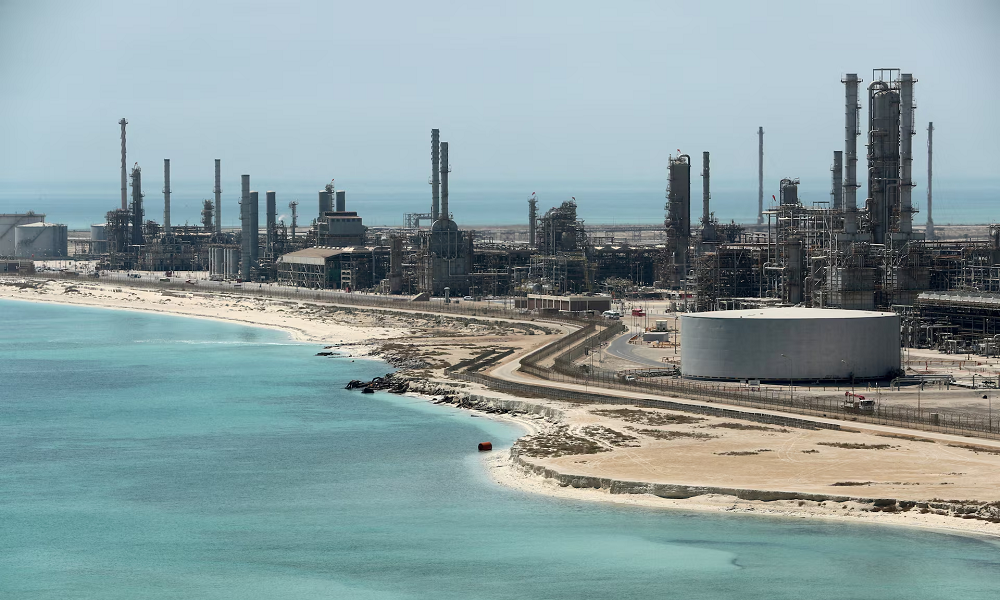
A helicopter belonging to Saudi oil giant Aramco crashed on Sunday in Ras Tanura on Saudi Arabia’s eastern coast on the Gulf, west of the Strait of Hormuz, killing 14 nationals, the state news agency reported, adding that the cause was unknown.
Aramco had resumed crude oil loadings on Friday at its Ras Tanura terminal in the Gulf after they were halted for nearly four months, Reuters reported.
“The relevant authorities have launched a full investigation to determine the cause of the crash,” the state news agency added.
Aramco did not respond immediately to an emailed request for comment.
The incident took place at 6 a.m. local time (0300 GMT), the state agency said, without providing further details.
Saudi Arabia, the world’s biggest oil exporter, has joined a rush to move cargoes after Middle East producers ramped up oil and gas output and exports ahead of an interim deal to halt the war between the United States and Iran.
World
Israel, Lebanon sign initial agreement after US-mediated talks
Israeli Prime Minister Benjamin Netanyahu said the agreement allows Israeli forces to continue to occupy southern Lebanon if Hezbollah does not disarm.
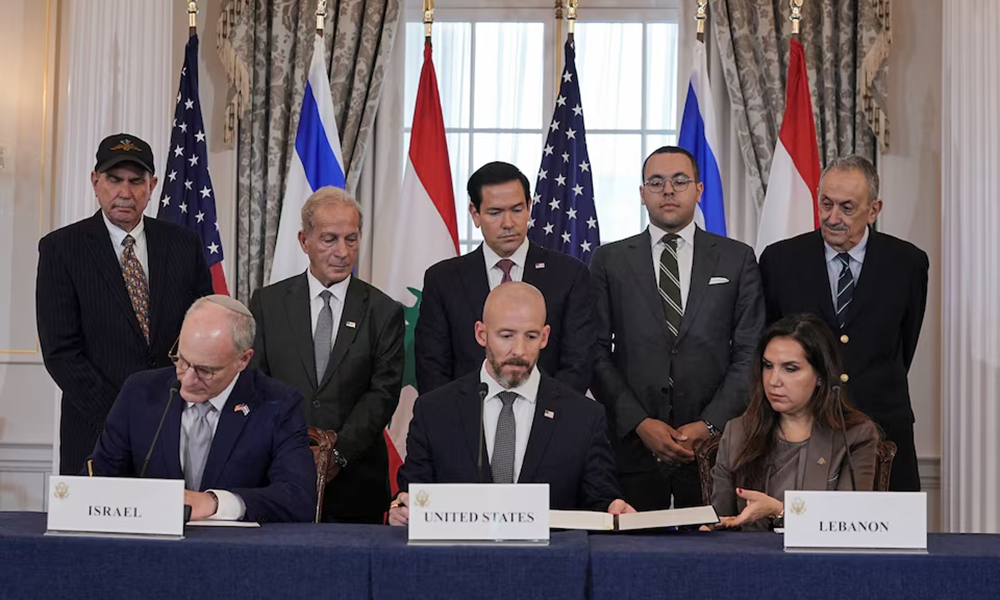
Israel and Lebanon signed a framework agreement in Washington on Friday following several days of talks to secure an end to fighting between Israel and Iran-backed Hezbollahmilitants, though both sides framed the deal as an initial step, Reuters reported.
Lebanese Ambassador Nada Moawad and her Israeli counterpart Yechiel Leiter signed the trilateral document with the U.S. at the State Department in Washington, providing few details.
Israeli Prime Minister Benjamin Netanyahu said the agreement allows Israeli forces to continue to occupy southern Lebanon if Hezbollah does not disarm.
“Today we’ve taken the first step in what will be a difficult journey, without a doubt, but an important and an essential and a necessary one,” U.S. Secretary of State Marco Rubio said before the agreement was inked.
In a later statement he said that the U.S. would facilitate the implementation of the deal through a trilateral “Military Coordination Group for Lebanon” and that Washington would commit significant resources, including an immediate $100 million in humanitarian assistance in coordination with the U.N.
Rubio added that the U.S. reaffirmed its intent to improve the capabilities of the Lebanese Armed Forces “to more effectively establish sovereignty throughout Lebanese territory” with more than $30 million in funds under existing U.S. authorities and appropriations.
The conflict between Israel and Hezbollah broke out when the armed group fired at Israel on March 2, days after the U.S. and Israel attacked Iran. The Hezbollah attacks triggered Israeli air and ground attacks that have killed more than 4,000 people in Lebanon and displaced more than a million.
Lebanon’s Moawad also called it a “first step” on the road to restoring Lebanese sovereignty.
“Iran is out, Hezbollah is out, and the road to peace between Israel and Lebanon is in,” Leiter said.
Netanyahu said in a statement that the deal would also allow the Lebanese army “to begin organizing to take control of territory,” starting with what he described as two “pilot zones” from which Israeli troops would withdraw from land they occupied during the war.
Israel describes that territory as a “security zone” or “buffer zone” where its troops can thwart Hezbollah attacks on northern Israel.
Lebanese President Joseph Aoun said the agreement should allow Lebanese to return to “fully liberated” land and rebuilt homes with “no partner” in its sovereignty.
Israel’s death toll from this round of hostilities with Hezbollah includes at least 32 soldiers and four Israeli civilians. Hezbollah does not release figures on its war dead. Reuters reported on May 4 that several thousand Hezbollah fighters had been killed in the war.
A State Department official told Reuters on Thursday that Israel had agreed to pull back from some of the territory it has occupied, something Israeli and Lebanese officials denied.
Before the talks resumed this week, Israel and Hezbollah agreed to halt fire even as Israel kept troops in southern Lebanon.
Violence has persisted since the ceasefire, with Israel saying on Friday its troops had struck and killed what the military described as seven Hezbollah members who were operating near the territory it is occupying. Reuters could not confirm this.
“To the degree that the Lebanese army performs in dismantling and disarming Hezbollah, we will proceed with additional pilot zones and the ultimate determination of an internationally recognized, secure, and agreed upon border,” Leiter told reporters after the signing.
Hezbollah lawmaker Hassan Fadlallah said Lebanese authorities would not be able to enforce the agreement unless, with U.S. support, “they go to civil war,” pro-Iranian broadcaster Al Mayadeen reported, read the report.
Hezbollah would confront any measure taken by Lebanese authorities and would hold on to its weapons even more, adding that the group’s opposition was “serious” and would not allow authorities to implement their commitments on the ground, Fadlallah said.
Israeli forces dropped leaflets over the southern Lebanese town of Mansouri on Friday ordering residents to leave, Lebanese state media reported, the first such order issued since the latest ceasefire between Israel and Hezbollah took effect.
A senior Lebanese military official said Israel had recently added Mansouri to its occupation zone. The official said Lebanese farmers had continued to enter and leave the town, but had not been living there.
An Israeli military spokesperson said the military issued what it described as a “reminder” to the civilian population that “the area is within the security zone in which (Israeli) soldiers operate. It’s a reminder not to be in the area so they won’t be harmed.”


Hanafi says war is not the solution, calls for regional cooperation and investment

Iran insists on keeping control over Hormuz, senior Iranian sources say

Russia urges Pakistan and Afghanistan to resolve disputes through diplomacy

Haaland fires Norway into World Cup Round of 16 with late winner

NRC warns of alarming global shortfall in humanitarian funding in 2026

Norway’s Viking-inspired World Cup team photo goes viral

TAPI project advances in Afghanistan as 84kms of pipeline laid

Afghanistan’s trade with Central Asia records sharp growth

Gaikwad set to replace injured Kohli for Afghanistan ODI Series

Iran banks hit by major cyber attack

Tahawol: Reactions to Pakistan’s attacks on Afghanistan discussed

Saar: Reaction to Pakistan’s airstrikes on Afghan soil discussed

Tahawol: Pakistan’s attacks on civilians in Afghanistan

Saar: Pakistani airstrikes on Afghanistan

Tahawol: Calls for diplomacy between Kabul, Islamabad
-
 Latest News5 days ago
TAPI project sees rapid progress in Afghanistan
-
 Business3 days ago
Afghanistan eyes direct Basmati rice imports from India amid tensions with Pakistan
-

 International Sports4 days ago
FIFA World Cup: Iran held by Egypt after controversial late goal Is disallowed
-
 Latest News4 days ago
Delawar says Afghanistan has achieved security and unity after 47 years
-
 Latest News4 days ago
EU announces major funding to support Afghan small businesses
-
 Latest News5 days ago
Ashura observed across Afghanistan with calls for unity and justice
-
 Latest News3 days ago
Afghan minister says ‘outsiders’ should not claim to support Afghanistan’s independence
-

 Sport3 days ago
Afghanistan, Uzbekistan set for friendly cricket clash in Khost