
Latest News
Iran, Afghanistan gear up to inaugurate Khaf-Herat railway line

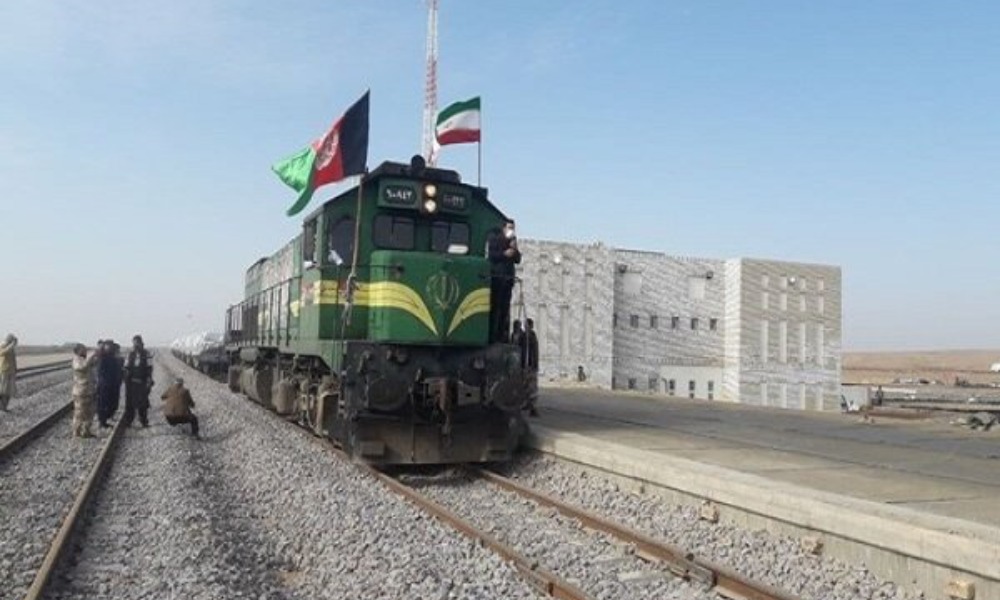
Iran’s Minister of Road and Urban Development Mohammad Eslami said on Wednesday that the Khaf-Herat railway link between Afghanistan and Iran will be officially inaugurated on Thursday.
Speaking to Irna News, Eslami also said Iran had invested 2.8 trillion Iranian rials (US$66.5 million) in the project, which he said will boost infrastructural development in Afghanistan and help bring economic prosperity to the country.
This will also become one of the main transit corridors in the region, Eslami added.
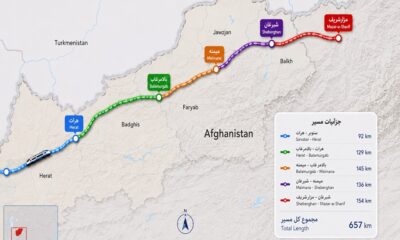
Khaf-Herat railway is 191 kilometers long and stretches across 77 kilometers inside Iran and 114 kilometers inside Afghanistan.
Earlier this month a trial freight train run was successfully completed and 400 tonnes of cement from Iran was delivered to Rosnak in Herat province.
A passenger train also carried Iranian railway officials to and from a meeting with their Afghan counterparts.
Construction of the project started in 2006 and was built in four stages – starting from an editing network inside Iran at Khaf.
Railway Gazette reported recently that completion has taken significantly longer than had been envisaged, with the latest section to be completed being the 62km stage 3 which ends at Rosnak on the road between Herat and the Iranian border.
The fourth stage is to be built in two phases. The first will be to extend the line to Robat Paryan and the second to Herat airport.
The Afghanistan Railway Authority said the line forms one of its most important regional connectivity projects, as it will provide the land-locked country with a link to Iranian ports and to the rail networks of Iran, Turkey and Europe.
Afghan officials told Railway Gazette that a passenger service is also being considered and that studies estimated that passenger traffic could reach 321,000 passengers a year, and freight traffic 6·8 million tonnes a year.












Kazakhstan’s Foreign Minister Mukhtar Tileuberdi has called for pragmatic and coordinated international engagement with Afghanistan, saying the country’s long-term stability is closely linked to the security and sustainable development of Central Asia.
Speaking during the general debate of the 81st session of the United Nations General Assembly in New York on Friday, Tileuberdi said humanitarian assistance to Afghanistan remains essential but alone cannot break the cycle of poverty, displacement and dependency.
He said Kazakhstan supports a “pragmatic, coordinated and step-by-step” approach to international engagement with Afghanistan, with the United Nations playing a central role.
Tileuberdi also said Kazakhstan is working with the UN to operationalize the United Nations Regional Centre for the Sustainable Development Goals for Central Asia and Afghanistan in Almaty.
He said the success of the centre should be measured by the results and assistance it delivers to the region.


Ariana Afghan Airlines increases Kabul-Delhi cargo flights

Khalilzad questions Pakistan’s commitment to Afghan welfare

India, UN envoy discuss Afghanistan’s humanitarian needs

Kazakhstan calls for coordinated international engagement with Afghanistan

Pakistan PM, UN chief discuss Afghanistan amid rising Kabul-Islamabad tensions

Saudi energy group signs major Afghanistan deals covering gas exploration and pipeline plans

Trump floats idea of renaming Atlantic or Pacific Ocean

US hits Egyptian bank branches with Iran sanctions as war marks six months

Nepal flood rescue mission enters critical phase as thousands remain missing

Iranian clubs to face Gulf opponents at neutral venues in Asian Champions League Elite

Exclusive interview with Abdul Latif Mansoor, Minister of MRRD

Tawsia: Overview of Afghanistan’s iron mines

Tahawol: Discussion on fresh Pakistani airstrikes on Afghanistan

Saar: Calls for international support for Afghanistan discussed

Tahawol: Opening of the 81st UN General Assembly Session
-

 World4 days ago
CNN, MS NOW and Politico sue Trump, challenging White House ban
-

 Latest News3 days ago
Ariana Afghan Airlines ranks seventh among 45 Central Asian airlines
-

 Latest News4 days ago
UN reiterates call for respect for international law after Kunar airstrikes
-
 Latest News5 days ago
Khalilzad condemns Pakistan airstrikes, says current strategy is not working
-

 Regional3 days ago
US and Iran hold first talks since June after Trump’s ‘annihilation’ threat
-

 Latest News3 days ago
Silk Road highway in Wakhan corridor now reaches the China border
-

 Latest News4 days ago
Afghan Official: Pakistan’s airstrikes will not go unanswered
-

 Sport4 days ago
Afghan boxing referee heads to China for international festival