
Latest News
Abdullah calls for ‘system support’ as clashes close in on Kabul

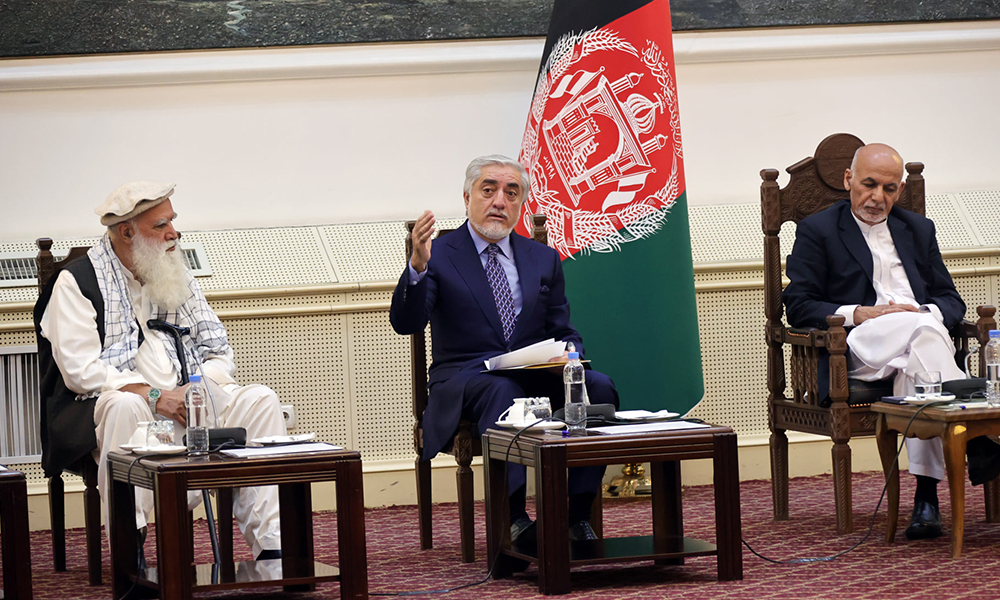
Abdullah Abdullah, Chairman of the High Council for National Reconciliation (HCNR), said Wednesday that clashes between security forces and the Taliban have reached the entrance gates of the capital, Kabul, and that “people have to support the system”.
Addressing the sixth session of the HCNR’s Leadership Committee meeting, Abdullah stated that as the international forces are close to completing their withdrawal process, a security vacuum has been created.
He said the Taliban could intensify violence if a unified political consensus is not created.
Abdullah stated that the group is playing for time; and that Afghan leaders have to determine their priorities.
“While we want peace, war is approaching the gates of the Afghan capital; I think a declaration of the full support of the elders is necessary,” Abdullah said.
The HCNR chairman also called for more international mediation amid stalled peace talks in Doha, Qatar.
“The contact teams are in touch with each other. Mediation by the United Nations and Qatar has also increased, and [hopefully] this will lead to the acceleration of the peace process,” he added.
This comes as clashes have continued to intensify across the country.
In the latest development, Taliban militants seized control of six district centers – in Takhar, Kapisa, Balkh, Samangan, Ghazni, and Kandahar provinces – in the past 24 hours, local sources told Ariana News.
According to the sources, Farkhar district in Takhar, Alasay in Kapisa, Kaldar in Balkh, Feroz Nakhchir in Samangan, Gelan in Ghazni, and Khakrez in Kandahar province fell to the Taliban in this time.
Kaldar, in Balkh, fell to the Taliban last week but Afghan National Defense and Security Forces (ANDSF) in cooperation with local uprising forces, led by the province’s former governor, Atta Mohammad Noor, regained control of the district on Tuesday, but on Wednesday, the Taliban released a video claiming the group had recaptured the district center.
Fawad Aman, deputy spokesman for the Ministry of Defense (MoD) said early Wednesday the ANDSF had pushed back the Taliban in many areas across the country.
“We have captured many areas and have launched heavy attacks on the enemy,” said Aman.
Local sources, meanwhile, told Ariana News that the Taliban have also recaptured Mirzaka district in Paktia, Dawlat Abad in Faryab, Shortepa and Kaldar in Balkh, Chah Ab, and Hazar Smoch in Takhar and Tala wa Barfak in Baghlan.
“Seven out of 14 districts are under Taliban control in the province,” said Shafiqullah Ahadi, an activist in Baghlan.
Sources in Takhar and Badakhshan provinces also said that the security situation had deteriorated in their provinces.
“Taliban have surrounded Takhar province, but operations have not started so far,” said Sayed Sayyed Salahuddin Burhani a member of Takhar provincial council.
“Taliban attempt to seize more areas,” said Ziaullhaq, an MP.
In addition, the Taliban has also reportedly seized control of the Khakrez district in Kandahar province and heavy clashes are ongoing in Grishk, Garmsir, Marjah, Nad Ali, and Nawa districts of Helmand province, as well as in the provincial capital Lashkhargah.
“Taliban want to capture districts, and Lashkargah city will also fall if the government does not help,” said Attaullah Haq Bayan, head of Helmand provincial council.
Afghan Commandos meanwhile have retaken control of the Imam Sahib Port in Kunduz after the Taliban seized the port last week.
Abdul Hadi Nazari, a spokesman for the 217th Pamir Military Corps, said at least 13 Taliban had been killed in the operation.
The Taliban has not yet commented.











Kazakhstan’s Foreign Minister Mukhtar Tileuberdi has called for pragmatic and coordinated international engagement with Afghanistan, saying the country’s long-term stability is closely linked to the security and sustainable development of Central Asia.
Speaking during the general debate of the 81st session of the United Nations General Assembly in New York on Friday, Tileuberdi said humanitarian assistance to Afghanistan remains essential but alone cannot break the cycle of poverty, displacement and dependency.
He said Kazakhstan supports a “pragmatic, coordinated and step-by-step” approach to international engagement with Afghanistan, with the United Nations playing a central role.
Tileuberdi also said Kazakhstan is working with the UN to operationalize the United Nations Regional Centre for the Sustainable Development Goals for Central Asia and Afghanistan in Almaty.
He said the success of the centre should be measured by the results and assistance it delivers to the region.


Trump rejects Iranian proposal to open Hormuz and end fighting

Abu Muslim Farah defeat Khurasan Faryab 2-0 in ACL season six

Saar: Concerns over Pakistan’s political crisis discussed

Afghanistan Champions League: Omar Zawak Herat beat Toofan Herat 1-0

Blast in Pakistan’s Dera Ismail Khan kills 11, injures 30

Saudi energy group signs major Afghanistan deals covering gas exploration and pipeline plans

Trump floats idea of renaming Atlantic or Pacific Ocean

US hits Egyptian bank branches with Iran sanctions as war marks six months

Nepal flood rescue mission enters critical phase as thousands remain missing

Iranian clubs to face Gulf opponents at neutral venues in Asian Champions League Elite
Saar: Concerns over Pakistan’s political crisis discussed

Exclusive interview with Abdul Latif Mansoor, Minister of MRRD

Tawsia: Overview of Afghanistan’s iron mines

Tahawol: Discussion on fresh Pakistani airstrikes on Afghanistan

Saar: Calls for international support for Afghanistan discussed
-

 Latest News4 days ago
Ariana Afghan Airlines ranks seventh among 45 Central Asian airlines
-

 Latest News5 days ago
UN reiterates call for respect for international law after Kunar airstrikes
-

 Regional4 days ago
US and Iran hold first talks since June after Trump’s ‘annihilation’ threat
-

 Latest News4 days ago
Silk Road highway in Wakhan corridor now reaches the China border
-

 Regional3 days ago
Iran airlines cancel flights as US sanctions hit
-

 Latest News5 days ago
Afghan Official: Pakistan’s airstrikes will not go unanswered
-

 Sport5 days ago
Afghan boxing referee heads to China for international festival
-
 Regional5 days ago
G7 foreign ministers call on Iran to stop arming Houthis