
Latest News
Kabir meets for talks with visiting Uzbekistan prime minister
The meeting came after Saturday’s signing between the two countries of 35 memorandums of understanding (MoUs) valued at a total of $2.5 billion.

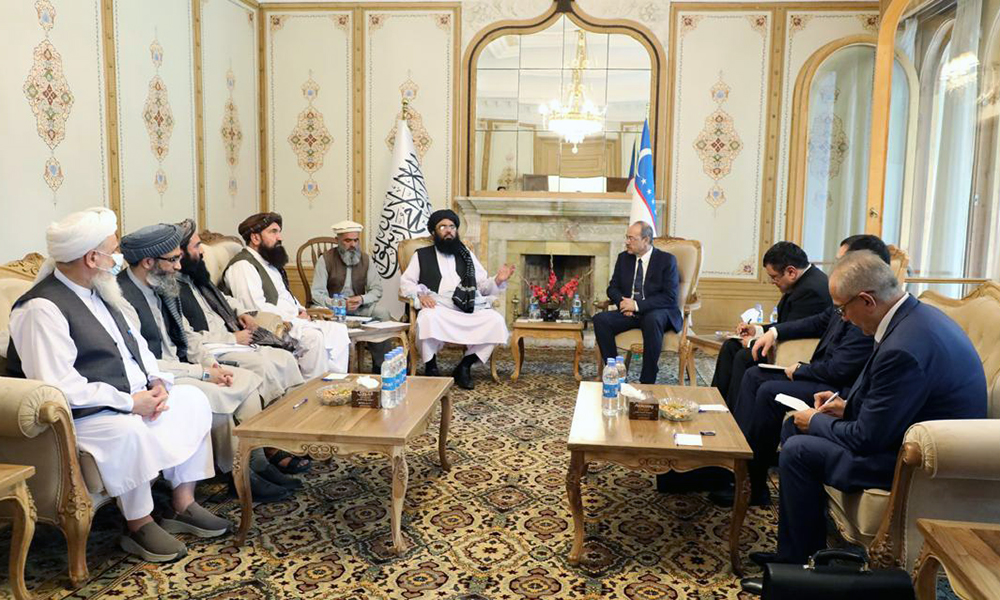
After signing $2.5 billion worth of agreements with Afghanistan on Saturday, the prime minister of Uzbekistan, Abdullah Aripov, met with political deputy prime minister Mawlavi Abdul Kabir for talks on strengthening cooperation in various sectors.
Also in the meeting were Islamic Emirate cabinet members, including ministers of tribal and border affairs; information and culture; and higher education.
Aripov expressed Uzbekistan’s commitment to fostering economic and commercial partnerships with Afghanistan in numerous sectors including mining, electricity and agriculture.
He also affirmed Uzbekistan’s readiness to support Afghanistan through initiatives such as the Trans-Afghan Corridor – a $4.8 billion railway project connecting Pakistan, Afghanistan, and Uzbekistan.
Kabir, in response, acknowledged the importance of strengthening ties between the two nations and reiterated the Islamic Emirate’s commitment to fostering positive relations with Uzbekistan and other regional and global partners, with a focus on prioritizing economic development.
Mawlawi Abdul Kabir underscored the Islamic Emirate’s desire for recognition as the legitimate authority of Afghanistan by countries and international bodies, asserting that only the Islamic Emirate can effectively represent Afghanistan and its people on the international stage.
He expressed optimism regarding Afghanistan’s prospective involvement in the Shanghai Cooperation Organization and underscored the commitment to ensuring that Afghanistan’s territory poses no threat to any nation.
Highlighting Afghanistan’s investment potential in various sectors, including mining, water, energy, transportation, and agriculture, Kabir encouraged investors, particularly those from Uzbekistan, to consider investing in Afghanistan.
In conclusion, the political deputy minister reiterated the Islamic Emirate’s readiness to participate in regional projects like TAPI and CASA-1000, emphasizing that Afghanistan’s stability and progress are essential for regional stability and development.
The meeting came after Saturday’s signing between the two countries of 35 memorandums of understanding (MoUs) valued at a total of $2.5 billion.
The MoUs include 12 investment agreements worth $1.4 billion and 23 trade agreements valued at $1.1 billion.
The deals were signed by Afghanistan’s Deputy Prime Minister for Economic Affairs, Mullah Abdul Ghani Baradar Akhund, and Uzbekistan’s Prime Minister Abdullah Aripov.
The implementation of these wide-ranging agreements is expected to significantly strengthen economic ties between the two neighboring countries and provide a major boost to bilateral trade. The agreements span various sectors including infrastructure, energy, agriculture, and manufacturing.
“This landmark signing is a testament to the strong political will and commitment of the leadership in both Afghanistan and Uzbekistan to deepen economic integration in the region,” said Mullah Abdul Ghani Baradar Akhund.
“We are confident that these agreements will create new avenues for investment, trade, and job creation, benefiting the people of both our nations.”
The signing comes amidst a broader push by the Afghan government to attract foreign investment and expand regional economic cooperation.











Kazakhstan’s Foreign Minister Mukhtar Tileuberdi has called for pragmatic and coordinated international engagement with Afghanistan, saying the country’s long-term stability is closely linked to the security and sustainable development of Central Asia.
Speaking during the general debate of the 81st session of the United Nations General Assembly in New York on Friday, Tileuberdi said humanitarian assistance to Afghanistan remains essential but alone cannot break the cycle of poverty, displacement and dependency.
He said Kazakhstan supports a “pragmatic, coordinated and step-by-step” approach to international engagement with Afghanistan, with the United Nations playing a central role.
Tileuberdi also said Kazakhstan is working with the UN to operationalize the United Nations Regional Centre for the Sustainable Development Goals for Central Asia and Afghanistan in Almaty.
He said the success of the centre should be measured by the results and assistance it delivers to the region.


Abu Muslim Farah defeat Khurasan Faryab 2-0 in ACL season six

Saar: Concerns over Pakistan’s political crisis discussed

Afghanistan Champions League: Omar Zawak Herat beat Toofan Herat 1-0

Blast in Pakistan’s Dera Ismail Khan kills 11, injures 30

Ariana Afghan Airlines increases Kabul-Delhi cargo flights

Saudi energy group signs major Afghanistan deals covering gas exploration and pipeline plans

Trump floats idea of renaming Atlantic or Pacific Ocean

US hits Egyptian bank branches with Iran sanctions as war marks six months

Nepal flood rescue mission enters critical phase as thousands remain missing

Iranian clubs to face Gulf opponents at neutral venues in Asian Champions League Elite
Saar: Concerns over Pakistan’s political crisis discussed

Exclusive interview with Abdul Latif Mansoor, Minister of MRRD

Tawsia: Overview of Afghanistan’s iron mines

Tahawol: Discussion on fresh Pakistani airstrikes on Afghanistan

Saar: Calls for international support for Afghanistan discussed
-

 World5 days ago
CNN, MS NOW and Politico sue Trump, challenging White House ban
-

 Latest News3 days ago
Ariana Afghan Airlines ranks seventh among 45 Central Asian airlines
-

 Latest News5 days ago
UN reiterates call for respect for international law after Kunar airstrikes
-

 Regional4 days ago
US and Iran hold first talks since June after Trump’s ‘annihilation’ threat
-

 Latest News3 days ago
Silk Road highway in Wakhan corridor now reaches the China border
-

 Latest News5 days ago
Afghan Official: Pakistan’s airstrikes will not go unanswered
-

 Regional3 days ago
Iran airlines cancel flights as US sanctions hit
-
 Regional5 days ago
G7 foreign ministers call on Iran to stop arming Houthis