
Latest News
Global outcry as rights groups condemn Pakistan over deadly strikes on Afghan civilians
The United Nations Assistance Mission in Afghanistan (UNAMA) meanwhile confirmed significant civilian casualties in the recent escalation between Afghanistan’s and Pakistani military forces.

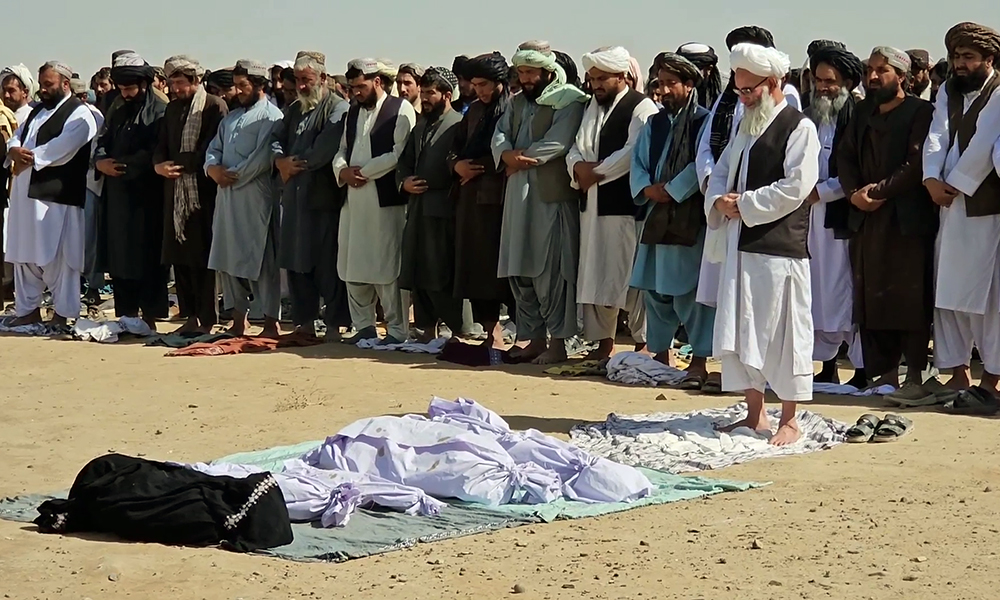
Human rights organizations around the world have condemned Pakistan’s recent air and artillery strikes on civilian areas in Afghanistan, describing the attacks as a serious violation of international law and a grave breach of Afghan sovereignty.
The International Human Rights Foundation (IHRF) said it has verified video evidence showing the aftermath of alleged cross-border shelling by Pakistani military forces on Afghan territory.
The footage, according to the IHRF, depicts extensive destruction and significant civilian casualties, including women and children.
“Targeting civilians and civilian infrastructure constitutes a grave breach of international humanitarian law,” the organization said in a statement.
“The IHRF condemns this attack in the strongest terms and calls for an immediate, independent investigation by the United Nations and relevant human rights bodies. The perpetrators of these apparent violations must be held accountable to ensure justice for the victims and their families.”
In Afghanistan, the Alliance of Human Rights Activists also denounced the strikes, saying ordinary Afghans were “paying the price for terror-driven politics.”
The group described the attacks as a “clear breach of Afghanistan’s territorial integrity” and called for regional cooperation to dismantle militant networks and address the root causes of extremism.
“The blood of innocent people and the sanctity of national sovereignty must be respected,” the statement said.
The condemnation follows Pakistan’s cross-border airstrikes on Wednesday targeting Kabul and the Spin Boldak district of Kandahar province. According to the Emergency Hospital in Kabul, at least 40 people, including women and children, were brought in following the attacks. The exact death toll remains unclear as assessments continue.
The United Nations Assistance Mission in Afghanistan (UNAMA) meanwhile confirmed significant civilian casualties in the recent escalation between Afghanistan’s and Pakistani military forces.
UNAMA said that since 10 October, cross-border violence has sharply increased, with the highest number of civilian deaths reported in Spin Boldak, where at least 17 people were killed and 346 injured.
Earlier clashes in Paktika, Paktia, Kunar, and Helmand provinces left one civilian dead and 15 others injured.
UNAMA welcomed the announcement of a ceasefire announced late Wednesday and called on all parties to protect civilians and adhere to the principles of distinction, proportionality, and precaution under international humanitarian law.
The escalating violence has deepened fears of renewed instability in the region. Rights groups and UN officials have urged the international community to intervene diplomatically to prevent further civilian harm and ensure accountability for cross-border attacks.












Kazakhstan’s Foreign Minister Mukhtar Tileuberdi has called for pragmatic and coordinated international engagement with Afghanistan, saying the country’s long-term stability is closely linked to the security and sustainable development of Central Asia.
Speaking during the general debate of the 81st session of the United Nations General Assembly in New York on Friday, Tileuberdi said humanitarian assistance to Afghanistan remains essential but alone cannot break the cycle of poverty, displacement and dependency.
He said Kazakhstan supports a “pragmatic, coordinated and step-by-step” approach to international engagement with Afghanistan, with the United Nations playing a central role.
Tileuberdi also said Kazakhstan is working with the UN to operationalize the United Nations Regional Centre for the Sustainable Development Goals for Central Asia and Afghanistan in Almaty.
He said the success of the centre should be measured by the results and assistance it delivers to the region.


Abu Muslim Farah defeat Khurasan Faryab 2-0 in ACL season six

Saar: Concerns over Pakistan’s political crisis discussed

Afghanistan Champions League: Omar Zawak Herat beat Toofan Herat 1-0

Blast in Pakistan’s Dera Ismail Khan kills 11, injures 30

Ariana Afghan Airlines increases Kabul-Delhi cargo flights

Saudi energy group signs major Afghanistan deals covering gas exploration and pipeline plans

Trump floats idea of renaming Atlantic or Pacific Ocean

US hits Egyptian bank branches with Iran sanctions as war marks six months

Nepal flood rescue mission enters critical phase as thousands remain missing

Iranian clubs to face Gulf opponents at neutral venues in Asian Champions League Elite
Saar: Concerns over Pakistan’s political crisis discussed

Exclusive interview with Abdul Latif Mansoor, Minister of MRRD

Tawsia: Overview of Afghanistan’s iron mines

Tahawol: Discussion on fresh Pakistani airstrikes on Afghanistan

Saar: Calls for international support for Afghanistan discussed
-

 World5 days ago
CNN, MS NOW and Politico sue Trump, challenging White House ban
-

 Latest News3 days ago
Ariana Afghan Airlines ranks seventh among 45 Central Asian airlines
-

 Latest News5 days ago
UN reiterates call for respect for international law after Kunar airstrikes
-

 Regional4 days ago
US and Iran hold first talks since June after Trump’s ‘annihilation’ threat
-

 Latest News4 days ago
Silk Road highway in Wakhan corridor now reaches the China border
-

 Latest News5 days ago
Afghan Official: Pakistan’s airstrikes will not go unanswered
-

 Regional3 days ago
Iran airlines cancel flights as US sanctions hit
-

 Sport5 days ago
Afghan boxing referee heads to China for international festival