
World
At least 65 killed in Algerian wildfires, Greece and Italy burn

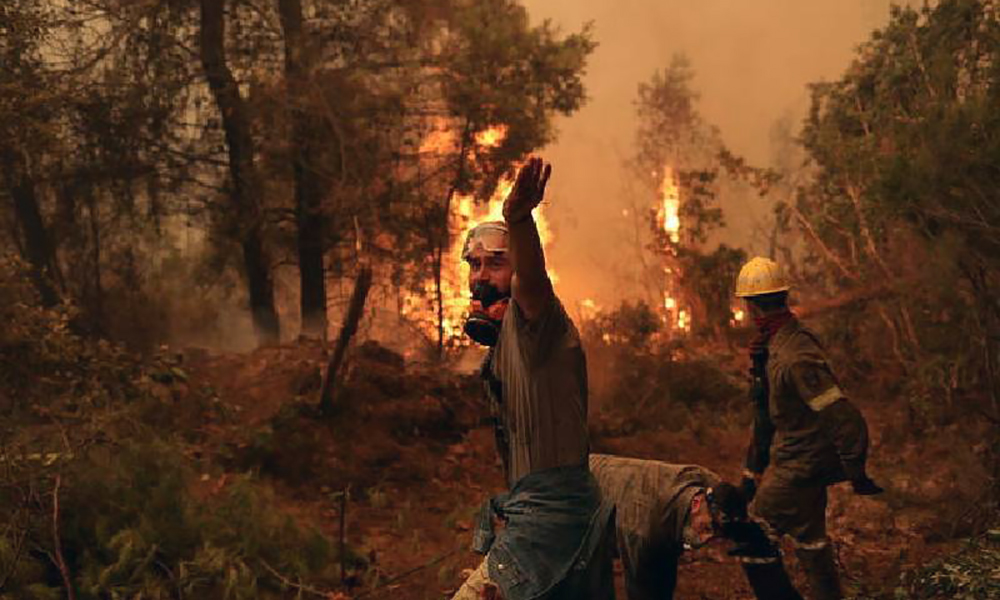
Exhausted Greek firefighters battled blazes for a ninth day on Wednesday amid sweltering temperatures that also helped stoke wildfires in Algeria, where at least 65 people died, and in southern Italy, Reuters reported.
From Turkey to Tunisia, countries around the Mediterranean have been seeing some of their highest temperatures in decades, as the United Nations climate panel this week warned that the world was dangerously close to runaway warming.
Greece, in the grip of its worst heatwave in three decades, evacuated around 20 villages on the Peloponnese, though ancient Olympia, site of the first Olympic Games, escaped the inferno, Reuters reported.
About 580 Greek firefighters, helped by colleagues from France, Britain, Germany and the Czech Republic, were battling blazes in Gortynia, near Olympia.
Flare-ups continued to ravage Evia, Greece’s second-largest island, just off the mainland east of Athens and scene of some of the worst devastation in the past week, Reuters reported.
“If helicopters and water bombing planes had come right away and operated for six, seven hours, the wildfire would have been put out in the first day,” said cafe owner Thrasyvoulos Kotzias, 34, gazing at an empty beach in the resort of Pefki on Evia.
Prime Minister Kyriakos Mitsotakis has called it a “nightmarish summer” and has apologised for failures in tackling some of the more than 500 wildfires that have raged across Greece.
At the other end of the Mediterranean, Algeria’s government deployed the army to help fight fires that tore through forested areas in the north of the country, killing at least 65 people, including 28 soldiers.
The worst hit area has been Tizi Ouzou, the largest district of the mountainous Kabylie region, where houses have burned and residents fled to shelter in hotels, hostels and university accommodation in nearby towns.
President Abdelmadjid Tebboune declared three days of national mourning for the dead.
In southern Italy fires ravaged thousands of acres of land as temperatures hit records well above 40 degrees Celsius and hot winds fanned the flames, Reuters reported.
Firefighters said on Twitter they had carried out more than 3,000 operations in Sicily and Calabria in the last 12 hours, deploying seven planes to try to douse the flames.
“We are losing our history, our identity is turning to ashes, our soul is burning,” a local mayor in Calabria, Giuseppe Falcomata, wrote on Facebook, after a 76-year-old man died when flames engulfed his house.
Tunisia’s capital Tunis recorded its highest ever temperature of 49C on Tuesday, the Meteorological Institute said.
Turkey has also suffered nearly 300 wildfires over the past two weeks which have devastated tens of thousands of hectares of woodland, though only three were reported still burning as of late Wednesday.
Turkey’s northern coast, however, faced a different challenge – floods after unusually heavy rainfall that tore down a bridge and left villages without power.
The wildfires are not limited to the Mediterranean region. California has suffered the second-largest wildfire in its history that by late on Sunday had covered nearly 500,000 acres (2,000 sq km).
The U.N. climate panel published a report on Monday that said greenhouse gases in the atmosphere were high enough to guarantee climate disruption for decades if not centuries.






World
New poll shows weak U.S. support for Iran conflict
Approval of the conflict has been below 40% since the U.S. and Israel launched strikes on February 28 — a stark contrast to the opening months of other recent conflicts.
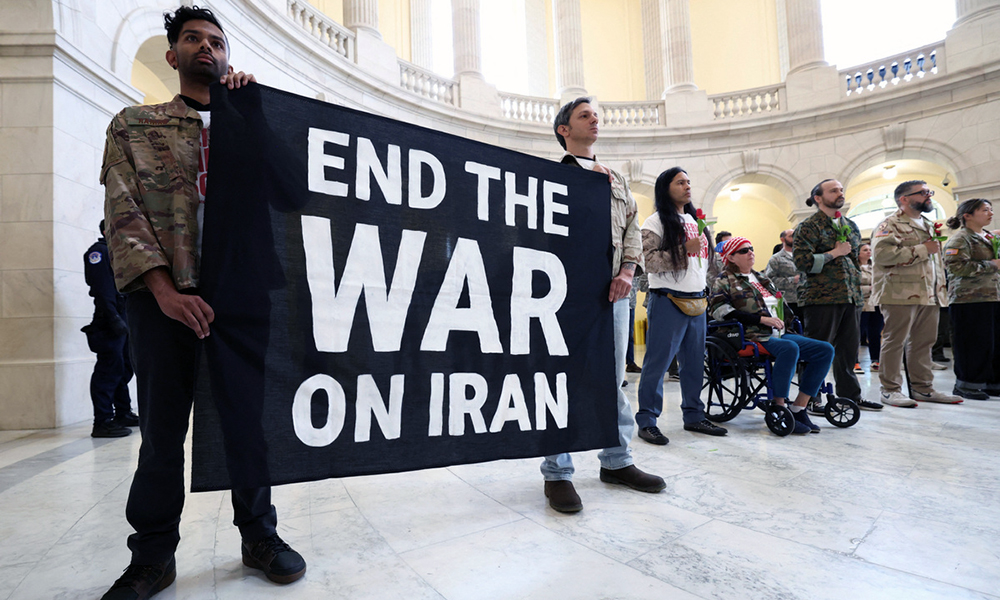
Just one in three Americans support the war on Iran, the lowest reading in a Reuters/Ipsos poll since the five-month-old conflict’s early days, with most respondents saying that President Donald Trump has failed to explain his goals, Reuters reported.
The poll, conducted Friday through Sunday, also showed the Republican president’s approval rating ticking higher to 37%, up three points from last month when his rating tied the lowest of his presidency.
Trump has offered shifting objectives for the conflict such as aiding Iranians to topple their leaders, taking out Iran’s ballistic-missile capabilities and preventing it from obtaining a nuclear weapon. The poll found that 69% of Americans — including four in 10 Republicans – think Trump has not “clearly explained the goals of U.S. military involvement in Iran.”
White House spokeswoman Olivia Wales said Trump will not make decisions based on “fluid opinion polls” and reiterated the president’s resolve to prevent Iran from ever acquiring a nuclear weapon. “What matters most to the American people is having a commander in chief who takes bold action to keep them safe,” Wales said.
Approval of the conflict has been below 40% since the U.S. and Israel launched strikes on February 28 — a stark contrast to the opening months of other recent conflicts.
While each had different context, the Iraq War from 2003 to 2011 had the support of about 70% of Americans in its early months. During the early days of the Afghanistan War, which lasted from 2001 to 2021, about 90% of the country backed the war, to polling, by Gallup.
Public disapproval of the war is weighing on Trump and his Republican Party ahead of the November midterm elections when the president’s allies will defend slim majorities in the U.S. Congress.
“It’s not clear why we started a war with them. I have no idea,” said Alex Womack, a retired turbine repair specialist from Stockbridge, Georgia, who became a Republican in part because he liked how Republican President George H.W. Bush handled the Gulf War in 1991.
Womack, who served in the U.S. Marine Corps during that conflict, said his support for Trump has ebbed because of the war. “I don’t think he’s doing very well, personally,” he said.
To date, 18 American soldiers have died in the conflict while thousands have died in Iran and in Lebanon, where Iran-allied fighters have battled Israeli forces.
The war has pushed gasoline prices sharply higher, a blow to the finances of many Americans. Gasoline prices are averaging just over $4 a gallon nationwide, up from about $3 a gallon just before the war started on February 28, read the report.
“This puts pressure on the party in a myriad of ways, all of them bad,” said Alex Conant, a Republican political strategist and a White House spokesman during the presidency of George W. Bush. “The White House officials have been saying since January that they need to win economic arguments. It’s hard to win the economic arguments when you’re clearly focused on foreign policy.”
Independent registered voters in the latest Reuters/Ipsos poll said they were favoring the Democratic congressional candidate over the Republican by 36% to 20%. Independent voters also favored Democrats over Republicans on economic policy, the poll found
In campaigning for the 2024 presidential election, Trump said he would keep the U.S. out of enduring conflicts. He initially estimated the Iran war would last four to five weeks. He has bristled over comparisons to other wars, including the Vietnam War, which lasted two decades and claimed the lives of more than 58,000 U.S. soldiers.
Rhyan Anderson, an independent from Fairburn, Georgia, who voted for Trump in 2024, said he thinks Trump should focus on domestic problems rather than on helping Israel or other allies.
“My biggest thing is just focus on the people who are actually in the country,” said Anderson, who works two jobs in security and data collection and said he voted for Democrat Joe Biden in 2020. “I know we have allies and things like that, but there’s a lot of people here that really need help.”
Since mid-March, the Reuters/Ipsos survey has asked respondents whether they support or oppose military strikes on Iran. At that time, 37% said they supported the war.
That compared to 27% approval on the day the war began, when the Reuters/Ipsos survey also gave respondents the option to choose unsure, which 29% did.
The latest Reuters/Ipsos survey, which was conducted online and nationwide, gathered responses from 1,246 U.S. adults and had a margin of error of 3 percentage points in either direction.
Myanmar’s military has sharply escalated attacks on civilians since a new administration took office in the war-torn country, a conflict monitor said on Monday, even as regional governments ramp up diplomatic engagement.
The Armed Conflict Location & Event Data Project (ACLED) said the onslaught was a result of the tactics deployed by Myanmar’s new military chief who took over in late March as his predecessor prepared to become the country’s president, Reuters reported.
“Since the ruling junta in Myanmar reconfigured its military command structure in March, civilians have been subject to the military’s worsening repression and intensified aerial bombing campaign,” ACLED said.
“These adjustments included the regular deployment of specialised groups of two to five jet fighters executing sustained airstrikes against single targets.”
A Myanmar government spokesperson did not immediately respond to questions from Reuters.
ACLED gathers data on Myanmar’s ongoing conflict from media reports and local partners, as well as reports by the UN, international monitoring groups and local human rights organisations.
Myanmar was plunged into turmoil after the military ousted Aung San Suu Kyi’s elected government in February 2021, sparking a civil war that has killed some 100,000 people and displaced millions.
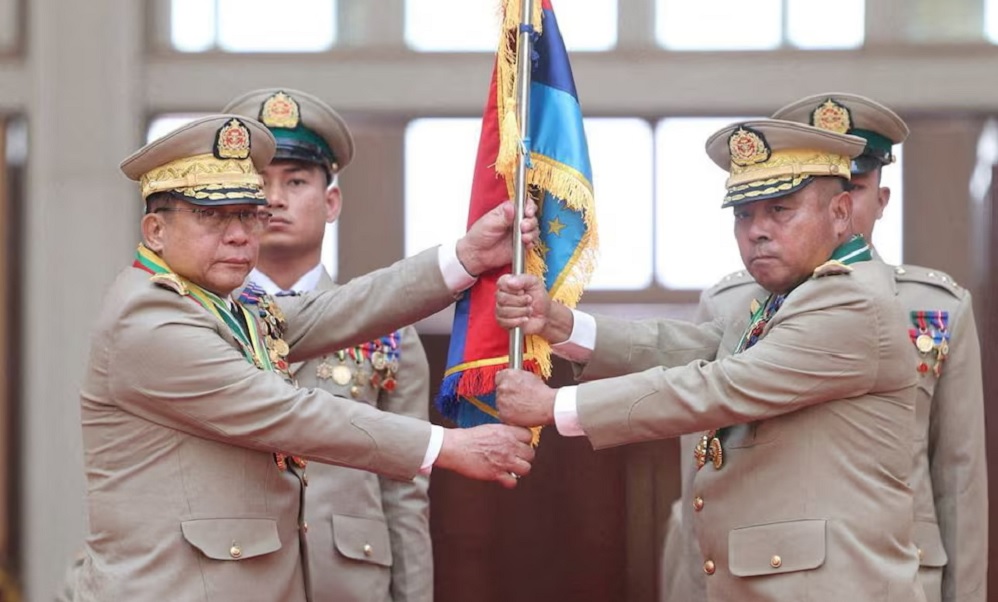
Days before becoming president after an election that banned most opposition, Min Aung Hlaing appointed long-time loyalist and former spymaster Ye Win Oo as the military’s new commander-in-chief.
Under his command, the military has launched renewed offensives into several border regions, including a frontier area with critical rare earth deposits and other vital trade routes.
“Reprieve for civilians is unlikely as the junta focuses its efforts on consolidating control following coup leader Min Aung Hlaing’s transition from commander of the military to civilian president in April,” ACLED said.
MASS KILLINGS
During the first half of 2026, ACLED said it recorded more than a dozen mass killings, resulting in over 450 civilian fatalities, around 40% of them in Myanmar’s central dry zone known as the Anyar region.
In May, hundreds of junta troops swept through parts of Myit Chay township, across the river from the ancient temples of Bagan, killing at least 40 people, three residents of the area told Reuters.
“About 700 soldiers came into the town, grabbed the belongings of the people here and then beat them and killed them,” said Ye Naung, 35.
Reuters could not independently verify accounts of the incident at Myit Chay, which is part of ACLED’s event database with at least five fatalities and was reported by local media.
“The military’s tactics in 2026 so far show merely shifting modalities of civilian repression rather than any reduction in its severity,” ACLED said.
The political transition in Myanmar has triggered a flurry of diplomacy, with Min Aung Hlaing travelling to key neighbours India and China.
There has also been tentative re-engagement with the 11-member Association of Southeast Asian Nations bloc, which barred Myanmar’s ruling generals from its summits after the coup.
Min Aung Hlaing will make an official visit to Thailand on August 6 to 7, as he pushes for further legitimacy.
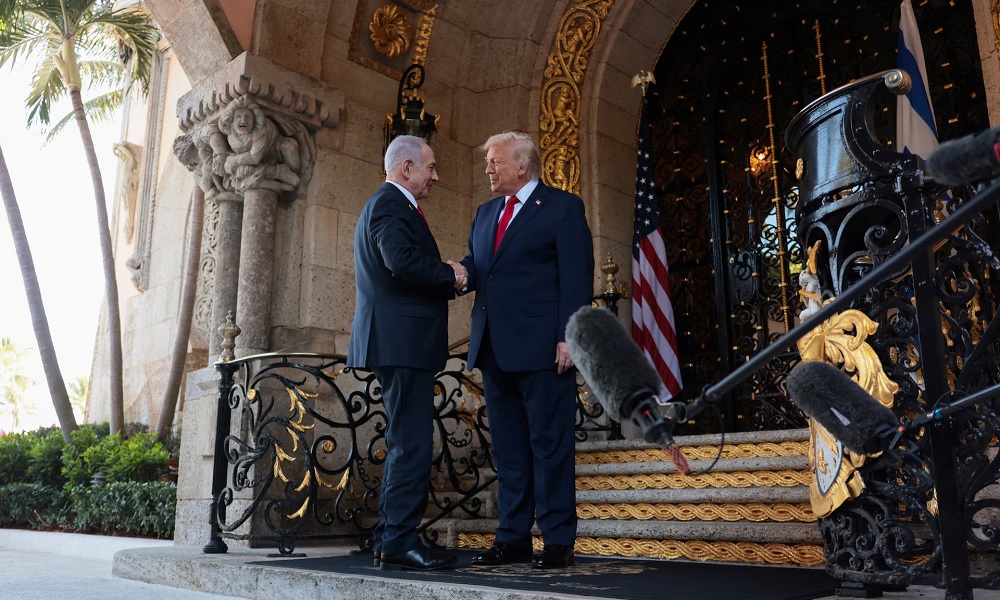
President Donald Trump said on Friday that Israeli Prime Minister Benjamin Netanyahu will visit the U.S. next week.
Trump’s comments came in his speech at the White House Correspondents’ Association Dinner on Friday, while he was falsely casting U.S. Senator Chuck Schumer as Palestinian, Reuters reported.
“I am going to send him (Schumer) a beautiful Palestinian outfit tomorrow, so he can greet Bibi Netanyahu when he comes to town next week,” Trump said.
“He turned Palestinian,” Trump said of Schumer, who is Jewish, while also joking that sharia law was Schumer’s “new founding.”
U.S. Muslim and Jewish advocacy groups have previously criticized Trump for calling Schumer, the top Senate Democrat, a Palestinian, with the rights groups saying Trump uses the term disrepectfully as a slur and as an insult.
Netanyahu’s office said earlier that he will travel to Washington on Monday and will meet with Trump on Tuesday. Netanyahu will also attend deceased U.S. Senator Lindsey Graham’s funeral, his office said.
The Trump-Netanyahu meeting will come as the U.S.-Israeli war on Iran completes five months.


Oman presents Iran with Gulf-backed plan for voluntary fees to use Hormuz

Germany deports first Afghan without criminal record since 2021, Reuters reports

Tahawol: Iran–US relations amid recent developments

Saar: Attack in Pakistan-controlled Chitral

Qosh Tepa and Akhawat to face off in AWPL final

India offers 1,000 online scholarships for Afghan students for 2026-27 academic year

Cricket world pays tribute to Afghanistan fast bowler Shapoor Zadran

Turkey spent over $120 million to prepare airport for Qatar-donated U.S. presidential aircraft

Thousands pay final respects as Afghan cricketer Shapoor Zadran buried in Kabul

Afghanistan U-15 team qualifies for FIFA U-15 World Cup
Tahawol: Iran–US relations amid recent developments
Saar: Attack in Pakistan-controlled Chitral

Tahawol: Afghanistan–Uzbekistan Economic Cooperation Enters New Phase

Saar: Growing Criticism in Pakistan Over Islamabad’s Afghanistan Policy

Tahawol: Trump halting major Iran escalation
-
 Latest News3 days ago
Badakhshan Governor, Army Chief reaffirm commitment to Afghanistan’s security
-
 Latest News5 days ago
Five armed men killed while attempting to cross Durand Line into Badakhshan
-
 Latest News4 days ago
U.S. government plan to interview Afghan refugees raises deportation concerns
-
 Latest News5 days ago
Iran reiterates call for inclusive government in Afghanistan
-
 Latest News4 days ago
Afghanistan, Turkey discuss expanding agricultural cooperation
-

 Regional3 days ago
US pauses strikes on Iran as diplomatic efforts gather pace amid regional tensions
-
 Business5 days ago
Over 205,000 Afghans visit Uzbekistan for trade and business in six months
-
 Business2 days ago
Iran seeks to establish free trade zone with Afghanistan and China