Latest News
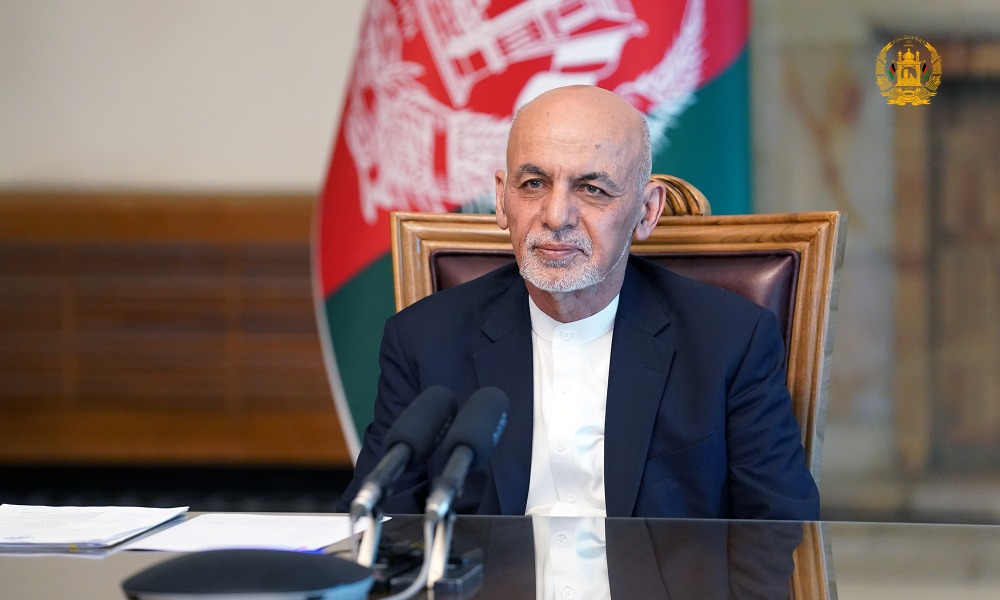
Ghani calls for ECO’s active role in Afghan peace process
Afghan President Ashraf Ghani has called on members of the Economic Cooperation Organization (ECO), an Asian political and economic intergovernmental organization, to play role in supporting a durable peace in Afghanistan.
Addressing the 14th ECO Summit on Thursday, Ghani stated that Afghanistan is in “a truly historic open moment to make a just in lasting peace to a political Agreement to eradicate violence by achieving the in-state of a sovereign democratic in united Afghanistan.”
Ghani told the members of the ECO: “We count on and need your support to secure international and regional guarantees for securing Afghanistan’s future.”
“Pakistan is an especially significant role to play in supporting a lasting peace process for it is the country more likely most likely to suffer from the adverse Consequences god forbid of a failed peace process.” He said.
President Ghani emphasized the urgency for building peace in the war-weary country.
“For 42 years we the people of Afghanistan have been denied the foundational right to peace it is time to stop the violence that has turned our beautiful country into a killing field,” Ghani noted.
He pointed out that ECO members’ support for a comprehensive ceasefire and to accelerate the negotiations in Doha is crucial.
“We, the people and government of Afghanistan and our international partners, have a true sense of urgency to make and build peace. Your support for a comprehensive ceasefire to accelerate the negotiations in Doha is essential,” Ghani stated.
Meanwhile, Ghani has also called on the Taliban to condemn the recent violence across the country.
“The Taliban have a moral responsibility to condemn the violence and socialize peace to their commanders in their rank and file when we are ready to make peace their Violence has no religious justification as pointed out by some of the most prominent Muslim scholars,” Ghani said.

Latest News
US State Department: Afghanistan fails to meet minimum fiscal transparency standards
The U.S. Department of State says Afghanistan’s ministries and other public-sector institutions failed to meet any of the minimum requirements for fiscal transparency during the review period.
In its 2026 Fiscal Transparency Report, released Tuesday, the State Department said no Afghan entity had published an executive budget proposal or an end-of-year report within a reasonable timeframe.
The report said that in the absence of a publicly available budget, there was no confirmation of government expenditures made to support public services. It also said Afghan institutions had not published timely information on public-sector debt obligations.
According to the report, publicly available revenue and expenditure figures did not correspond to actual revenues and expenditures, based on information gathered through contacts and the government’s inability to service public-sector debts.
However, some state-owned enterprises independently published information on their revenues and expenditures.
The State Department also said an entity calling itself the Supreme Audit Office, which announced that it would begin operating in 2022, had not clarified the legal basis for its activities and did not publish any audits or audit findings during the review period.
The report further noted that the IEA did not make public the budgets of their “military” and intelligence services.
The U.S. State Department recommended that Afghan ministries and public institutions improve fiscal transparency by publishing reliable budget documents on time, following internationally accepted budgeting principles, strengthening oversight of off-budget accounts, and making information on public-sector debt publicly available.
It also called for clearer laws governing natural-resource extraction and public procurement, as well as ensuring that any supreme audit institution operates independently and meets international standards.
Meanwhile, the Islamic Emirate’s spokesperson, Zabihullah Mujahid, said Afghanistan’s budget does not belong to any other country, and therefore there is no obligation to provide information to others about how it is spent.
Latest News
FAO warns water shortages and heat put Afghanistan’s agriculture under pressure
FAO assessed current conditions and prospects using climate forecasts, remote-sensing data and consultations with farming communities across all 34 provinces.
The Food and Agriculture Organization of the United Nations (FAO) has warned that water shortages and above-average temperatures are placing increasing pressure on summer crops and grazing across Afghanistan.
In its August 2026 outlook for Afghanistan’s 2026/27 agricultural season, FAO assessed current conditions and prospects using climate forecasts, remote-sensing data and consultations with farming communities across all 34 provinces.
The agency said persistent water shortages, combined with high temperatures, are affecting agricultural conditions during the summer season and increasing pressure on crops and livestock.
FAO also warned that persistently high fertilizer prices could limit farmers’ ability to invest in the upcoming winter wheat season, potentially affecting production prospects.
Looking ahead, the report says a strengthening El Niño and the possible development of a positive Indian Ocean Dipole could bring above-average precipitation during winter and spring.
Such conditions could improve water availability and boost prospects for agricultural production, but FAO cautioned that heavier rainfall could also increase the risk of floods, landslides, crop damage and livestock losses.
The agency said the latest outlook highlights the need for continued monitoring, anticipatory action and timely, practical climate and agricultural advisories to help farmers and livestock owners prepare for changing conditions.
Latest News
Hana raises concerns over Afghan women and children amid Iran’s expulsion policy
It said the risks are particularly serious for children born in Iran or those who have spent much of their lives there.
The Hana Human Rights Organization has raised serious concerns over the situation of Afghan women and children in Iran, saying the country’s plan to regulate and expel undocumented Afghan nationals remains in effect.
According to Hana, Iran’s Ministry of Interior has confirmed that the “Plan for the Regulation and Expulsion of Unauthorized Afghan Nationals” has not been suspended.
The organization said the policy is continuing amid the consequences of armed conflict and an increasingly securitized environment in Iran, which it said has heightened the vulnerability of Afghan migrants and asylum seekers.
Hana said it has previously documented cases involving the arrest and mistreatment of Afghan nationals, deportations, family separation and difficulties obtaining civil documentation and accessing essential services.
The organization warned that continued implementation of the expulsion policy could worsen these problems.
Hana expressed particular concern for Afghan children under 18, stressing that children’s rights are independent of their parents’ migration status.
It said irregular residence should not, by itself, justify a child’s detention, separation from family or removal without an individualized assessment. Any decision affecting a child, it added, should prioritize the child’s best interests, preserve family unity and provide additional safeguards for unaccompanied and separated children.
The organization warned that large-scale expulsions without clear procedures to identify and protect children at risk could result in family separation, disruption to education, lack of legal protection, difficulties establishing legal identity, exploitation and return to unsafe conditions.
It said the risks are particularly serious for children born in Iran or those who have spent much of their lives there.
Hana also highlighted gender-specific risks facing Afghan women and girls. It warned that deportation to Afghanistan without assessing risks linked to gender, previous political or social activities, family circumstances and access to support networks could expose them to serious human rights violations.
The organization said being classified as an “unauthorized foreign national” should not replace an individual assessment of a person’s protection needs and the risks they may face upon return.
Hana stressed that while states have the authority to regulate the entry and residence of foreign nationals, migration enforcement must comply with international human rights principles, including non-refoulement, the prohibition of collective expulsion, access to individualized procedures and respect for family unity.
It called for heightened protection for women and children, warning that continuing the expulsion plan without effective legal and protection safeguards could lead to further human rights violations against Afghan migrants and asylum seekers in Iran.
-
Sport3 days agoAfghanistan secure direct qualification for 2027 Men’s ODI World Cup
-
Regional4 days agoGoods transporters to go on strike from Saturday after talks with Pakistan govt fail
-
Latest News3 days agoPakistan-backed armed groups in Balochistan using former Afghan government forces: report
-
Sport4 days agoRashid Khan takes six as Afghanistan thrash Ireland by 92 runs
-
World4 days agoUS Senate passes Russia sanctions championed by Graham; US House next
-
Sport2 days agoAbasin Defenders stun Kabul Zalmi in Kabul Premier League
-
Latest News4 days agoMoldova president criticizes visa approval for IEA delegation
-
Regional3 days agoTurkey, Pakistan, Saudi Arabia defence pact technically same as NATO’s Article 5, Turkish minister says