
Latest News
In shock announcement, Trump says U.S. wants to take over Gaza Strip
Senior Hamas official Sami Abu Zuhri condemned Trump’s calls for Gazans to leave as “expulsion from their land.”

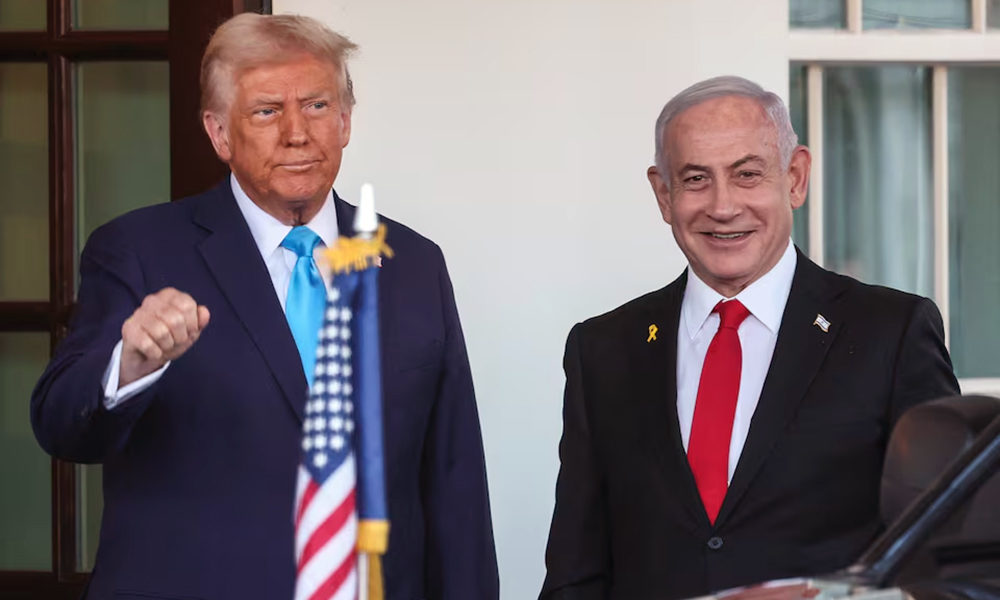
President Donald Trump said the U.S. would take over the war-ravaged Gaza Strip and develop it economically after Palestinians are resettled elsewhere, actions that would shatter decades of U.S. policy toward the Israeli-Palestinian conflict, Reuters reported.
Trump unveiled his surprise plan, without providing specifics, at a joint press conference on Tuesday with visiting Israeli Prime Minister Benjamin Netanyahu.
The announcement followed Trump’s shock proposal earlier on Tuesday for the permanent resettlement of the more than two million Palestinians from Gaza to neighboring countries, calling the enclave – where the first phase of a fragile Israel-Hamas ceasefire and hostage release deal is in effect – a “demolition site.”
Trump can expect allies and foes alike to strongly oppose any U.S. takeover of Gaza, and his proposal raises questions whether Middle East power Saudi Arabia would be willing to join a renewed U.S.-brokered push for a historic normalization of relations with U.S. ally Israel.
The U.S. taking a direct stake in Gaza would run counter to longtime policy in Washington and for much of the international community, which has held that Gaza would be part of a future Palestinian state that includes the occupied West Bank, read the report.
“The U.S. will take over the Gaza Strip, and we will do a job with it too,” Trump told reporters. “We’ll own it and be responsible for dismantling all of the dangerous unexploded bombs and other weapons on the site.”
“We’re going to develop it, create thousands and thousands of jobs, and it’ll be something that the entire Middle East can be very proud of,” Trump said. “I do see a long-term ownership position and I see it bringing great stability to that part of the Middle East.”
Asked who would live there, Trump said it could become a home to “the world’s people.” Trump touted the narrow strip, where Israel’s military assault in response to Hamas’ Oct. 7, 2023, cross-border attack has leveled large swaths, as having the potential to be “The Riviera of the Middle East.”
Trump did not directly respond to a question of how and under what authority the U.S. can take over and occupy Gaza, a coastal strip 25 miles (45 km) long and at most 6 miles (10 km) wide, with a violent history. Successive U.S. administrations, including Trump in his first term, had avoided deploying U.S. troops there.
Several Democratic lawmakers quickly condemned the Republican president’s Gaza proposals, Reuters reported.
Netanyahu, referred to a few times by Trump by his nickname, “Bibi,” would not be drawn into discussing the proposal in depth other than to praise Trump for trying a new approach.
The Israeli leader, whose military had engaged in more than a year of fierce fighting with Hamas militants in Gaza, said Trump was “thinking outside the box with fresh ideas” and was “showing willingness to puncture conventional thinking.”
Netanyahu may have been relieved that Trump, who forged close ties with the Israeli leader during his first term in the White House, did not pressure him publicly to maintain the ceasefire. He faces threats from far-right members of his coalition to topple his government unless he restarts the fighting in Gaza to destroy Iran-backed Hamas.
Some experts have suggested Trump sometimes takes an extreme position internationally to set the parameters for future negotiations. In his first term, Trump at times issued what were seen as over-the-top foreign policy pronouncements, many of which he never implemented.
A U.N. damage assessment released in January showed that clearing over 50 million tonnes of rubble left in Gaza in the aftermath of Israel’s bombardment could take 21 years and cost up to $1.2 billion.
Jonathan Panikoff, former deputy U.S. national intelligence officer for the Near East, said Trump’s plan would mean a lengthy U.S. military commitment and if it came to fruition would be viewed by the Arab world as Washington “not learning its lessons from nation building in Iraq and Afghanistan.”
Trump earlier repeated his call for Jordan, Egypt and other Arab states to take in Gazans, saying Palestinians there had no alternative but to abandon the coastal strip, which must be rebuilt after nearly 16 months of a devastating war between Israel and Hamas militants.
But this time Trump said he would support resettling Palestinians “permanently,” going beyond his previous suggestions that Arab leaders had already steadfastly rejected.
Forced displacement of Gaza’s population would likely be a violation of international law and would be fiercely opposed not only in the region but also by Washington’s Western allies. Some human rights advocates liken the idea to ethnic cleansing.
Senior Hamas official Sami Abu Zuhri condemned Trump’s calls for Gazans to leave as “expulsion from their land.”
“We consider them a recipe for generating chaos and tension in the region because the people of Gaza will not allow such plans to pass,” he said.
Trump offered no specifics on how a resettlement process could be implemented but his proposal echoed the wishes of Israel’s far right and contradicted Democratic former President Joe Biden’s commitment against mass displacement of Palestinians, Reuters reported.
Aaron David Miller, a former Middle East adviser to Republican and Democratic administrations, said Trump had given Netanyahu a “huge pass” with his Gaza announcement. “He validated almost every right-wing fantasy in Israel,” Miller said.
The Saudi government, in a statement, stressed its rejection of any attempt to displace Palestinians from their land and said it would not establish relations with Israel without establishment of a Palestinian state.
Just two weeks into his second term, Trump was hosting Netanyahu at the White House to discuss the future of the Gaza ceasefire, strategies to counter Iran and hopes for a renewed push for an Israeli-Saudi normalization deal.
His Gaza proposal followed a frenetic first two weeks in office in which Trump has talked about a U.S. takeover of Greenland, warned of the possible seizure of the Panama Canal and declared that Canada should be the 51st U.S. state.
Some critics have said Trump’s expansionist rhetoric echoes old-style imperialism, suggesting it could encourage Russia in its war in Ukraine and give China justification for invading self-ruled Taiwan.
Trump described the Gaza Strip as a longtime “symbol of death and destruction” and said Palestinians there should be housed in “various domains” in other countries. He said the U.S. will take over the Gaza Strip, “level the site” and create economic development but did not say how.
Trump, who had a career of developing real estate before getting into politics, cast a broad-brush, optimistic vision of a U.S. takeover of Gaza while skirting details on how the United States would go about possessing the enclave and securing it.
He was also vague on where the Palestinian inhabitants of Gaza would go, saying he was confident Egypt and Jordan would take many of them, despite those governments already rejecting the idea.
What impact Trump’s proposals have on negotiations over the second phase of the Gaza ceasefire deal was unclear, as Hamas has adamantly insisted it wants to remain in Gaza while Netanyahu has vowed to destroy the group and never allow it to again rule the territory, read the report.
Trump’s Middle East envoy, Steve Witkoff, played a key role in helping the Biden administration secure the long-sought Gaza deal before the Jan. 20 transfer of power in the U.S. The first phase has led to Hamas’ release of 18 hostages and Israel’s release of hundreds of jailed Palestinians.
“We’re in Phase 2 now,” Witkoff told reporters earlier. He said he met Netanyahu on Monday to discuss parameters for the policy negotiations and would meet the prime minister of Qatar, a mediator in the negotiations, in the U.S. on Thursday.








Afghanistan’s Ministry of Defense says a Pakistani military post near Spin Boldak was targeted and destroyed after Pakistani forces opened fire toward Afghanistan.
Ministry spokesperson Enayatullah Khwarazmi said in a post on X that Afghan forces suffered no casualties or damage in the clash.
Khwarazmi also rejected claims made by the Pakistani side about the incident, describing them as “propaganda.”
Latest News
Mujahid: Pakistan attacking Afghanistan to evade Mecca Pact responsibilities
He warned that the Islamic Emirate would give an “appropriate response” to what he called the Pakistani military regime’s “bullying.”
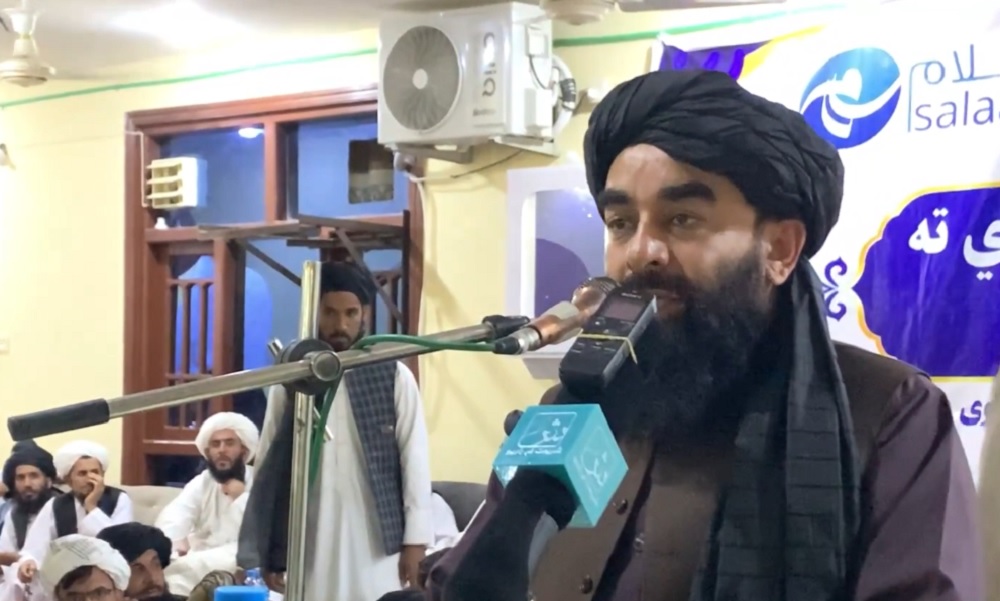
Islamic Emirate spokesperson Zabihullah Mujahid has accused Pakistan of carrying out attacks on Afghanistan to divert attention from its domestic problems and to evade responsibilities under the “Mecca Pact.”
Speaking at a religious seminary in Kandahar, Mujahid said Pakistan was facing political and economic challenges at home and was using attacks on Afghanistan to shift public attention away from protests and its internal problems.
“Pakistan, by violating the territory of its neighboring Islamic country, wants to divert attention from its failures,” he said.
Mujahid also criticized Pakistan’s political situation, claiming that political space had been restricted and that freedoms guaranteed under the country’s laws were not being allowed.
He said Pakistan’s economic problems had also increased significantly and accused the country of seeking to distract the public from those problems by engaging in conflict with Afghanistan.
Mujahid further accused Pakistan’s military leadership of putting the Pakistani people at risk through what he described as its “false position.”
He warned that the Islamic Emirate would give an “appropriate response” to what he called the Pakistani military regime’s “bullying.”
His remarks followed Pakistani airstrikes on Kandahar, Paktia and Khost provinces on Thursday, which Afghan authorities said killed four civilians.
The strikes came three days after attacks on Kunar and Paktika provinces, in which Afghan authorities said three civilians were killed.
Latest News
Kabul rejects U.S. claim that meth seized in Pakistan was of Afghan origin
Balkhi said the Islamic Emirate of Afghanistan (IEA) has imposed an absolute ban on the production, trafficking and use of all types of narcotics in Afghanistan.
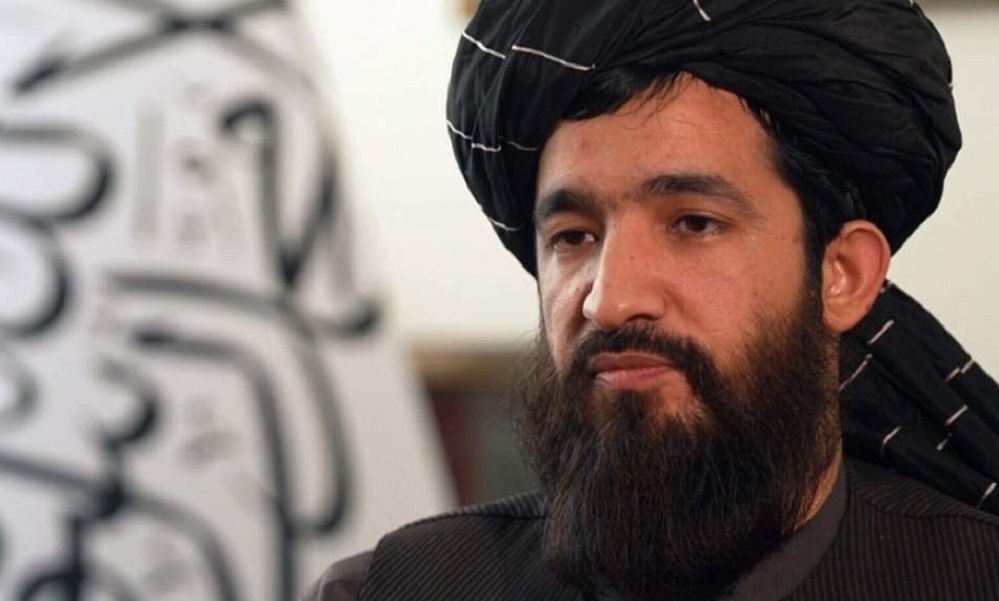
Afghanistan’s Foreign Ministry spokesperson Abdul Qahar Balkhi has rejected a U.S. claim that 463 kilograms of synthetic drugs seized in Pakistan were of Afghan origin, calling the attribution “unfounded and politically motivated.”
Balkhi said the U.S. Embassy in Islamabad should investigate the origin of the seized drugs in Pakistan rather than attributing them to Afghanistan.
“The attribution by the U.S. Embassy in Islamabad of the synthetic drugs bound for Sri Lanka and intercepted in Pakistan through joint U.S.-Pakistani efforts as ‘Afghan-origin’ is an unfounded and politically motivated allegation,” Balkhi said.
He said the Islamic Emirate of Afghanistan (IEA) has imposed an absolute ban on the production, trafficking and use of all types of narcotics in Afghanistan.
Balkhi also claimed that following the ban in Afghanistan, the cultivation, production and trafficking of narcotics have increased “on the other side of the Durand Line.”
He further argued that Afghanistan does not have the capacity to produce synthetic drugs and said crossing points along the Durand Line have been completely closed to all movement for nearly a year.
His remarks came after the U.S. Embassy in Islamabad said U.S. and Pakistani anti-narcotics authorities had seized 463 kilograms of crystal methamphetamine worth an estimated $21 million and bound for Sri Lanka.
The embassy said the operation led to multiple arrests and highlighted ongoing U.S. cooperation and training with Pakistani authorities to disrupt international drug-trafficking networks.


Afghanistan Champions League: Arman FC and Aino Mina play out goalless draw

Afghanistan says Pakistani military post destroyed near Spin Boldak

Nepal beat Afghanistan in Asian Games cricket

Mujahid: Pakistan attacking Afghanistan to evade Mecca Pact responsibilities

Kabul rejects U.S. claim that meth seized in Pakistan was of Afghan origin

Saudi energy group signs major Afghanistan deals covering gas exploration and pipeline plans

ATN secures exclusive rights to broadcast T20I series in India across Afghanistan

Trump floats idea of renaming Atlantic or Pacific Ocean

US hits Egyptian bank branches with Iran sanctions as war marks six months

Nepal flood rescue mission enters critical phase as thousands remain missing

Tahawol: Discussion on fresh Pakistani airstrikes on Afghanistan

Saar: Calls for international support for Afghanistan discussed

Tahawol: Opening of the 81st UN General Assembly Session

Saar: OIC Assessment of Afghanistan’s humanitarian and development situation discussed

Tahawol: Reactions to Pakistan’s attacks on Afghanistan discussed
-

 Sport4 days ago
Afghanistan to face Japan and Nepal in Asian Games cricket group stage
-
 Regional4 days ago
Iran and US trade threats after Houthi attacks escalate regional conflict
-

 World4 days ago
CNN, MS NOW and Politico sue Trump, challenging White House ban
-

 Health4 days ago
Four-day polio vaccination campaign begins across Afghanistan
-

 Latest News3 days ago
UN reiterates call for respect for international law after Kunar airstrikes
-
 Latest News4 days ago
Khalilzad condemns Pakistan airstrikes, says current strategy is not working
-

 Latest News2 days ago
Ariana Afghan Airlines ranks seventh among 45 Central Asian airlines
-

 Latest News3 days ago
Afghan Official: Pakistan’s airstrikes will not go unanswered