
Latest News
Muttaqi in China: Afghanistan sees itself as a bridge connecting nations

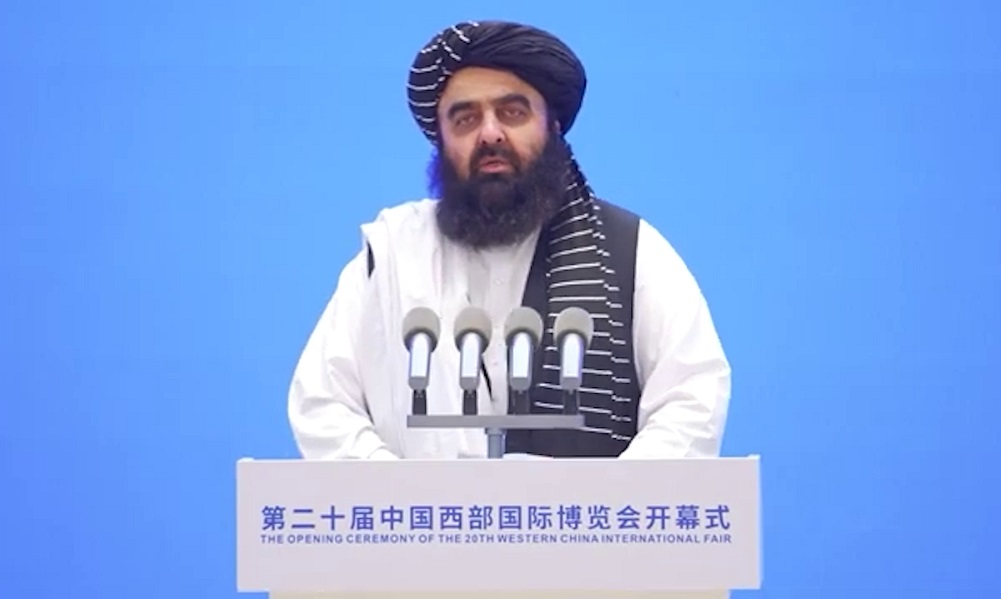
Amir Khan Muttaqi, Acting Foreign Minister of the Islamic Emirate of Afghanistan (IEA), has stated that Afghanistan does not view itself as a landlocked country, but rather as a strategic bridge linking nations, markets, and civilizations.
Speaking at the opening ceremony of 20th Western China International Fair in Sichuan province, Muttaqi emphasized that decades of war and instability had stripped Afghanistan of its historic role as a regional crossroads. However, he expressed optimism that the country is now poised to reclaim that position.
“Afghanistan does not see itself as isolated by geography,” Muttaqi said. “Rather, like other countries, it views itself as a vital bridge—one that connects people, economies, and civilizations. Unfortunately, war and insecurity over the past 45 years deprived both Afghanistan and its neighbors of the opportunity to benefit from its strategic location.”
Highlighting the Islamic Emirate’s foreign policy approach, Muttaqi noted that the IEA is pursuing an economy-focused agenda aimed at expanding trade with all neighboring countries and fostering long-term stability.
“With abundant natural resources, a young workforce, agricultural potential, and a crucial geographic position, Afghanistan can once again become a hub for trade and regional transit,” he said. “The Islamic Emirate has established a secure and trustworthy environment for both trade and investment.”
Muttaqi also underlined the growing partnership between Afghanistan and China, calling China not only a neighbor but also a “good economic partner.”
“We value China’s role in agriculture, infrastructure, and technology, and we are committed to building the foundation for long-term cooperation in these key sectors,” he said.
He further noted that in recent years, more than 2,000 new companies have begun operations in Afghanistan, and that the government’s fight against corruption has been “serious and effective.”












Kazakhstan’s Foreign Minister Mukhtar Tileuberdi has called for pragmatic and coordinated international engagement with Afghanistan, saying the country’s long-term stability is closely linked to the security and sustainable development of Central Asia.
Speaking during the general debate of the 81st session of the United Nations General Assembly in New York on Friday, Tileuberdi said humanitarian assistance to Afghanistan remains essential but alone cannot break the cycle of poverty, displacement and dependency.
He said Kazakhstan supports a “pragmatic, coordinated and step-by-step” approach to international engagement with Afghanistan, with the United Nations playing a central role.
Tileuberdi also said Kazakhstan is working with the UN to operationalize the United Nations Regional Centre for the Sustainable Development Goals for Central Asia and Afghanistan in Almaty.
He said the success of the centre should be measured by the results and assistance it delivers to the region.


Abu Muslim Farah defeat Khurasan Faryab 2-0 in ACL season six

Saar: Concerns over Pakistan’s political crisis discussed

Afghanistan Champions League: Omar Zawak Herat beat Toofan Herat 1-0

Blast in Pakistan’s Dera Ismail Khan kills 11, injures 30

Ariana Afghan Airlines increases Kabul-Delhi cargo flights

Saudi energy group signs major Afghanistan deals covering gas exploration and pipeline plans

Trump floats idea of renaming Atlantic or Pacific Ocean

US hits Egyptian bank branches with Iran sanctions as war marks six months

Nepal flood rescue mission enters critical phase as thousands remain missing

Iranian clubs to face Gulf opponents at neutral venues in Asian Champions League Elite
Saar: Concerns over Pakistan’s political crisis discussed

Exclusive interview with Abdul Latif Mansoor, Minister of MRRD

Tawsia: Overview of Afghanistan’s iron mines

Tahawol: Discussion on fresh Pakistani airstrikes on Afghanistan

Saar: Calls for international support for Afghanistan discussed
-

 World5 days ago
CNN, MS NOW and Politico sue Trump, challenging White House ban
-

 Latest News3 days ago
Ariana Afghan Airlines ranks seventh among 45 Central Asian airlines
-

 Latest News5 days ago
UN reiterates call for respect for international law after Kunar airstrikes
-

 Regional4 days ago
US and Iran hold first talks since June after Trump’s ‘annihilation’ threat
-

 Latest News3 days ago
Silk Road highway in Wakhan corridor now reaches the China border
-

 Latest News5 days ago
Afghan Official: Pakistan’s airstrikes will not go unanswered
-

 Sport4 days ago
Afghan boxing referee heads to China for international festival
-

 Regional5 days ago
G7 foreign ministers call on Iran to stop arming Houthis