Connect with us

Latest News

UAE rescue team deployed to aid Afghanistan earthquake survivors

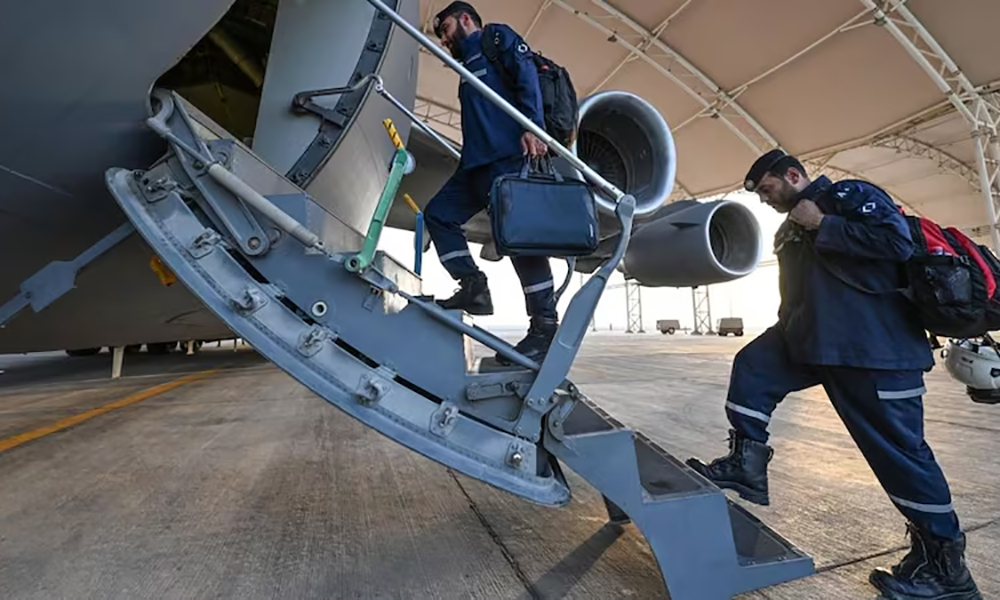
President of the United Arab Emirates directed teams from Abu Dhabi Civil Defence, the National Guard and the Joint Operations Command to assist the response to the earthquake.

Published

on

A team has left the UAE to help with rescue operations in Afghanistan after the earthquake that has killed more than 1,400 people.

The team will conduct field assessments in co-ordination with local authorities in the east of the country to enhance the effectiveness of search and rescue operations, state news agency Wam reported.

It comes after President of the United Arab Emirates directed teams from Abu Dhabi Civil Defence, the National Guard and the Joint Operations Command to assist the response to the earthquake.

“[They will help] broaden the scope of response, provide logistical and relief support to affected areas, and work to save as many lives as possible by rescuing survivors from under the rubble,” Wam said.

The presence of the search and rescue team will coincide with efforts by Emirates Red Crescent to provide medical aid, supplies and shelter to those affected.

The 6.0-magnitude earthquake, followed by at least five aftershocks, hit remote areas in mountainous provinces near the border with Pakistan on Sunday night.

The earthquake’s epicentre was about 27km north-east of the city of Jalalabad, according to the US Geological Survey, which said it struck 8km below the Earth’s surface. Shallow quakes can inflict greater damage.


Latest News

Afghanistan records historic 95% drop in opium production: UNODC

Afghan authorities maintain that the cultivation, production, and trafficking of narcotics in the country have been reduced to near zero under current enforcement measures.

Published

on

The United Nations Office on Drugs and Crime (UNODC) says Afghanistan’s anti-narcotics campaign has achieved a “historic record” following a 95% reduction in opium poppy cultivation over the past three years, while warning that the growing production of synthetic drugs is emerging as a major global concern.

In an interview with Ariana News, the UNODC representative in Afghanistan said the narcotics situation in the country has changed significantly since the 2022 ban on the cultivation and production of illicit drugs, with sustained reductions recorded between 2023 and 2025.

UNODC representative Polleak Ok Serei described the development as unprecedented, saying the 95% reduction in poppy cultivation represents a major global milestone.

“In the past three years — 2023, 2024, and 2025 — the 95% reduction in opium poppy cultivation has been maintained. This is a remarkable achievement and a truly historic record. Previous efforts lasted only one year,” he said. “This is not only important for Afghanistan, but for the entire world, as Afghanistan previously produced around 80% of the global illicit opium supply.”

He added that following these developments, UNODC has adjusted its programs, shifting greater focus toward alternative livelihoods for farmers who previously depended on poppy cultivation.

According to him, while these efforts have shown progress, they remain insufficient due to Afghanistan’s broader humanitarian, economic, and environmental challenges.

UNODC also warned that the shift from traditional narcotics to synthetic drugs is creating new challenges for health systems, requiring updated medical responses and treatment approaches.

“We have had to adapt our activities accordingly,” the UN official said. “We are focusing heavily on alternative livelihoods for farmers, because those previously dependent on this production need new sources of income. We also had to reassess health interventions, particularly due to the shift from traditional drugs to synthetic drugs, which requires different medical approaches.”

The UN agency stressed that drug trafficking is a transnational issue requiring coordinated international cooperation among law enforcement and judicial authorities.

“Drug trafficking is a cross-border phenomenon. There are traffickers operating not only inside Afghanistan but also outside the country. Therefore, international cooperation between police and judicial authorities is essential,” he said.

UNODC called on neighboring countries and the international community to increase cooperation and investment in long-term solutions, including rural livelihoods, addiction treatment, and dismantling trafficking networks.

The statement comes as UNODC’s World Drug Report 2026 highlights rapid changes in global drug markets, driven by technology, instability, and the emergence of new synthetic substances.

According to the report, global drug production and trafficking patterns are shifting significantly, particularly in the opioid market. While Afghanistan’s opium production has sharply declined since 2022, production increases in countries such as Myanmar have not fully offset global supply changes, leading traffickers to increasingly turn toward synthetic opioids such as fentanyl and other highly potent substances.

The report warns that these new synthetic drugs can be significantly more powerful and deadly than traditional narcotics, posing serious risks to public health and security worldwide.

UNODC also noted that rising global demand for drugs such as methamphetamine and cocaine is expanding trafficking routes into new regions, including Africa and Asia, further complicating international control efforts.

Meanwhile, Afghan authorities maintain that the cultivation, production, and trafficking of narcotics in the country have been reduced to near zero under current enforcement measures.

Continue Reading

Latest News

Karzai marks Ashura, calls for unity and national progress

Published

on

Former Afghan President Hamid Karzai has marked Ashura, the anniversary of the martyrdom of Imam Hussein, describing the occasion as a symbol of reform, sacrifice, and social responsibility.

In a message posted on X, Karzai said Imam Hussein stood against social injustice and deviation, calling on society to embrace reform and righteousness. He said the historic events of Karbala continue to inspire responsibility, courage, and awareness among Muslims.

Karzai added that the people of Afghanistan, like Muslims around the world, commemorate Ashura and regard love for the family of the Prophet Muhammad (PBUH) as a source of unity and brotherhood.

He also expressed hope that Afghans would use the spiritual significance of Ashura to strengthen national unity and work together for the country’s progress, prosperity, and advancement through education and knowledge.

Continue Reading

Latest News

Afghanistan’s Interior Ministry reports major anti-narcotics operations over past year

Published

on

Afghanistan’s Ministry of Interior Affairs says more than 11,000 operations were carried out against drug traffickers across the country over the past year, resulting in the arrest of over 13,000 individuals who were later referred to judicial authorities.

Marking International Day Against Drug Abuse and Illicit Trafficking in Kabul on Thursday, officials said that during more than 25,000 poppy eradication operations, over 21,000 jeribs of land were cleared of poppy cultivation.

The ministry added that more than 7,000 drug addicts were collected from different parts of the country during the past year, while security forces also seized more than 2,000 tons of narcotics.

According to official figures, the anti-narcotics measures carried out over the past year include:

  • 11,022 operations conducted against drug traffickers

  • 25,764 operations launched to destroy poppy fields

  • 7,844 drug addicts collected for treatment

  • 2,159 tons of narcotics confiscated

  • 13,326 individuals referred to courts

  • 21,569 jeribs of land cleared of poppy cultivation

  • 533 drug production factories destroyed

Currently, Afghanistan has 16 drug rehabilitation centers nationwide, with 12 already operational and four others in the process of becoming active.

According to officials from the Ministry of Interior Affairs Afghanistan, more than 13,000 people are currently undergoing treatment, while around 185,000 addicts have been collected for rehabilitation over the past several years.

The report comes as the Islamic Emirate highlights major progress in combating narcotics, an issue that had severely damaged Afghanistan’s reputation in previous administrations when the country was considered one of the world’s largest producers of illicit drugs.

Continue Reading
Advertisement
Advertisement
Advertisement
Advertisement

Trending

Copyright © 2025 Ariana News. All rights reserved!


Warning: Undefined array key "slug" in /var/www/vhosts/ariananews.af/httpdocs/wp-includes/class-wp-theme-json.php on line 2117

Warning: Undefined array key "slug" in /var/www/vhosts/ariananews.af/httpdocs/wp-includes/class-wp-theme-json.php on line 2117

Warning: Undefined array key "slug" in /var/www/vhosts/ariananews.af/httpdocs/wp-includes/class-wp-theme-json.php on line 2117
















