
World
Why Palestinians can count on American students but not Arab allies to protest

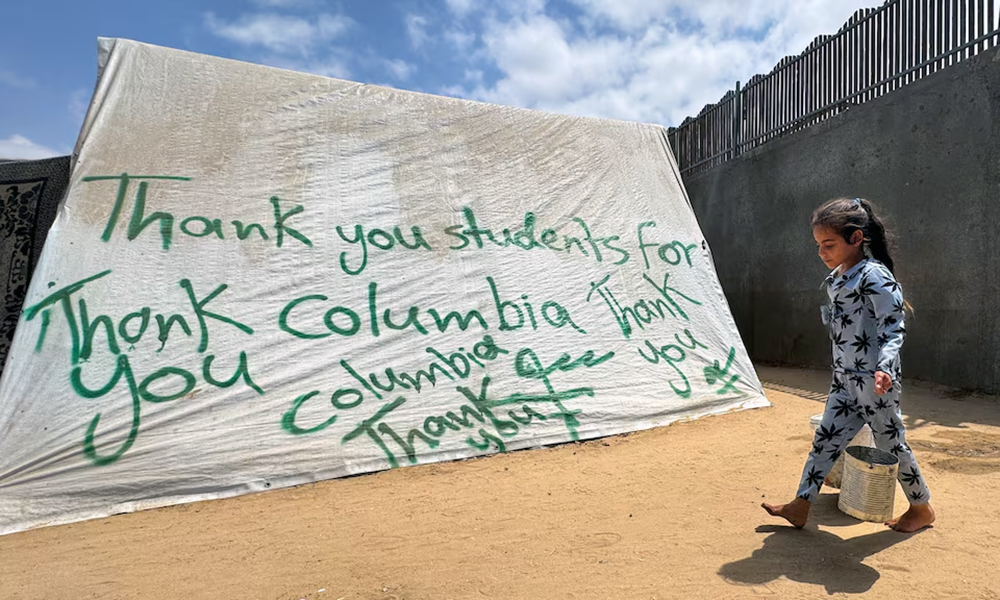
Palestinians may be gratified to see American university campuses erupt in outrage over Israel’s offensive in Gaza, but some in the embattled enclave are also wondering why no similar protests have hit the Arab countries they long viewed as allies, Reuters reported.
Demonstrations have rocked U.S. universities this week, with confrontations between students, counter protesters and police, but while there have been some protests in Arab states, they have not been nearly as large or as vociferous.
“We follow the protests on social media every day with admiration but also with sadness. We are sad that those protests are not happening also in Arab and Muslim countries,” said Ahmed Rezik, 44, a father of five sheltering in Rafah in Gaza’s south.
“Thank you students in solidarity with Gaza. Your message has reached us. Thank you students of Columbia. Thank you students,” was scrawled across a tent in Rafah, where more than a million people are sheltering from Israel’s offensive.
Reasons for the comparative quiet on Arab campuses and streets may range from a fear of angering autocratic governments to political differences with Hamas and its Iranian backers or doubts that any protests could impact state policy, read the report.
American students at elite universities may face arrest or expulsion from their schools, but harsher consequences could await Arab citizens protesting without state authorisation.
And U.S. students may feel more motivation to protest as their own government backs and arms Israel, while even those Arab countries that have full diplomatic relations with it have been strongly critical of its military campaign.
When asked about the conflict, Arabs from Morocco to Iraq have consistently voiced fury at Israel’s actions and solidarity with Gaza’s embattled inhabitants, leading to muted Ramadan celebrations across the region last month.
Some rallies to support Palestinians have erupted, notably in Yemen where the Houthis have joined the conflict with strikes on shipping in the Red Sea.
And Arabs around the region have also shown their horror at the war and support for their fellow Arabs in Gaza on social media, even if they have not taken to the streets.
But whatever the reason for the lack of public protests, some people in Gaza are now drawing unfavourable comparisons between the tumult in the United States and the public reaction they can see in other Arab countries.
“I ask Arab students to do what the Americans have done. They should have done more for us than the Americans,” said Suha al-Kafarna, displaced by the war from home in northern Gaza.
In Egypt, which made peace with Israel in 1979 and where President Abdel Fattah al-Sisi has largely outlawed public protests, the authorities fear that demonstrations against Israel could later turn against the government in Cairo.
At state-sanctioned protests over the war in October, some demonstrators veered off the agreed route and chanted anti-government slogans, prompting arrests.
“One cannot see the lack of large public protests against the war and the muted reaction on the Egyptian street in isolation from a broader context of crackdown on all forms of public protest and assembly,” said Hossam Bahgat, head of the Egyptian Initiative for Personal Rights.
At the American University in Cairo security forces are less likely to intervene on campus and there have been some protests. But a student activist there who requested anonymity said they could still face consequences for demonstrating.
“Being arrested here is nothing like being arrested in the U.S. It’s completely different,” he said, adding that there was “the factor of fear” preventing many from taking to the streets.
In Lebanon, where success in studies has become even more personally important to many young people after years of political and economic crises that have shrunk their shot at future prosperity, that calculation is even tougher.
Several students Reuters approached at campus protests in Beirut declined to be interviewed, saying they feared repercussions from university authorities.
The complex histories of Lebanon and other Arab states such as Jordan that host many Palestinian refugees also play into the question of public protests.
In Lebanon, some people blame Palestinians for triggering the 1975-90 civil war. Others fear any overt displays of support for Palestinians might be hijacked by the Iran-backed Hezbollah, which has been trading fire with Israel since the start of the Gaza conflict, Reuters reported.
“The Arab world is not reacting like Columbia or Brown (U.S. universities) because they don’t have the luxury to do so,” said Makram Rabah, a history professor at the American University of Beirut.
Besides, he added, with public opinion already largely backing the Palestinian cause it was not clear what protests there would achieve.
“The dynamics of power and the way you change public perception are just different in the Arab world compared to the U.S.,” he said.
For Tamara Rasamny, a Lebanese-American arrested and suspended for participating in a sit-in at Columbia a month before getting her degree, that reality has come home hard.
She was meant to deliver a speech at her graduation, and thought about whether it would have been more powerful to send a message there or through her possible arrest.
“And then I thought, my speech is literally about being brave, courageous and speaking up – so I thought if I’m not even listening to my own words, who am I to say anything? That was my logic, and it was worth it,” she told Reuters from New York.
Rasamny said she knew it might not have been possible to express herself this way had she been at home in Lebanon.
“I feel in Lebanon it would be more frustrating to watch what’s unfolding because there hasn’t really been an outlet to do much about it – like take to the streets,” she said.



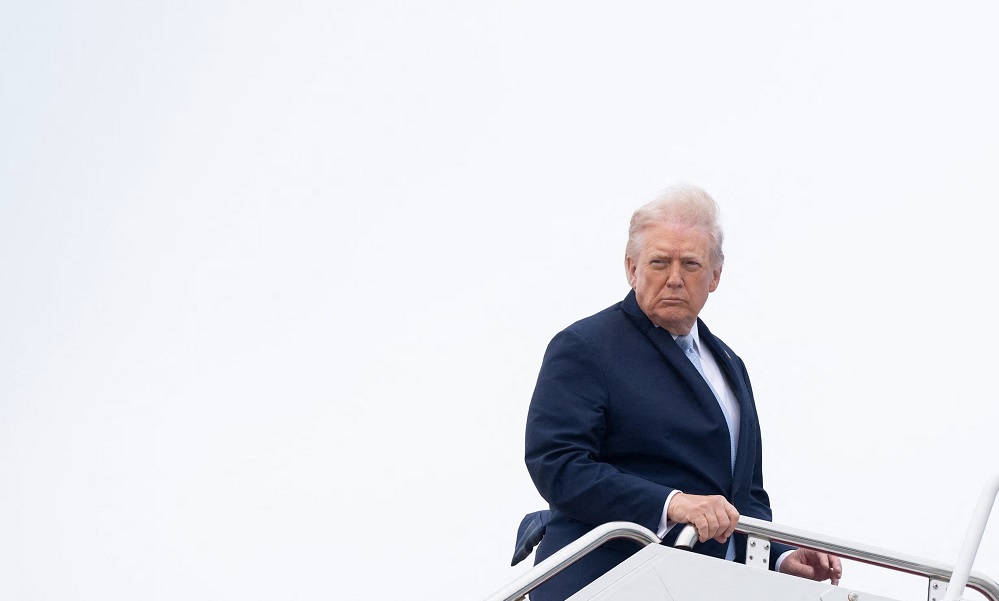
U.S. President Donald Trump on Saturday threatened to “obliterate” Iran’s power plants if Tehran does not fully reopen the Strait of Hormuz within 48 hours, a significant escalation barely a day after he talked about “winding down” the war.
“If Iran doesn’t FULLY OPEN, WITHOUT THREAT, the Strait of Hormuz, within 48 HOURS from this exact point in time, the United States of America will hit and obliterate their various POWER PLANTS, STARTING WITH THE BIGGEST ONE FIRST!” Trump said on social media, Reuters reported.
Trump’s ultimatum would expand the scope of U.S. strikes to infrastructure that affects daily civilian life in Iran.
The threat of Iranian attacks has kept most ships from getting through the strait, a narrow waterway that serves as the conduit for around a fifth of global oil and liquefied natural gas supplies, threatening a global energy shock. Its near-closure sent European gas prices surging as much as 35% last week.
Iran’s Khatam al-Anbiya military command headquarters said Sunday that if the U.S. attacks Iran’s fuel and energy infrastructure, then Iran would target all U.S. energy, information technology and desalination infrastructure in the region.
Energy prices spiked last week after Iran responded to an Israeli attack on its major gas field by hitting Qatar’s Ras Laffan Industrial City, which processes around a fifth of the world’s liquefied natural gas, causing damage that will take years to repair.
The threats to Gulf infrastructure came as the conflict entered dangerous new territory.
Israeli officials said Iranian forces had for the first time fired long-range missiles, expanding the risk of attacks beyond the Middle East, even as an Iranian strike injured dozens of people not far from Israel’s nuclear site.
Iran launched two ballistic missiles with a range of 4,000 km (2,500 miles) at the U.S.-British military base at Diego Garcia in the Indian Ocean, Israeli military chief Eyal Zamir said. The Israeli military said it was the first time Iran had used long-range missiles since the United States and Israel began attacking Iran on February 28.
“These missiles are not intended to strike Israel. Their range reaches European capitals – Berlin, Paris, and Rome are all within direct threat range,” Zamir said in a statement on Saturday.
A source at Britain’s defense ministry said the attack had occurred before the government gave specific authorization on Friday for the U.S. to use British military bases to carry out strikes on Iranian missile sites.
More than 2,000 people have been killed during the war. In Israel, 15 people have been killed in Iranian strikes.
TRUMP SENDS MIXED SIGNALS
Trump and his administration have sent mixed messages about U.S. goals throughout the war, now in its fourth week, leaving U.S. allies struggling to respond.
Trump’s ultimatum on Saturday was the most abrupt shift yet. Trump’s rhetoric pivoted from a drawdown to an explicit 48-hour countdown to strike Iran’s power infrastructure, even as U.S. Marines and heavy landing craft continue heading to the region.
Iran’s largest power plants include the Damavand power plant near Tehran (2,868 megawatts of capacity), the Kerman plant in southeastern Iran (1,910 MW), and the Ramin steam power plant in Khuzestan province (1,890 MW), according to industry and energy databases.
The country’s sole nuclear plant at Bushehr on Iran’s southern coast produces about 1,000 MW.
Earlier this month, Trump raised the idea of destroying Iran’s power grid even while downplaying the notion. “We could take apart their electric capacity within one hour, and it would take them 25 years to rebuild,” Trump told reporters on March 11. “So ideally, we’re not going to be doing that.”
U.S. voters appear increasingly concerned that the war could expand. Energy price shocks are fuelling inflation, hitting consumers and businesses hard, a major political liability for Trump as he seeks to justify the war to the public before November elections in which control of Congress is at stake.
Trump had also accused NATO allies of cowardice over their reluctance to help open the strait. Some allies have said they will consider it, but most say they are reluctant to join a war that Trump started without consulting them.
IRANIAN STRIKES HIT SOUTHERN ISRAEL
The Israeli military said on Sunday that it is conducting strikes in Tehran, hours after attacks on southern Israel.
Late on Saturday, Iranian missiles hit the southern Israeli cities of Dimona and Arad, injuring dozens of people, including children, in separate strikes. Iran’s Revolutionary Guards said in a statement early Sunday that they targeted “military installations” and security centers in southern Israel.
Israeli military spokesperson Brigadier General Effie Defrin said in a post on X that the country’s air defenses were functioning but did not intercept the strikes. “We will investigate the incident and learn from it,” he said.
Israel’s secretive nuclear reactor is about 13 km (8 miles) southeast of Dimona. Both cities lie near several military sites, including Nevatim Air Base, one of the country’s largest.
“This has been a very difficult evening in the battle for our future,” Israeli Prime Minister Benjamin Netanyahu said in a statement released by his office following the strike on Arad.
“We are determined to continue striking our enemies on all fronts,” the statement said.
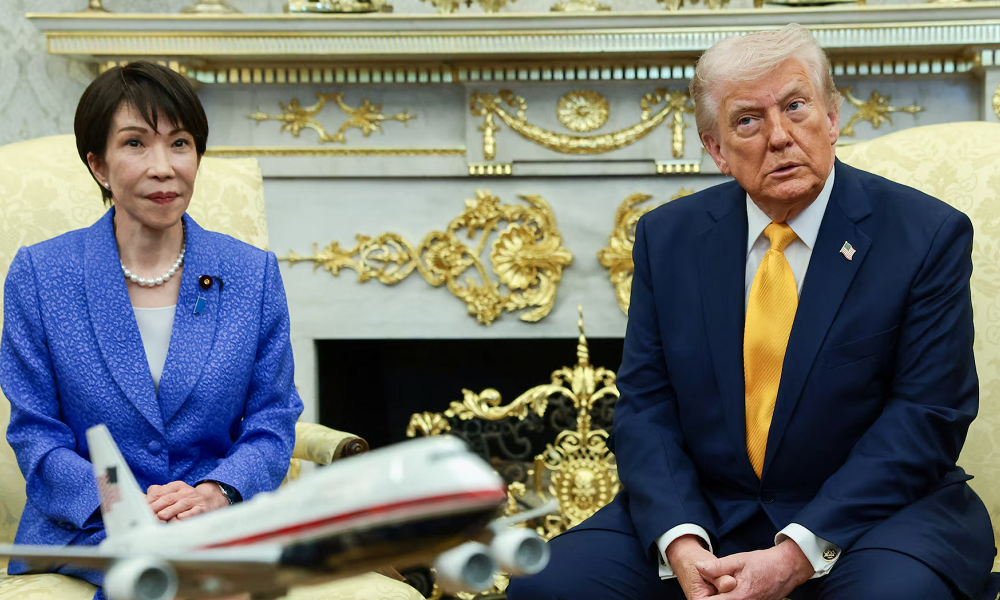
U.S. President Donald Trump on Thursday compared recent U.S. strikes on Iran to Japan’s 1941 attack on Pearl Harbor, as he defended his administration’s military actions during a meeting with Japanese Prime Minister Sanae Takaichi at the White House.
Responding to a question about why allies were not informed in advance, Trump said the element of surprise was intentional. “We wanted surprise. Who knows better about surprise than Japan?” he said, referencing the attack on Attack on Pearl Harbor.
The remark appeared to catch Takaichi off guard, as she reacted visibly during the Oval Office meeting.
Japan’s 1941 attack on the U.S. naval base in Hawaii killed more than 2,300 Americans and led the United States to enter World War II. Then-President Franklin D. Roosevelt famously described the day as “a date which will live in infamy.”
The war ended in 1945 after U.S. atomic bombings of Atomic bombings of Hiroshima and Nagasaki.
Trump’s comments drew mixed reactions in Japan. Some observers said the comparison was inappropriate given its historical sensitivity, while others downplayed it as a joke.
Speaking in Tokyo, engineer Yuta Nakamura said Takaichi had been placed in a difficult position but handled the moment carefully. Meanwhile, retiree Tokio Washino said the reference made him feel uneasy, given Japan’s wartime history.
World
US weighs troop deployment as Iran war enters new phase
The administration is also weighing options to secure Iran’s stockpiles of highly enriched uranium, a move that experts say would be highly complex and dangerous even for elite forces.
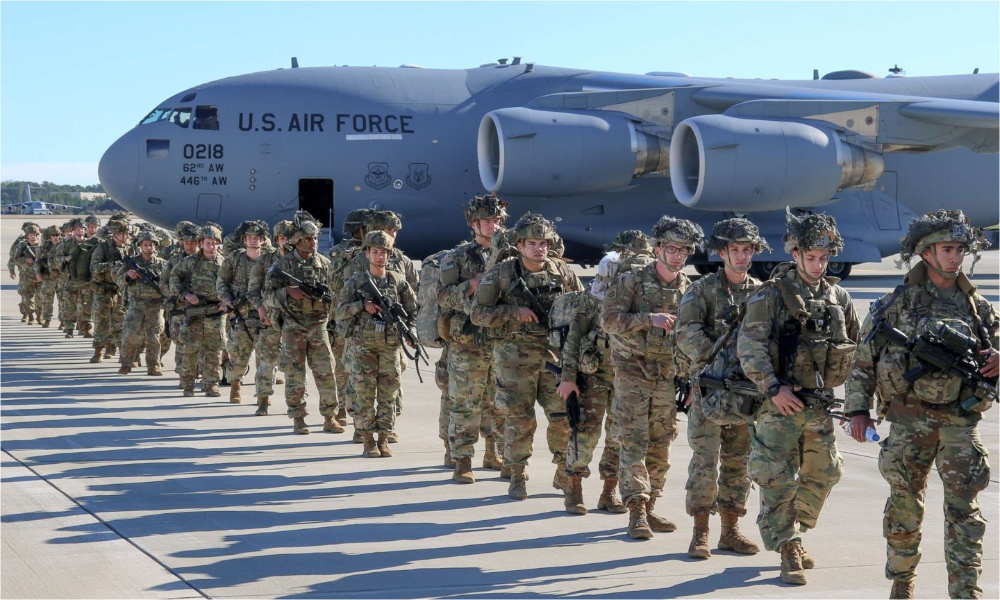
The United States is considering sending thousands of additional troops to the Middle East as the war with Iran enters a potentially more complex stage, according to U.S. officials and sources familiar with the discussions.
The move would give US President Donald Trump broader military options as the conflict, now in its third week, continues to escalate. While no final decision has been made, officials say the administration is exploring scenarios that could expand the scope of current operations, Reuters reported.
Among the options under review is securing commercial shipping through the Strait of Hormuz, a critical corridor for global energy supplies. While such a mission would rely largely on naval and air power, it could also involve deploying U.S. forces along Iran’s coastline.
Another proposal under discussion includes sending ground forces to Kharg Island, which handles the vast majority of Iran’s oil exports.
U.S. strikes have already targeted military sites on the island, but analysts say controlling the facility could be seen as more strategically valuable than destroying it outright.
Officials caution, however, that such an operation would carry significant risks due to Iran’s missile and drone capabilities.
The administration is also weighing options to secure Iran’s stockpiles of highly enriched uranium, a move that experts say would be highly complex and dangerous even for elite forces.
A White House official said no decision has been taken on deploying ground troops, emphasizing that “all options remain on the table” as the administration pursues its military objectives, including weakening Iran’s missile and naval capabilities and preventing it from acquiring nuclear weapons.
The discussions come as U.S. forces intensify their campaign against Iran. Since the start of hostilities in late February, Washington says it has conducted thousands of strikes targeting Iran’s military infrastructure, including its navy, missile systems and defense industry.
According to U.S. Central Command, more than 120 Iranian vessels have been damaged or destroyed.
Despite the scale of operations, the conflict has also taken a toll on U.S. forces. At least 13 American troops have been killed and around 200 wounded, though most injuries are reported to be minor.
Any decision to deploy ground troops could carry political consequences for Trump, who has previously pledged to avoid new foreign wars and faces skepticism among parts of the American public over deeper involvement in the Middle East.
Complicating matters further, the U.S. military is set to lose the presence of one of its key aircraft carriers, the USS Gerald R. Ford, which is being sent for maintenance following a fire.
While an amphibious ready group with more than 2,000 Marines is expected to arrive in the region, officials say broader reinforcement plans are still under consideration.
Trump has also sent mixed signals on whether the U.S. should take responsibility for securing the Strait of Hormuz, at times suggesting allies should take the lead or even questioning continued American involvement.
As military planning continues, officials stress that no immediate ground deployment is expected, but acknowledge that the situation remains fluid as Washington evaluates its next steps in the conflict.


Iran says Hormuz open to all but ‘enemy-linked’ ships

Afghani strengthens nearly 10% against US dollar amid banking sector reforms

Deadly violence likely without dialogue between Afghanistan and Pakistan: ICG

Pakistani military violates Afghanistan ceasefire again

IEA allegedly appoints envoy to Berlin embassy ‘without Germany’s approval’

Pakistani military jet downed in Afghanistan’s Jalalabad, pilot captured alive

Afghan Air Force conducts airstrikes in Islamabad, other cities

Prominent Muslim scholar issues fatwa calling for Afghanistan-Pakistan ceasefire

Afghan air force strikes key Pakistani military installations in retaliatory operation

IEA: Special circle in Pakistan has launched mission to destabilize region

Tahawol: Pakistan’s efforts to destabilise Afghanistan

Saar: Decline in international assistance to Afghanistan

Tawsia: Assessment of Afghanistan’s economic activities in 1404

Tahawol: Temporary ceasefire draws broad support

Saar: Emphasis on resolving conflicts through diplomacy
-
 Latest News4 days ago
IEA announces temporary pause in defensive operations against Pakistan for Eid
-
 Latest News4 days ago
Pakistan opposes normal Afghanistan–India relations: Shaheen
-
 Latest News4 days ago
Karzai accuses Pakistan of seeking to destabilise Afghanistan after Kabul strike
-
 Latest News3 days ago
Pakistani shelling hits Kunar districts despite ‘pause in hostility’ over Eid
-
 Regional4 days ago
Iran strikes Tel Aviv with cluster warheads in retaliation for killing of security chief
-
 Sport2 days ago
Afghanistan national buzkashi falls short in Kokpar World Championship semifinals
-
 Latest News5 days ago
Afghanistan condemns deadly Kabul airstrike, warns of continued self-defence
-
 Latest News4 days ago
Muslim scholars condemn Kabul hospital attack, urge ceasefire